Why Young People in India Are Turning to Astrology Apps for Answers
A mix of religious beliefs, emotional support, and new technology is making an app service very popular

(Image source: Studio Seagraves)
April 2025 is a blur in 25-year-old Sarbani Mishra’s memory, but she remembers her feelings clearly: a steady, gnawing anxiety that sat in her chest through the final months of her university management degree. Placement season had arrived, and one by one, companies came and went. Soon, classmates began receiving offers. Mishra kept checking her inbox. “There was this constant anxiety,” she says. “Every day you keep thinking—will I get through this or not?”
Around that time, something else began appearing with uncanny regularity on her phone. Instagram reels. Then YouTube ads. Then more reels. The algorithms seemed to know precisely where she was in life and what was giving her stress. The videos followed a familiar script: a young professional struggling at work, someone worrying about a relationship, someone waiting for a message from an ex. “It was almost like they were talking about my situation,” Mishra recalls. “There were reels saying things like, Are you worried about your job? Will your partner cheat on you? Will you marry the person you love? These were the exact questions people around me were asking in real life.”
The clips were slick, fast, and seemingly intimate. Influencers and content creators delivered them in the confessional tone typical of Instagram videos, often dramatizing everyday anxieties—jobs, break-ups, office politics—through familiar Bollywood-style heartbreak tropes. Some even carried endorsements from Bollywood actors themselves, lending the posts a veneer of glamour. Almost every video ended the same way: a casual nudge to download an astrology consultation app. One name appeared repeatedly across social media platforms: Astrotalk.
At first, Mishra ignored it. But the ads persisted for days, trailing her across her social media accounts. “It kept showing up everywhere,” she says. “After a point you start wondering what it actually is.” Eventually, one evening, she clicked.
The app promised instant answers and a two-minute free chat. Mishra asked if she would get a job soon. The astrologer was certain: current struggles would ease. “He said something like, after four months Mercury will support you and things will improve.”
The two minutes ended quickly. To continue the conversation, the app prompted her to pay. By then, she was already invested. “You start feeling like maybe they know something you don’t,” she says. “So you keep going.”
What followed was a pattern she would return to over the next few weeks: logging in during moments of uncertainty, typing out questions about jobs, relationships, or decisions she felt unequipped to make. The responses were rarely definitive, but they offered something else—temporary reassurance. “I don’t know if it worked exactly the way they said,” Mishra admits. “But at least it calmed me down. It gave me something to hold on to for a few days.”
For Mishra, the app functioned less as prophecy than as an emotional outlet. “Sometimes you just want to vent,” she says. “Even if it’s to an astrologer on a screen.”
By the time she realized how often she had begun opening the app, Mishra had already enmeshed herself in a rapidly expanding digital phenomenon: a new generation of astrology platforms in India that blend ancient belief systems with algorithms, targeted advertising, and the attention economy.
While Astrotalk [with 50 million downloads] may be the most visible name in this quickly expanding market, it is far from alone. A growing constellation of platforms—Astroyogi, AnytimeAstro, InstaAstroSocial, AstroChat.com, Narsimha Astrology, ClickAstroLive, and others—are competing for the same pool of anxious, digitally native users.
Earlier, astrology operated in India through diffuse, loosely regulated networks of practitioners, shaped by hereditary training, patron-client relationships, and informal entry into the profession, rather than any standardized institutional structure. With the rise of these apps, astrology is now accessed on smartphones, woven into the same digital routines that structure everything from social media use to job searches.
But industry observers say the boom cannot be explained by technology alone. Experts point to a deeper social churn—economic precarity, delayed life milestones, migration, loneliness in cities, and a widening mental health vacuum—that has left many young Indians searching for certainty wherever they can find it. Astrology apps, they argue, have stepped into that gap, turning moments of collective anxiety and personal uncertainty into a fast-growing digital marketplace.
Selling Certainty, Minute by Minute
If Mishra’s introduction to astrology apps came through an algorithm that seemed to know her anxieties, for 23-year-old journalist Megha, the pull was less sudden and far more ambient. Astrology had always existed quietly in the background of her life. “I was never deeply invested in astrology myself,” she says. “But it was always present around me. My mother, father, even my nani [maternal grandmother] believed in it, so it never felt unfamiliar or strange.”
Three years ago, when Megha began dating her partner in Mumbai, astrology moved from the margins of family conversations into the rhythms of her everyday life. Her partner’s family, she says, took it seriously. His father regularly consulted what he called their “family astrologer,” particularly when it came to decisions about business.
“Sometimes my partner would call home and come back looking worried,” Megha recalls. “If the astrologer had predicted something negative about the business, it would stay with him for the whole day.”
To counter that anxiety, he began consulting astrologers online—often through Astrotalk.
The app was already hard to miss. “They were doing a lot of Instagram marketing,” she laughs. “It was everywhere. You couldn’t really skip it.”
But what turned the app from background noise into something she used herself was proximity to a regular app user. Around nine months into their relationship, the couple moved in together. Megha began watching her partner’s pattern up close: moments of worry followed by quick consultations with astrologers on the app, small bursts of reassurance, and then temporary calm. “Because we were living together, I saw how often he turned to it,” she says. “Gradually, I found myself doing the same thing.”
At first it felt harmless—almost casual curiosity. When something uncertain cropped up in her own life, whether about work or her relationship, the app was there, immediate and accessible. “You could just open it and ask a question,” she says. “It gave a kind of emotional reassurance in the moment.”
But that immediacy also made it harder to disengage.
“I wouldn’t call it belief [in astrology],” Megha reflects now. “It was more like a dependency on certainty.”
Questions about career clarity slowly expanded into more intimate territory—compatibility, marriage, finances, whether something bigger in life was “meant” for her. The phase after she moved in with her partner, she says, was also when her anxiety was highest. Both of them were consulting astrologers regularly. “It stopped being curiosity and became a habit,” she says.
For a while, the reassurance worked. “Hearing something hopeful in a vulnerable moment can feel grounding,” she explains. But over time she began noticing something unsettling about her own behavior. “At some point I realized I was chasing reassurance,” she says. “Even when I knew the answers were often telling me what I wanted to hear, I kept going back.”
And the app made returning almost frictionless. Users scroll through long lists of astrologers— tarot readers, numerologists, even “celebrity astrologers”—filterable by price, expertise, and ratings. Sessions run on a timer through an in-app wallet. “You add money, start chatting, and the clock begins,” Megha says. “When the balance runs out, the chat pauses unless you recharge immediately.”
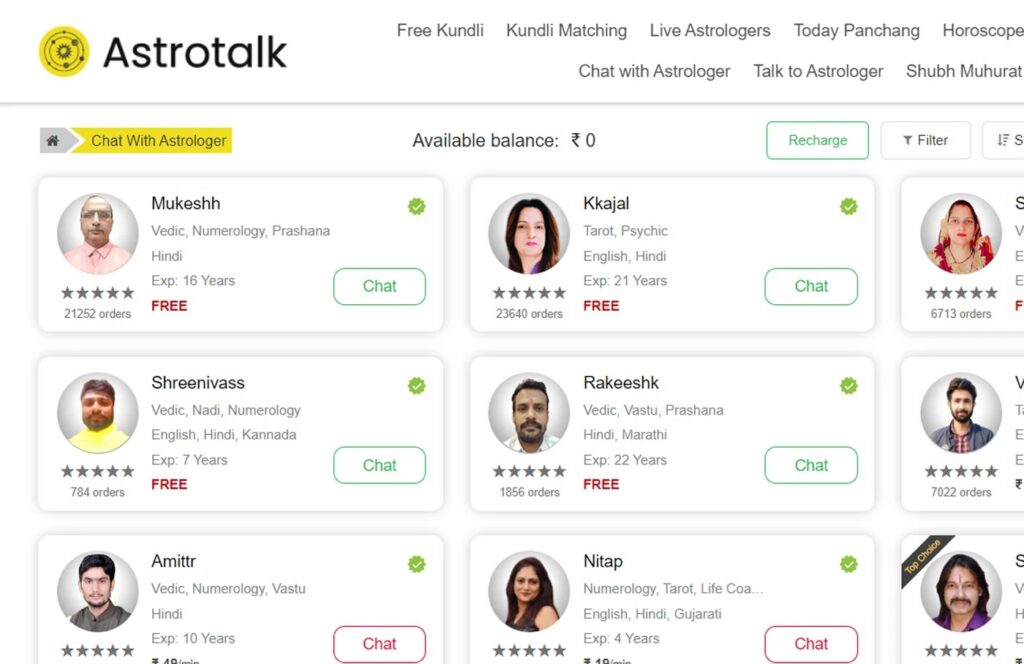
(The Astrotalk app interface shows a list of available online astrologers. Image source: Agora)
She would usually load the equivalent of $5 at a time. But the app constantly nudged her to add more to extend the conversation.
“It makes it very easy to keep going,” she says. “And very tempting.”
In interviews with more than a dozen users across India, a similar pattern emerged. Almost all described how easy it was to slip into the app’s paid ecosystem once the initial free interaction ended. The two-minute trial chat often stretched into longer consultations, the price increasing with every additional minute. Some users said they had spent only a few hundred rupees before stepping away. Others admitted the costs accumulated quickly. Over weeks or months of sporadic consultations, the total sometimes climbed to $100 or more for some users.
The rapid growth of the industry reflects that pattern at scale. These platforms have seen explosive expansion in recent years, with the most prominent among them reporting surging revenues and user numbers. Astrotalk, for instance, has doubled its revenue to around $69 million in FY24 and is projected to cross $106 million this year, while profits have reportedly grown more than twelvefold to nearly $10.6 million. The wider astrology app market is expected to expand at an annual rate of roughly 49 percent through the end of the decade, potentially reaching an estimated $1.8 billion by 2030, up from about $168 million in 2024. The scale of this transformation is most visible in Astrotalk itself, which has turned a traditionally informal service into a large digital marketplace.
Much of that growth rests on a simple economic logic: monetizing immediacy. Astrology apps are structured around the promise of instant answers—on-demand consultations with astrologers, quick compatibility checks, bite-sized predictions, and even recommendations for rituals or remedies, such as fasting or chanting mantras. Users pay not for long deliberation but for immediate emotional relief or decision support in moments of uncertainty. The model, industry analysts say, raises the average revenue per user by encouraging frequent, small transactions that are easy to repeat. Over time, those repeated purchases can turn a momentary consultation into a habit—and, for some users, a dependency.
The Anxious Youth and the Mental Health Crisis
If the questions users pose on these apps—about jobs, relationships, marriages, betrayals—often sound intensely personal, they also reflect struggles that many young Indians are grappling with today. For some, the apps become less about belief in astrology and more about finding a place to steady themselves.
Soumyajit Bhar, an ecological economist and Assistant Professor at the School of Liberal Studies, BML Munjal University, says the phenomenon needs to be understood within a larger psychological and social context. “People are carrying a lot of anxiety that they cannot manage,” he says. “These platforms end up becoming spaces where individuals can vent out their feelings, but also hold on to something—some sense of direction—so that everything does not feel like a total collapse.”
According to estimates, roughly one in ten people in India experiences some form of mental health condition—about 10.6 percent of the population—with depression and anxiety emerging as major contributors to disability, particularly among adolescents and young adults. At the same time, access to care remains severely limited: the country has only about 0.75 psychiatrists per 100,000 people.
In such a vacuum, Bhar says, many people look elsewhere for emotional support. “When formal systems of support are scarce or difficult to access, people try to cope with what is available to them,” he explains. “These apps are offering something within that ecosystem—some way to manage uncertainty.”
Bhar traces the rise of such platforms to deeper shifts in how social life itself is organized. Over the past few decades, India’s social structures have gradually moved from tightly knit collective arrangements—such as joint families and community-based decision-making—towards more individualized lives in cities. That shift, he says, has created a paradox.
“Individualization gives you a sense of freedom and control,” Bhar explains. “But it also produces anxiety. When you are on your own, you have to make every decision yourself—about career, relationships, where to live, what to do next.”
Earlier, such decisions were often negotiated collectively, embedded within family structures and shared value systems. Today, many young people must navigate them alone. “There is less collective deliberation, less shared frameworks to fall back on,” Bhar says. “That absence can make people extremely anxious.”
Bhar compares the feeling many users describe to trying to hold dry sand in their hands. “You are trying to grasp control, but everything slips away,” he says. “What these platforms offer is the assurance that someone can tell you what lies ahead.”
When jobs feel precarious, relationships unstable, and the future increasingly difficult to predict, the promise of clarity can become deeply attractive. But the anxieties many users carry into these consultations are rarely only personal. They are tied to wider structural pressures. “When everything around you is uncertain—your environment, your work, your relationships—you begin to hunger for certainty,” Bhar says. In that vacuum, he argues, new forms of reassurance emerge. “When collective structures weaken and institutional support is limited, people start looking for other anchors.”
This search for reassurance is not unique to India. In China, for instance, young people increasingly turn to online tarot readers and feng shui consultants—often described as a form of “cheap therapy”—to navigate uncertainty around work, relationships, and the future.
Youth Being More Religious?
Beyond technology making astrology more accessible—and the growing anxieties of living in an uncertain world—another force shaping the popularity of such platforms is the way younger generations are engaging with religion and spirituality.
Globally, organized religion itself appears to be losing ground. A study by the Pew Research Center found that religious affiliation declined slightly worldwide between 2010 and 2020, falling by about one percentage point over the decade. In the same period, the share of people identifying with no religion rose from 23 percent to over 24 percent.
India, however, appears to be moving along a different trajectory. The country’s demographic profile—where roughly 65 percent of the population is under the age of 35—has produced a generation that is not necessarily abandoning faith, but reshaping how it engages with it. Surveys suggest that many young Indians continue to see religion and spirituality as important, even as they explore them outside traditional institutional settings.
A survey conducted by YouGov and Mint found that more than half of India’s Generation Z— born roughly between the late 1990s and early 2010s—consider religion important, and nearly two-thirds say they pray regularly. Another study of India’s youth by MTV reported that a majority of respondents felt spirituality helped them gain clarity in their lives, while many said prayer boosted their confidence during moments of uncertainty.
Counselling psychologist Manavi Khurana, in a conversation with Deutsche Welle, notes that the vocabulary of faith among younger people often blends with the language of mental health and self-help. “Gen Z has a much wider vocabulary to describe what they are feeling—terms like healing, grounding, or getting in touch with the self,” she says. “Spirituality, religion, wellness, and well-being often get mixed together, even though they are not exactly the same.”
At the same time, this renewed engagement with spirituality cannot be entirely separated from the wider political and cultural shifts shaping contemporary India. The growing visibility of religious identity in public life—alongside the rise of majoritarian politics and religious nationalism—has also reshaped how faith circulates in everyday spaces, including digital ones.
For many young Indians, the result is a hybrid form of belief: less tied to temples or institutions alone, yet deeply intertwined with digital platforms like astrology, self-help language, and the search for personal certainty.
Regulations That Are Almost Not There
As tech-driven astrology platforms grow rapidly in popularity, the promises those apps make now offer remarkably specific outcomes: that an astrologer can predict the exact month—if not the precise date—when someone will get married, know when an ex-partner might return, or determine when a promotion is around the corner. Users are often nudged toward additional purchases along the way: gemstones, crystals, ritual services, or paid subscriptions promising quicker results. In some cases, advertisements suggest that subscribing to certain consultations could bring career breakthroughs or financial gains within days.
Such sensational promises have increasingly become a staple tactic for astrology platforms competing for attention in the crowded online marketplace. Industry observers note that a significant portion of these companies’ budgets is spent on aggressive digital marketing—particularly through social media ads and influencer promotions—to acquire new users. Yet despite the scale of these campaigns and the nature of the claims being made, regulatory scrutiny has remained limited.
Of course, belief in astrology itself is not illegal in India. But when that belief becomes a commercial service—especially one that markets highly specific outcomes—legal questions begin to emerge. Consumer law experts note that monetizing astrology through definitive or unsubstantiated claims could potentially fall within the scope of existing consumer protection frameworks.
Under the Consumer Protection Act, 2019, for instance, misleading advertisements or false assurances about a product or service can attract liability. Section 2(47) of the Act defines misleading advertisements as those that falsely describe a service or make guarantees that cannot be substantiated. If astrology platforms claim to guarantee outcomes such as marriage, employment, or financial success, legal experts say such assurances could potentially be examined under this provision.
Questions around data also arise. Astrology apps typically require users to input personal information—from birth dates to relationship details and life events—to generate predictions. With the passage of the Digital Personal Data Protection Act, 2023, companies that collect and process such sensitive personal data are expected to follow stricter rules around consent, transparency, and data handling.
For now, however, enforcement remains largely absent. As the astrology app industry expands into a billion-dollar digital marketplace, the regulatory framework governing it is still catching up—leaving a space where faith, commerce, technology, and emotional support intersect with relatively little oversight.
Anuj Behal is an independent journalist and urban researcher based in India. His work explores the intersections of religion, injustice, diaspora migration, and climate change. His bylines include The Guardian, Al Jazeera, Nikkei Asia, Thomson Reuters, and more.