Invisible Hands in the Holy Land
The vulnerable migrant workers who keep Saudia Arabia running for millions of tourists every year
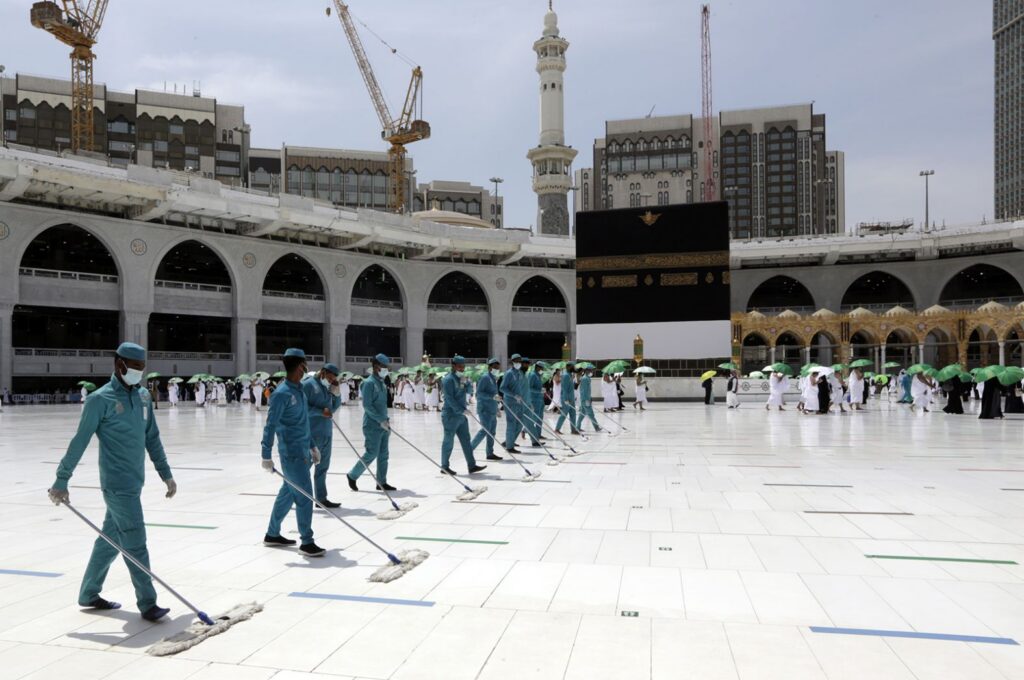
(Workers disinfect the ground at the Grand Mosque around the Kaaba in July 2021. Image source: Amr Nabil/AP/CNN)
“All of you are children of Adam, and Adam was created from dust.”
نَّاسُ كُلُّهُمْ بَنُو آدَمَ وَآدَمُ خُلِقَ مِنْ تُرَابٍ
In early Islamic accounts of his Farewell Sermon in 632 CE, it is said that the Prophet Muhammad stood atop the hot sands of Mount Arafah to counsel his young nation of followers. On the outskirts of Makkah, a city in present-day Saudi Arabia, a mass of ten thousand gathered to hear the words later understood as a summation of Islam’s moral vision. He preached of justice. He preached of prayer. And he preached, insistently, of equality: “All mankind is from Adam and Eve. An Arab has no superiority over a non-Arab, nor a non-Arab has any superiority over an Arab; a White has no superiority over a Black nor a Black has any superiority over a White—except by piety and good action.”
Millenia later, I arrived in a Makkah (often rendered in English as Mecca) that seems, at first glance, to realize this vision. Members of every nation are present. Language itself has become a currency in the city, traded in the air along with the sounds of prayer. Arabic, Urdu, Farsi, Bangla: languages braid and collide as pilgrims surge toward the Grand Mosque.
Malcolm X once wrote rapturously of the radical clarity he found in Makkah, the way the imperatives of religious brotherhood force pilgrims to confront a common humanity through shared rituals of prayer and movement. As they perform each of Islam’s five daily prayers, women and men of all races and backgrounds stand shoulder to shoulder, a human penumbra encircling the Ka’bah, the cube-shaped sanctuary at the heart of Islam’s holiest mosque.
Makkah dazzles with this vast choreography of devotion, its symmetry, its serenity. And for the House of Saud, the self-proclaimed guardians of Makkah since the early 20th century, its custodianship is a deep wellspring of national and religious pride. But this beauty has a shadow.
Beneath this world of white-marbled sanctity runs another, one sustained by those whose names are rarely spoken and whose exploitation stains the holiness they maintain. A legion of migrant workers who keep the holiest city in Islam immaculate, whose bodies absorb the weight of a global religious industry worth billions.
For decades, these workers have been rendered invisible—essential to Makkah’s function yet excluded from its promises of dignity and justice. But if the city is to live up to the egalitarian ideals it proclaims, their labor must be protected, their rights enforced, and their humanity recognized.
***
The holy city is animated by sound. Makkah is a citadel of motion and language. During a recent umrah trip (an optional pilgrimage), I was admonished for walking too slowly in Arabic (yallah ya hajja!) and prodded from the ground in Urdu (chalo bhaji!).
It is also a city of contradictions. Commercialization pulses through the sacred. An infamous clock tower full of retail stores looms over the Ka’bah, offering luxury shopping to the weary pilgrim. At one point inside the clock tower, I was cornered by a saleswoman adamant that I buy an $800 black silk abaya to take home. This spectacle of wealth and choice stood in stark contrast to the men and women just outside the clock tower, waiting in food distribution lines under the relentless sun. Amid 100-degree heat, workers received plates of dates and cups of water while pilgrims carried off designer goods. Around them, screens flash the slogans of Saudi’s Vision 2030, promising prosperity and progress. Below, the engine of that progress labors on, sweating in the unforgiving desert heat.

(Image source: CDC)
The city’s glitter and the pilgrims’ transcendent spiritual experience depend on hands that rarely touch recognition or reward. Here, the sacred, the commercial, and the labor of migrant workers intersect, a tension that is easy to overlook but impossible to ignore once seen.
This, too, is Makkah. Even within the heart of the Islamic nation, fault lines run deep.
Many of these workers arrived in Saudi Arabia on the same hollow promise extended to migrant laborers across the Gulf: a better life, wages to send home, and the hope of lifting families out of poverty through the kafala system.
The kafala system has earned itself many descriptors: modern-day slavery, a racialized labor caste, the price of development. Its architecture is quite simple: kafala is a labor sponsorship program used widely throughout the Gulf Cooperation Council (GCC) countries, Jordan, and Lebanon. Private citizens and corporations sponsor work visas for millions of migrant laborers annually, allowing them to enter the country on a temporary legal status. Kafala ties the migrant’s legal residency and employment to this single sponsor. With that sponsorship comes extraordinary control: the sponsor can renew, transfer, or cancel the worker’s visa, effectively deciding whether the migrant can stay in the country, switch jobs, or return home.
In practice, kafala functions as more than a bureaucratic rule; it is a legal framework that embeds exploitation into the structure of labor. By outsourcing control of immigration to private actors, the system ensures that workers’ legal status, livelihood, and mobility are all contingent on the goodwill of their sponsors. The result is a system where low wages, poor working conditions, and routine abuse are predictable outcomes. Debt bondage begins before work even starts. Workers often arrive indebted, having paid predatory recruitment agencies fees amounting to months, sometimes nearly a year, of their future salaries. Although many Gulf states technically ban recruitment fees, the costs are commonly passed on to migrants through illegal brokers and subcontractors. A Bangladeshi laborer might pay the equivalent of $2,800 before ever boarding a plane, locking him into a cycle of debt bondage that makes quitting or returning home financially impossible.
Once inside the Gulf, vulnerability hardens. Many workers lack Arabic fluency, familiarity with local law, or any meaningful ability to self-advocate. They are forced to sign contracts in Arabic without knowing their contents. It is routine for sponsors to confiscate passports, phones, and residency cards, to restrict movement outside the home, or to impose GPS surveillance through tracking apps. Leaving the workplace without permission can instantly render someone “absconded,” a legal category that triggers detention, loss of status, and deportation.
Domestic workers, who live inside their employers’ homes, are especially vulnerable. Women domestic workers experience the most severe forms of exploitation, facing a constellation of abuses that extend far beyond long hours and low pay. Their labor—cooking, cleaning, and childcare—is isolated within private homes, where surveillance and control are absolute. Women in this sector report not only physical and verbal abuse but also sexual harassment, assault by male employers, struggles to secure adequate food and rest, and severe isolation that compounds psychological harm. In Saudi Arabia, for example, Amnesty International documented cases of Kenyan women domestic workers who endured 16‑hour days, were denied days off, and faced sexual, verbal, and physical assault while held in conditions that resembled imprisonment. Their exclusion from labor law means that exploitation and violence often go unchecked, with few pathways to legal recourse or safe exit.
Crucially, these workers fall under the jurisdiction of interior ministries, not labor ministries, meaning their status is treated primarily as an immigration issue rather than an employment matter. As a result, they are excluded from labor protections such as regulated working hours, minimum wage, and the right to seek redress, leaving them vulnerable to exploitation and coercion without any meaningful legal options. To change jobs, migrants need their sponsor’s written approval. To exit the country, they often need the same. Even in cases where employers agree to transfer sponsorship, they may require workers to sign false statements waiving unpaid wages or pay additional fees for the transfer.
In short, the worker’s fate hinges, almost entirely, on the goodwill of the sponsor. At its most benign, the sponsor relationship masquerades as soft paternalism. But workers are tied to the benevolence of their employers, who can at any time report them as an absconded worker. At its far more common extreme, it creates a totalizing power imbalance in which a migrant’s legal existence depends on an individual employer’s temperament.
The racial element of kafala is impossible to ignore. Though often described by Gulf governments in neutral administrative terms, kafala most directly encompasses workers from South Asia and Africa. Across GCC states, Western expatriates from Europe, North America, and Australia typically occupy high‑status, well‑paid professional roles with greater legal mobility and protections, while non‑Arab, non‑Western migrants from South Asia and Africa are clustered in low‑paid, precarious, and often dangerous work. Wage gaps, job segregation, and legal exclusion are pervasive: employers in the UAE have been documented paying South Asian workers lower salaries for the same work than other groups, and in Saudi Arabia, African domestic workers have reported overt racial abuse, segregation within homes, and derogatory treatment tied explicitly to their skin color and origin. Rather than incidental, these racial hierarchies are embedded in the very mechanisms of kafala, shaping which bodies are marked as disposable and which are afforded dignity.
***
Saudi Arabia, home to the largest migrant labor population in the region, epitomizes the paradox. It is the political and religious center of the Muslim world and the self-described engine of a new modernity under Crown Prince Mohammed bin Salman. When you travel across the country, you see billboards with the prince’s faces smiling beatifically above the mantra of Vision 2030, a promise to transform the kingdom into a “global investment powerhouse.” Petro-wealth has been funneled into megaprojects and self-described “giga-projects”: entire cities built from scratch, luxury tourism zones, futuristic industrial corridors.
This glossy development narrative—the oasis materializing, improbably, in the desert!—rests on the backs of those whose names will never appear in promotional materials. The skyscrapers, the metro lines, the polished marble floors of the two Holy Mosques: all maintained, built, and sustained by migrant workers operating under a system designed to keep them compliant, invisible, and replaceable.
Approximately 70 percent of the GCC workforce is migrant, and Saudi Arabia alone hosts 13.4 million migrant workers, or 42 percent of its population, fueling everything from holy site maintenance to the sprawling construction boom in Riyadh and Makkah. These figures underscore that exploitation is not incidental; it is foundational to Saudi’s economic life.
***
The Gulf countries cry foul at criticism of kafala. They argue that all great industrial powers are built on the backs of others, that one should not be answering for the sins of many. They correctly point out that sponsorship systems exist elsewhere in the world. But what they omit is that the kafala system is uniquely coercive. It grants sponsors extraordinary power over workers’ mobility, legal status, and livelihoods while effectively excluding those workers from domestic labor protections. It is a legal structure designed to produce dependency.
Like many of the Middle East’s entrenched inequalities, the origins of kafala are partly British. British colonial administrators introduced sponsorship rules in the early twentieth century to regulate Pearl Coast labor migration, imposing a bureaucratic mechanism to control foreign workers deemed economically necessary but politically risky. With the discovery of oil, the system expanded and was standardized. What began as a tool of colonial management was absorbed and naturalized into Gulf governance, eventually becoming the backbone of its modern economies.
Even the word kafala has been warped through this evolution. In Islamic ethics, kafala traditionally refers to guardianship, in the sense of protection, akin to the root shared with khalifa, one entrusted with responsibility. In classical usage, it was a form of social solidarity: a guarantor stepped in to support another, without personal gain, grounded in trust and communal care. Often, kafala referred to guardianship of orphans, to the ethical duty of one believer to support the larger community and the vulnerable without personal gain. The modern kafala system bears little resemblance to that ideal. What once signified protection has been transformed into a structure of subjugation. As Professor Ray Jureidini, a human rights scholar, and Said Fares Hassan, a specialist in Islamic legal traditions, note, these arrangements were never meant to mediate employment and were certainly not mechanisms of control. Traditional kafala was “underwritten by an Islamic ethic of trust and protection,” never intended to govern employment and certainly not meant to be commodified. What exists in the Gulf today is a perversion of that ethic, an inversion of a system meant to protect the vulnerable into one designed to control them.
***
Amidst rising scrutiny of the kafala system, Gulf host countries began implementing reforms, such as standardizing contracts, letting workers transfer jobs after a certain period, and easing restrictions on leaving the country. In June 2025, Saudi Arabia announced that it would abolish the kafala system, replacing it with a contractual employment model. In principle, the reform promised migrant workers the right to change jobs and leave the country without employer permission. The announcement was greeted as historic. But human rights organizations, including the Bahrain Institute for Rights and Democracy, issued an immediate warning: Saudi Arabia has announced reforms before.
What matters is not the language of abolition, but whether employer control is meaningfully dismantled. Early indications suggest it is not. Many workers remain excluded from core employee protections, including limits on working hours, rest days, minimum wage guarantees, the right to change employers, access to legal recourse, and the freedom to leave the country without employer permission. Informal coercion persists through contract manipulation, wage theft, and retaliation. Migrant workers are still barred from forming unions, striking, or engaging in collective bargaining. Free expression remains tightly constrained, leaving workers with no safe avenue to challenge abuse. The structure may be renamed, but the imbalance endures.
***
Asceticism runs deep in Islamic tradition. The purification of the body, self-denial, and discipline are rewarded activities. But the asceticism of the migrant worker is not voluntary. It is coerced. The blistered hands that clean the marble floors of Makkah do not belong to people seeking spiritual reward through suffering: they belong to laborers who work because they have no alternative.
Among pilgrims, and within Muslim discourse broadly, there is a temptation to romanticize these workers. Look how they endure with a smile. How patient they are. How holy their suffering must be. Their endurance is framed as fi sabillillah, for the sake of God. But sanctity does not excuse exploitation.
If faith is to be meaningful, the Islamic ethical tradition insists that it must translate into justice. Muslims often recite the Qur’anic verse: “And what will explain to you the steep path? It is the freeing of a slave…” (90:12–13). But too often, this is treated as a historical ideal rather than a present directive. The truth is: slavery in the Muslim world has not disappeared. It has changed forms. Freeing slaves is not a command frozen in the 7th century. To free a person today means dismantling systems that bind immigration status to employer control, that masquerade as benevolence while entrenching dependency. It means refusing to romanticize suffering and insisting that reform is not a cosmetic shift but structural change, including enforceable labor protections, collective bargaining rights, and dignity for all workers.
A system may be legal. It may be state-sanctioned. That does not make it just. Many Muslim-majority countries remain havens for modern slavery, and even the most celebrated “reforms” to kafala still leave workers exposed. Faith, justice, and dignity are intertwined. To honor the prophetic ideal of equality is to confront these realities, to protect the invisible hands that make holiness possible.
Safiyah Zaidi is a law student and writer whose work explores identity, diaspora, and the law’s role in shaping justice.