The Gospel of Peter Thiel
Tech-monarchism and the politics of the Antichrist
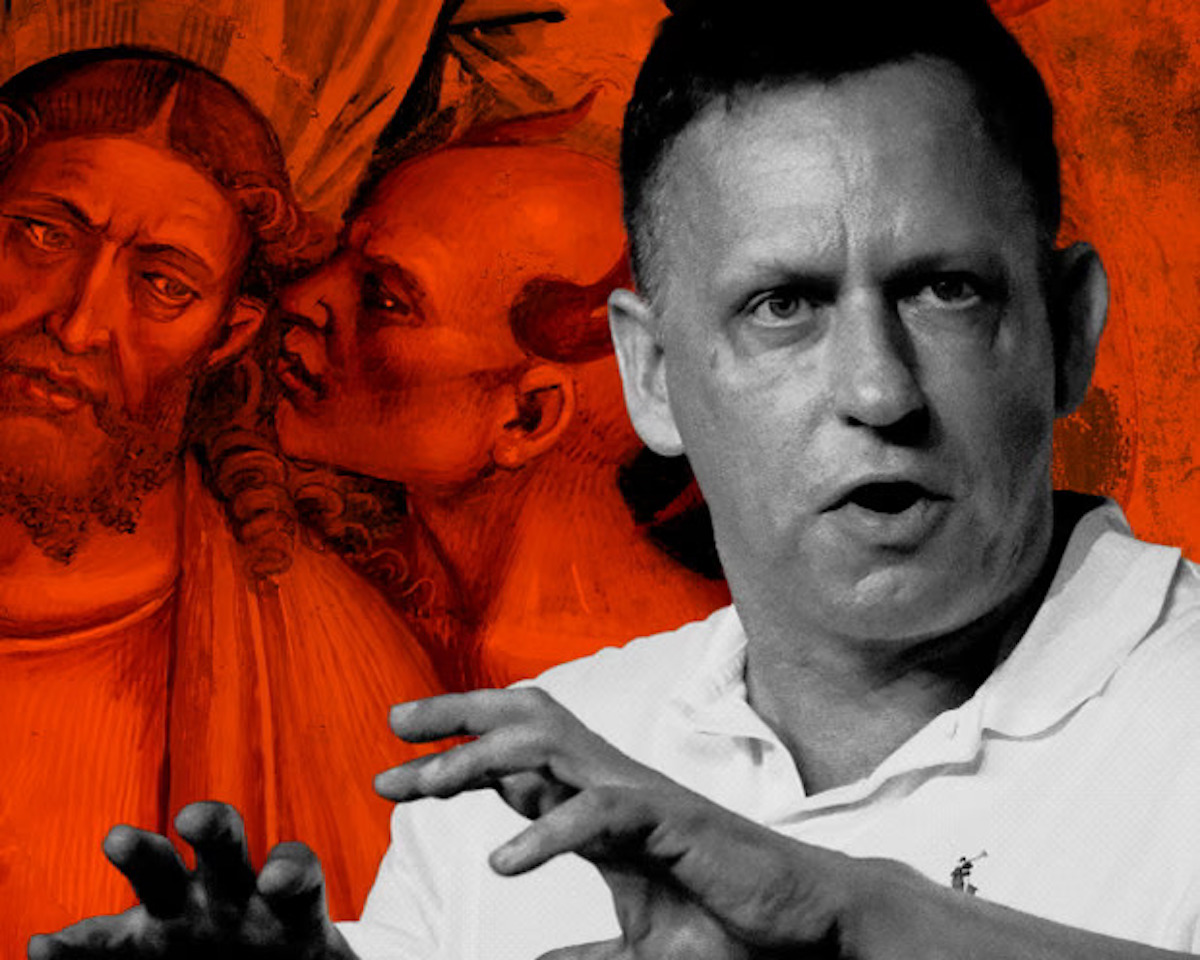
(Image source: The Guardian/Getty Images)
He looks like a brain trying to explode from its casing. The extruded vein, like a python, extends across his forehead, which is shiny with sweat. One would assume his resting state is tense rage. Every breath sounds like seething. Despite the guise of casualness – a fashionable t-shirt, a nonchalant mid-fade haircut, blue dockers – there is nothing easy about this man. He looks, as journalist George Packer once noted, “uncomfortable having a body.”
It’s June 2025. Peter Thiel is sitting across from Ross Douthat, a conservative reporter from the New York Times, for a video podcast interview. Douthat asks him about the future of humanity.
What follows is clipped on social media endlessly, played tens of millions of times across the globe:
Douthat: I think you would prefer the human race to endure, right?
Thiel: Uh ——
Douthat: You’re hesitating.
Thiel: Well, I don’t know. I would — I would ——
Douthat: This is a long hesitation!
Thiel: There’s so many questions implicit in this.
Douthat: Should the human race survive?
Thiel: Yes.
Douthat: OK
Thiel: But I also would like us to radically solve these problems. And so it’s always, I don’t know, yeah…
This is a trademark of Thiel. He hesitates, hems and haws, when answering questions. It’s as if he is calculating all the possible arguments for each side before coming out with his own answer. In the interim, everyone listening is treated to a filler-word salad.
Later in the interview, Douthat asks him about the Antichrist. This leads to another viral moment. Instead of hesitating, Thiel goes right into a script he’s been reciting for years about who the candidates are for the Antichrist, why warnings about Armageddon are a sign the Antichrist is upon us, and how risk, rather than security, is the way to avoid existential collapse as a species. As much as one might be disgusted by Thiel’s hesitation about the future of humanity, the more confusing question for many was about Thiel’s religious worldview. Why was Peter Thiel, one of the most influential billionaires in the world — a man whose life is based on tech innovation and coldhearted calculation — more ready to answer questions about the Antichrist, Armageddon, and the Bible than about the survival of humanity?
Peter Thiel is known as a venture capitalist, a Silicon Valley kingmaker, and a right-wing political financier. Less often is he treated as what he has, in my estimation, spent decades becoming: a monarchist theologian. Thiel is a devoted, if heterodox reader of scripture and political theology who has built an entire cosmology out of the Bible and twentieth-century political thought. Understanding Thiel requires taking this religious dimension seriously rather than dismissing it as an eccentric hobby. When one examines Thiel’s essays, interviews, and lectures, a pattern emerges: Thiel’s monarchist techno-theology promises to save humanity, even if only a few humans are left to experience it.
Thiel, by his own accounts, is religious, but not spiritual. Which, of course, reflects an inversion of the familiar “spiritual but not religious” category, in which one describes a personal sense of transcendence detached from any institutional tradition. Thiel’s version is a genuine commitment to a specific religious tradition — Christianity — pursued not through prayer, or metaphysical experience but through history, theology, and technological “miracles.” Understanding what this means requires tracing a chain of intellectual influences that runs through the Nazi jurist Carl Schmitt, the University of Chicago anthropologist Leo Strauss, and above all the literary theorist and philosopher of religion René Girard. This lineage leads to Thiel’s distinctive vision of Jesus, the Antichrist, and the founder-king who might save a small remnant of humanity from a self-inflicted apocalypse.
As we shall see, Thiel’s theology leads him to believe that democracy and human freedom are no longer compatible. Were Thiel a reclusive billionaire kook — a twenty-first century Howard Hughes — this would be bad enough. But he’s not. Thiel is one of the most influential people in the Trump administration, Silicon Valley, and perhaps across the globe. Given his wealth and power, we need to take his claims about democracy and religion seriously.
The Shadow of September 11
Thiel’s clearest and most systematic statement of his worldview appears not in a media interview but in a 2004 essay called “The Straussian Moment,” written in the aftermath of the September 11 attacks and published in a volume of conference papers connected to the work of René Girard. Unlike his more freewheeling podcast appearances, this essay forced Thiel to work out his ideas with some rigor, which is why it functions as something like a decoder key for everything he has said and written since.
The essay begins with a genuine crisis: how should a society respond when a devastating, unpredictable act of violence shatters its assumptions about order and safety?
Thiel’s first resource is the German political theorist Carl Schmitt, whose role as an architect of the Nazi worldview made him a lightning rod for critics eager to brand Thiel a fascist by association. What Thiel actually borrows from Schmitt is narrower: the idea that human beings are fundamentally divided by irreconcilable differences in what they value most, and that politics is therefore not a neutral arena of negotiation but a battlefield organized around the distinction between friend and enemy. Pluralism, in this view, is a comforting illusion; when people disagree about ultimate questions, the underlying dynamic is domination or being dominated. Thiel appears to have concluded that Osama bin Laden’s wealth and education did nothing to soften his hostility toward the West.
Yet, Thiel concludes that the friend-enemy framework is a dead end, because in a nuclear age it means annihilation. The atomic bomb changes everything: unrestrained conflict between civilizations no longer ends in the defeat of one side, but in the possible destruction of everyone.
Strauss, Democracy, and the Return of Caesarism
Having rejected pure Schmittian conflict as a suicidal path, Thiel turns to Leo Strauss, the influential émigré political philosopher who taught for decades at the University of Chicago and who corresponded with Schmitt early in his career. Strauss is revered among conservative political theorists for the claim that there exists a natural, objective standard of human flourishing — a “right way to be human” — rather than an infinite plurality of equally valid options. On Thiel’s reading, the American founding aspired to embody this natural good. But that noble surface, Thiel argues, has always depended on activities that are anything but noble: espionage, secrecy, and violence conducted outside the view and consent of ordinary citizens, the sort of ugly work dramatized endlessly in spy fiction.
The danger Thiel identifies here is that once the public recognizes this gap between democratic ideals and the coercive machinery that actually sustains them, faith in democracy itself collapses. Notably, Thiel does not seem to regard this collapse as a tragedy to be prevented. He appears to welcome it. In “The Straussian Moment,” he approvingly cites the early-twentieth-century German historian Oswald Spengler’s prediction, from The Decline of the West, that a new Caesarism would eventually and inexorably replace democratic structures — with the willing being led and the unwilling being dragged along regardless. For Thiel, the September 11 attacks constituted an apocalypse in the original sense of the Greek word: not a catastrophe but an “unveiling,” a revelation that the democratic order was already hollow and headed toward supersession by something more like monarchy.
Thiel roots this skepticism about democracy directly in scripture. In a 2024 interview with economist and former New York Times columnist Tyler Cowen, he asked rhetorically whether there is a single instance in the Bible where the united judgment of the crowd turns out to be correct, and answered his own question in the negative: Joseph’s brothers are wrong and Joseph is right; the builders of the Tower of Babel are wrong; the crowd that condemns Christ is wrong. Where Athens, in Thiel’s shorthand, represents the Greek tradition of collective deliberation, Jerusalem — the biblical tradition — instead teaches suspicion of the crowd and elevation of a singular, chosen leader. The turn away from democracy toward some form of Caesarism is not a plausible political future. It’s a biblically sanctioned model.
Girard and the Tech-Monarch
If Schmitt supplies the diagnosis of conflict and Strauss supplies the account of democracy’s coming end, it is René Girard who supplies the theological infrastructure that ties everything together. Girard, a French literary theorist and philosopher of religion who died in 2015, argued that human beings are fundamentally creatures who emulate: we do not simply want things independently; we learn to want them by observing and copying the desires of others. Language acquisition, cultural transmission, and social learning all depend on this imitative capacity, which Girard treated as one of the deepest and most distinctive features of human nature.
Thiel extracts two central lessons from Girard, his old college mentor from his time as a Stanford undergraduate. The first concerns the nature of time itself. Where many religious traditions understand time cyclically — as an endless return, a wheel of recurrence — Thiel argues that the “Judeo-Christian” tradition introduced something genuinely new: linear time, a history that moves forward and does not repeat itself, in which particular events and choices matter because they will never come again. In the 2024 interview with Tyler Cowen, Thiel points to the Book of Daniel’s succession of kingdoms, each historically unique, as biblical evidence that that history is a meaningful, non-repeating sequence.
Thiel rejects predestination and insists that history remains genuinely unwritten, open to intervention by those with the will and vision to act.
The second and more consequential lesson concerns emulative desire and its destructive potential. If human beings desire what others have, then human societies are inherently prone to escalating rivalry: we envy what our neighbors have, and that envy curdles into resentment, theft, and eventually violence. Thiel has described the human brain, in almost mechanical terms, as a “gigantic imitation machine” — a description that carries real personal stakes for him, since being nothing more than an imitator, a copycat lost in a homogenous crowd, appears to be one of his deepest anxieties. It is also, on his account, the explanation for his early and famously lucrative bet on Facebook: social media, in his reading, is a mimicry generator, an economy built on people watching, wanting, and copying one another.
Left unchecked, Girard argues, this cycle of imitative rivalry threatens societies with the same kind of runaway violence that Schmitt’s friend-enemy logic predicts. According to Thiel, Girard’s solution is the scapegoat mechanism. Communities under the pressure of internal rivalry resolve their tensions, at least temporarily, by uniting against a single victim, blaming that person or group for their collective suffering, and expelling or killing them. The murder brings a fragile peace, and over time that victim is often mythologized, transformed retroactively into a god, a saint, or a sacred founding figure whose death is remembered as the origin of communal order. Thiel points to stories like Cain and Abel, or Romulus and Remus, as recurring cultural instances of this underlying pattern.
Monarchy, the Living Scapegoat, and Thiel’s Christ
Yet, sometimes, Thiel argues, the person who would ordinarily be scapegoated — the one who is envied because they possess everything a society desires: wealth, beauty, charisma, land — manages to postpone their own sacrifice. Thiel proposes that monarchy itself may have originated exactly this way. “Every king was a living god,” he said in an infamous Stanford lecture. “Every god was a murdered king.” Thiel’s theology of the living scapegoat-king shapes his theology. For Thiel, Jesus is the King of Kings. But in the face of a vision of Christ as a public servant, Thiel’s version narrows and technologizes Jesus. For him, Christ is King because he liberates human beings from their default condition as copycats — the “gigantic imitation machine” — and shows a path toward genuine originality. “Technology maps to miraculous supernatural creation, and globalization maps to naturalistic uniformitarian evolution,” Thiel told George Packer in 2012. “Technology involves the creation of radically new things that have not existed, and globalization maps to the continual copying of things that already exist.” Following Jesus, in Thiel’s rendering, has little to do with caring for the poor or the vulnerable; it means becoming an innovator, refusing to be a mere copy of everyone else, and thereby reflecting the creative, world-making power of God.
Thus, in Thiel’s techno-theology, the most important contemporary “kings” are the founders of tech startups — those who would take us to a new world. Tech-founders, following Jesus’ example, will save us. If we let them. “A startup is basically structured as a monarchy,” Thiel says. “We don’t call it that, of course. That would seem weirdly outdated, and anything that’s not democracy makes people uncomfortable.” In startup culture, there is no voting or representation. Even when a board is formed and the startup transforms into a “mature company,” Thiel maintains “it ends up somewhere between constitutional republic and monarchy.” Innovation requires the best ideas. That means allowing a god-like founder to reign as the unquestioned leader. “It is more tyrant than mob because it should be.”
Armageddon and the Antichrist
All of this converges on the apocalyptic vocabulary that has drawn so much public attention to Thiel in recent years: his recurring discussion of Armageddon and the Antichrist. Thiel regards some version of civilizational catastrophe as a live possibility, whether triggered by nuclear weapons, artificial intelligence, nanotechnology, or climate change. But in his framework, the greater danger is not the catastrophe itself so much as the response it is likely to provoke. Fear of Armageddon, he argues, makes populations desperate for safety, and that desperation makes them susceptible to a charismatic leader who promises peace through centralized, global control. That leader, offering security in exchange for submission, is what Thiel identifies as the Antichrist — not a supernatural being so much as a political figure or movement that consolidates total, one-world authority under the banner of protecting humanity from itself.
Following tropes in American evangelical apocalypticism going back to the Cold War, Thiel argues that the Antichrist’s defining trait is the promise of peace deployed as a means of seizing power. One of Thiel’s favorite targets is Oxford Professor Nick Bostrom, who warned of four major existential risks in a 2019 essay: AI, climate crises, nuclear war, and bio weapons. In order to stave off Armageddon, Thiel says that Bostrom wants to restrict technological development, limit the diversity of thought to a state orthodoxy, implement preventive policing using advanced technology, and “establish effective Global governance.” For Thiel, these solutions point toward the rise of the Antichrist in the form of a “one world totalitarian state.”
“The thing that has political resonance is: We need to stop science, we need to just say ‘stop this,’” Thiel told Ross Douthat in their 2025 New York Times interview. “And this is where, in the seventeenth century, I can imagine a Dr. Strangelove, Edward Teller-type person taking over the world. In our world, it’s far more likely to be Greta Thunberg.”
In other words, Thiel is more afraid of a non-violent climate activist than the surveillance state he’s helping build through his company Palantir.
Thiel therefore imagines himself and a small number of similarly positioned innovators as walking a narrow path between two failure modes: on one side, the unrestrained, Schmittian violence of a world without any check on rivalry and conflict; on the other, the suffocating, homogenizing control of an Antichrist-led global government that eliminates risk by eliminating freedom and innovation alike. Neither path leads anywhere good, in his view, which is precisely why the founder-king’s task is so essential and so lonely.
Tech Founders as Saints
Thiel’s techno-theological system casts a Holy Remnant of tech-founders as the saints who have and will advance humanity’s deification through the march of history. In Thiel’s mind, democracy and liberalism are “exhausted.” The question is not whether democracy will survive, but what will come after it. If 9/11 was a decisive blow to the American ethos, then the Trump presidencies have been an apokalypsis in the form of the tearing down of the post-War consensus in favor of something yet to be determined.
Instead of looking for Girard’s scapegoat, Thiel is configuring new forms of tech-monarchy. For him, the choices seem to be a one-world government ruled by the likes of a Green Party hero like Greta Thunberg, who will squash all innovation and free thought in the name of existential safety, or a tech CEO who will use technology to lead humanity – or at least a small sector of it – into new forms of freedom, governance, and flourishing. “The usual narrative is that society should be organized to cater to and reward the people who play by the rules,” Thiel said in 2012. “Perhaps we should focus more on the people who don’t play by the rules. Maybe they are, in some key way, the most important. Maybe we should let them off the hook.”
Thiel is a Founder, not a Hero. As such, his ultimate goal is not to ascend the top of the political pile, but to find an innovation beyond “the totalitarian and fundamentalist catastrophes to the unthinking demos that guides so-called ‘social democracy.’” If, as he infamously declared, democracy and freedom are no longer compatible, it is because democracy allows too many people to get in the way of humanity’s evolution. This has led to his various investments in life-extension technologies, and his interests in transhumanism, cyberspace, and autonomous network cities; as well as the development of surveillance technologies. The advancements that will allow the few to save humanity despite the inevitable demise of the many.
 As I argue in American Caesar: How Theocrats and Tech Lords are Turning America into a Monarchy, Thiel’s sights are not set on making America great again, but on an escape from the current system that will lead to authentic human “freedom.” Yet, instead of a return to Christendom, he follows Jesus by looking to tech as the way to stave off Armageddon. “The fate of our world may depend on the effort of a single person,” Thiel writes, “who builds or propagates the machinery of freedom that makes the world safe for capitalism.” As George Packer notes in his New Yorker profile of Thiel, “There’s no doubt who that is.”
Peter Thiel has spent two decades sizing up our democracy in order to figure out a way to topple it. Through his enormous wealth, political grooming of elites, and platforming of anti-democratic philosophers, Thiel has fused national security and monarchist theory into a single governing project. Perhaps the clearest indication of Thiel’s political worldview is not in his investments, but in his art. In a November 2023 feature at The Atlantic, Barton Gellman describes the statue Thiel commissioned for his new home in Los Angeles: It is a map of Thiel’s worldview featuring a hero molded in “in the aesthetic of Dungeons & Dragons, thick with monsters and knights and castles. . .” Thiel is at the center of the piece, waging battle on a lion and dragon with a longbow. “The lion is labeled ‘Fair Elections.’ The dragon is labeled ‘Democracy,’” Gellman writes. “The Thiel figure is trying to kill them.”
We don’t have the luxury of dismissing Thiel’s machinations as the tinkering of a weird technocrat. Thiel may have more power and influence over the short-term direction of the United States than most people realize. Dismissing his ideas as the quack fiddling of an out of touch aristocrat is not an option. Thiel has plans that will affect all of us.
Bradley Onishi is the author of American Caesar and Preparing for War. He founded the Straight White American Jesus podcast, Axis Mundi Media, and the Institute for Religion, Media, and Civic Engagement. A Research Associate at the U.C. Berkeley Center for Religion, he often writes for outlets like Rolling Stone, Politico, and the New York Times, and appears regularly on MSNnow.