Vaccine Hesitancy is More Like a Religion than a Disease
Understanding what people believe about vaccines will help us find a way forward to keep communities safe
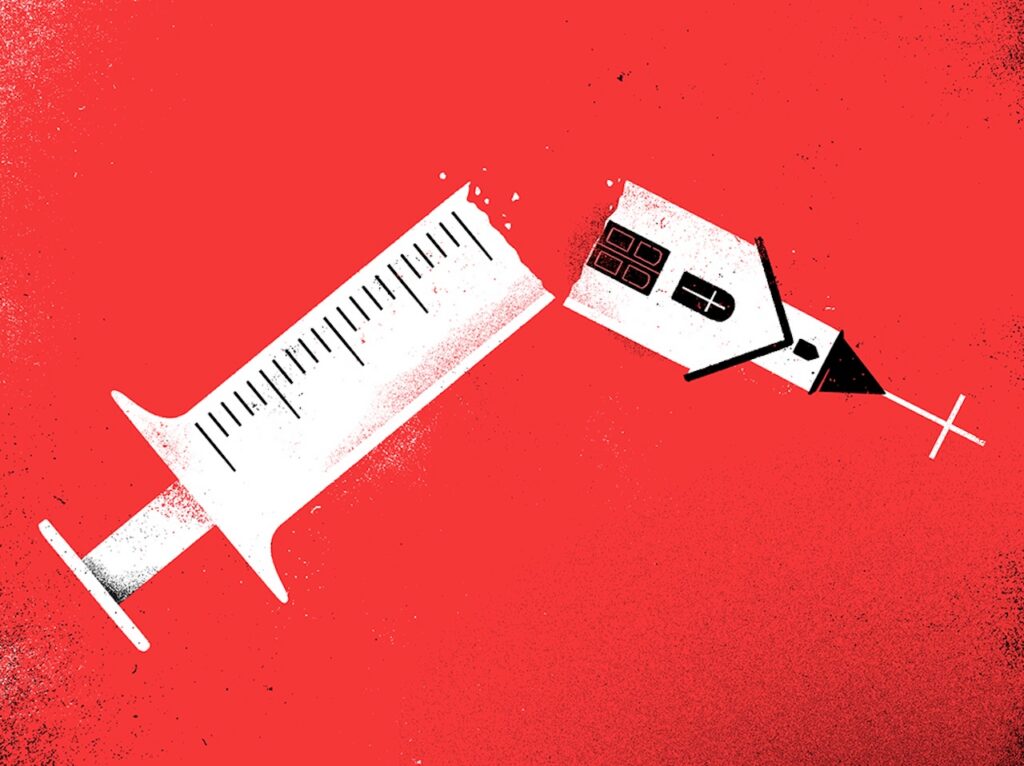
(Image source: Sébastien Thibault)
In September 2025, Health and Human Services Secretary Robert F. Kennedy Jr. advised states to vigorously uphold Americans’ rights to refuse vaccines on the grounds of religious freedom. His argument was twofold. First, Americans deserve the legal right to opt out of mandatory vaccinations, and second, this freedom was critical for building public trust in vaccination programs. Critics condemned this move as a poorly disguised attack in Kennedy’s larger war on the nation’s mass vaccination programs.
As a scholar of religion who has studied the past fifty years of vaccine hesitancy in the United States, Kennedy’s argument made sense to me––even though I understand the potentially deadly ramifications it posed. This is because vaccine hesitancy is not about following statistics or following the doctor’s orders. It’s about religion.
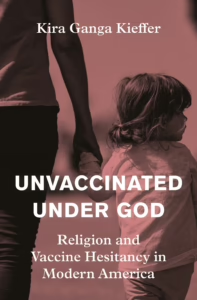 In my book, Unvaccinated Under God: Religion and Vaccine Hesitancy in Modern America (Princeton University Press, 2026), I argue that Americans express fears and opposition to vaccination using a range of religious beliefs and identities. Vaccine hesitancy is not about scientific illiteracy. Rather, it is powered by a belief that vaccines can trigger other diseases, upset the sacred order of parental responsibility, and violate bodily autonomy. In this view, vaccines can cause tremendous physical and moral injury. For vaccine hesitant people, vaccines are not passive, utilitarian medical care. They carry deep risk and religious significance.
My research helps to explain why measles cases are surging and vaccination rates against diseases such as measles, whooping cough, and polio have dropped among incoming kindergarteners by more than 3 percent nationwide since 2020.
For decades, healthcare professionals and liberal policymakers have characterized vaccine hesitancy as being rooted in scientific ignorance and misguided individualism. Before and after the Covid pandemic, their many attempts to increase trust in vaccine safety and mass vaccination leaned into messaging such as “Believe in Science,” “Trust Doctors,” and “Vaccines are Safe and Effective.” They also blamed hesitancy on “anti-science” political agendas. State legislators across the country worked to cut back on the legal availability of religious exemptions to mandatory vaccines. Those efforts were largely stopped by a surprising wave of grassroots activism that defended exemptions as medical freedom and religious liberty. Courts have upheld these exemptions as constitutional, notably in West Virginia, which added them in early 2025.
For many Americans who are vaccine hesitant, as well as those who outright refuse vaccines for themselves or their children, “Believe in Science” misses the mark. Vaccine hesitant people do believe that epidemic diseases are harmful and think that most vaccines work. However, they also believe that vaccines act in multitudes of mysterious, negative, and undesirable ways. It is this fluidity of effects that they find deeply––or even existentially––disturbing.
Vaccine hesitant people imbue vaccines with a range of meanings and dangers that are both physical and symbolic. They allege that vaccines commonly cause adverse effects that doctors deny are true. This is why public health advocates need a different strategy. They may have more success in gaining trust among skeptics if they examine claims of adverse effects as existential concerns about what is sacred and how their bodies should be treated. This is because vaccine hesitant people have historically expressed their doubts about vaccination and medical authority using the language and sensibilities of religion rather than biomedicine.
The Religion of Vaccine Hesitancy
No religious scriptures warn people to avoid vaccines, and it is uncommon for priests, pastors, or rabbis to give sermons on the topic. In fact, religious leaders have historically supported mass vaccination as a low-risk life-saving practice.
So, why is vaccine hesitancy religious?
To answer this question, we must expand what we think of as religion beyond traditional doctrines and institutions. There are many reasons to do so. First, institutional religious affiliation does not nearly cover the wide range of Americans who fall into the “spiritual but not religious” or “religious nones” categories. Second, people rarely follow their church’s doctrines to the letter. They “live” religion in how they approach their daily behaviors, relationships, and moral quandaries without deferring to religious authorities. And third, religious language and ideas permeate American culture, so most of us are steeped in mainstream Christian and/or alternative spiritual ideas to the extent that we do not even identify them as religious. In my book, I show how expanding what we classify as “religious” is beneficial for understanding the history of vaccine hesitancy and what is driving it today.
Over the past fifty years, vaccine hesitant people have formed what many social scientists call a “moral community” by developing meaningful mythologies about how to keep bodies pure or sacred. This is something many traditional religious communities do as well. Consider Orthodox Jewish dietary laws or conservative Christians’ sacralization of virginity. In both cases, what people consume and how they behave reflects and determines spiritual character.
Similar, vaccine hesitant moral communities are united by myths. Mythologies should not be misunderstood as incorrect facts or conspiracy theories that scientists could disprove. Rather, they are stories told collectively that explain otherwise inexplicable events. They convey moral truths about what makes a body good and how to preserve its innate purity from a contaminating world. Wellness culture does this, and so does the broader Make America Healthy Again movement.
Modern vaccine hesitancy was born out of an important myth that arose in popular culture in the early 1980s. It provided a plausible explanation for why some children were falling ill with neurological disorders of unknown origins.
A Religious History
In 1982, a scandal over the safety of the diphtheria, pertussis, tetanus (DPT) vaccine caused an uproar among a subset of American parents. Some formed a grassroots campaign in response to a documentary that purported that the DPT vaccine caused children to develop irreversible neurological disorders. The activists who lobbied for a safer DPT shot were not overtly religious in that they did not come from the same church or represent a specific religious tradition.
Yet the language and storytelling that powered their movement reflected strong moral commitments which caused them to question the communitarian logic behind the mass vaccination program. These parent-activists, originally known as Dissatisfied Parents Together––later National Vaccine Information Center––spoke publicly and wrote about their experiences of having children who developed sudden neurological disorders after receiving a routine vaccination. Through their narratives, parents spoke as converts to a new worldview in which healthy babies fell irreversibly ill despite following doctor’s orders and state laws. From their perspective, they had unwillingly sacrificed their children to the cause of public health, and doctors could no longer be trusted.
Bonding over shared trauma, parents joined together. They attracted others who did not have firsthand experience, but who were touched by their stories and felt called to share in their fight to reform the DPT vaccine and obtain justice for harmed children. Their moral community was dedicated to the idea that the medical system should be held responsible for the risks that mandatory vaccines posed. Many explained this in terms of having “lost children” who deserved to be remembered as wounded veterans injured in the nation’s war against epidemic diseases.
Parent-activists of the 1980s spoke about vaccine risks as a form of child sacrifice in which the health of a few children was given up for the protection of the herd. They used the rhetorical style most common to evangelical Christians: witnessing, a conversational practice in which someone shares their salvation story with others. The vaccine hesitancy movement grew through similar storytelling. Vaccine injury became a parable––a seemingly secular message told with religious forms and significance. Today’s vaccine hesitancy conferences share this confessional style.
By the late 1990s, the vaccine hesitancy movement had lost some steam until the publication of an infamous article by medical researcher Andrew Wakefield in the British medical journal The Lancet. Wakefield asserted that the measles-mumps-rubella (MMR) vaccine was linked to autism. Ten years later, Wakefield’s article was discredited (many times over), retracted, and Wakefield was barred from medical practice. However, Wakefield’s assertions made waves among the generation of young mothers who were having babies during the late nineties and early 2000s. It created a new myth that explained the cause of autism––now classified as autism spectrum disorder. And because doctors did not know the cause or cure of autism, the MMR-autism myth took hold.
Many parents feared that giving their child the vaccine put them at higher risk of developing autism than of preventing measles. In books, magazines, and online forums, contributors argued that they could not bear the guilt that they would feel if their vaccinated child developed an incurable disorder. This thinking racked the country during the early 2000s and remains influential today.
When Wakefield’s article was published in 1998, the vaccine hesitancy moral community started to reflect the contemporary ideas and aesthetics of alternative spirituality and the growing “spiritual but not religious” contingent of younger Americans. Their spirituality was highly individualistic and honored personal experience. It sacralized nature, often through wellness product consumption, such as health foods and natural lifestyles. As scholars of religion have shown, health food regimens are borne out of moral reasoning that classifies certain foods as “good” and others as “bad” for one’s health. This logic, that our consumption choices––what we eat and what we buy––create positive or negative outcomes for our bodies also says a lot about who we are as people. In short, you are what you eat (or don’t eat). In the late 1990s and early 2000s, health and wellness advocates learned how to maximize physical and spiritual purity by minimizing artificial ingredients and reliance on experts. Again, this was secular culture operating as religion.
The MMR-autism controversy was fueled by women who treated their maternal decision-making as a spiritual practice, wherein salvation was earned by children’s success––including their health. In this high-pressure mothering culture, vaccinating kids was treated as a critical decision. Failure meant that a child may have developmental deficits that were preventable by the vaccine hesitant mother. This was because the growing vaccine hesitant community interpreted the onset of these disorders as a breach of maternal duty. Filling the breach were chemicals, preservatives, and environmental toxins that indiscriminately seeped into children’s naturally pure bodies.
During the 2010s, measles broke out in religious enclaves across the country. These included Somali refugee communities in Minneapolis, Amish country in Ohio, and ultra-Orthodox Jewish neighborhoods in Brooklyn. Repeated outbreaks led public health professionals and mainstream media to assume that vaccine hesitancy originated in devoutly religious communities and spread outward into the mass public.
In actuality, the dynamic moved in the opposite direction. Traditional religious doctrines did not drive vaccine hesitancy in these places. Rather, religious sensibilities concerning bodily purity, risk, and parental roles filtered into devout, insular communities where skepticism toward governmental and medical authorities has historically been key to group survival.
A Political Epidemic
In 2015, many state legislators––mostly Democrats––looked to boost vaccine compliance by repealing religious or personal belief exemptions from mandatory vaccination requirements. These exemptions are the only legal options for people who wanted to skip required vaccines for nonmedical reasons.
The State of California was the first to abolish these exemptions in 2015, but when other states moved to cut nonmedical exemptions in the name of public safety, a groundswell of activists all over the country rallied to fight these efforts under the banner of “medical freedom.”
Leading up to the Covid-19 pandemic, there was a convergence of vaccine hesitant people from the earlier generation who found common cause with conservative politicians. Libertarians––generally open to deregulating healthcare––and supporters of President Donald Trump’s Make America Great Again agenda agreed broadly with the cause of medical freedom, especially when it was branded as an arm of religious liberty. Later, the ReAwaken America Tour solidified this connection for conservatives. Republican politicians quickly added the loosening of vaccine requirements to their slate of “medical freedom” policies.
Quickly, vaccine hesitant activists realized the political utility of the “religious” qualifier in “religious exemptions.” As a result of this coalition of conservatives who were willing to adopt vaccine hesitancy under the mantle of religious liberty, vaccine hesitancy was rebranded as conservative. For some, it even became culturally Christian to the extent that the MAGA movement was dominated by White Christian identity politics. We know that the result of this coalition was that 15 percent of American adults had not received a Covid-19 vaccine by December 2021.
Today, the number of unvaccinated school children is on the rise, and vaccine hesitancy has been largely adopted as a conservative culture war issue. In this new framing, vaccines symbolize liberalism, dependence, and trust in faulty institutions. Remaining unvaccinated represents independence, individualism, and biological toughness. In many ways this is ideological purity embodied as biological purity. In other words, some people are newly determined to reject vaccines as a means of aligning their physical bodies with their beliefs in bodily autonomy.
A New Path for Public Health
Vaccine supporters, policymakers, and medical professionals should better understand vaccine hesitancy as a religious impulse that deserves respect not derision. Rather than strive to eradicate vaccine hesitancy as though it is a disease, leaders should focus their efforts on understanding of how vaccine hesitancy operates religiously within hesitant communities. This is the first step toward trusted communication. These efforts could help mitigate the fallout from future public health crises and help reaffirm scientific reasoning as a common framework for public debate rather than political partisanship.
The way through the growing impasse between vaccine advocates and refusers must be built on a foundation that recognizes religion as personal, cultural, and related to everyday concerns. Vaccine hesitant people need to believe that public health authorities understand their concerns as sincere and rooted in a desire to protect that which they believe is sacred––their bodies, parenthood, and autonomy. Speaking their language may be the key to reducing vaccine hesitancy.
Kira Ganga Kieffer is a Visiting Assistant Professor of Religious Studies at Fairfield University.
***
Interested in more on this topic? Check out episode 69 of The Revealer podcast: “Vaccine Hesitancy and Religion.”