Compacts of Silence
An excerpt from “Whispers in the Pews: Evangelical Uniformity in Divided America”
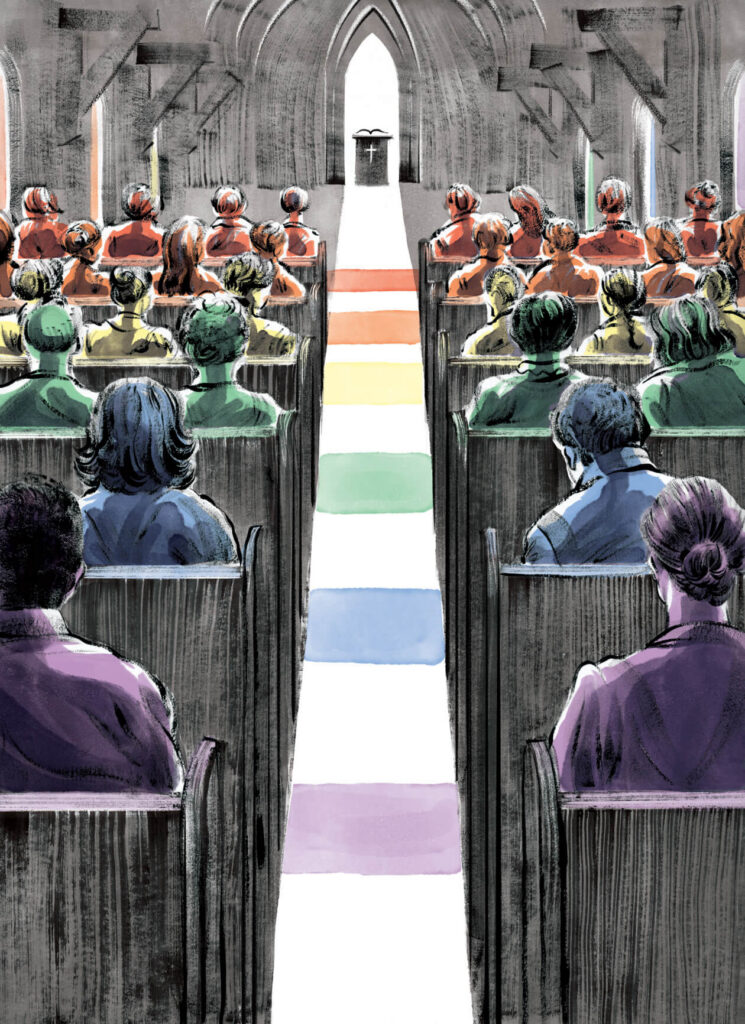
(Image source: Chloe Cushman/The Walrus)
The following excerpt comes from Amy D. McDowell’s Whispers in the Pews: Evangelical Uniformity in a Divided America (New York University Press, 2026). The book is based on an ethnography of a church where “all are welcome” in Oxford, Mississippi, a college town on the brink of deep polarization. The book shows how silence, small talk, and denial crush dissent before it has a chance to emerge in evangelical settings and argues that quiet omissions are just as powerful as the loudest factions of the religious and political right.
This excerpt highlights how the church actively evaded talk about its assumed stance on LGBTQ+ inclusion, effectively making it taboo for churchgoers to accept or acknowledge the queer people in their lives.
***
Churchgoers were aware that gay people come, sometimes. A few told me they had noticed a man standing next to another man during service, or have run into a friend from high school, family acquaintance, or colleague from work who they know is gay or lesbian. But they never “brought that up” to anybody, as one churchgoer said, and were not in conversation with others about if or about how to welcome LGBTQ+ people to church. They pretended to not see or notice “it.” Pretending was easier than confronting theological inconsistencies that could put God up for debate. Noticing could also make their job as a welcoming congregation complicated, just as it could make it harder to appear as if everyone fits under the umbrella that the church prescribes for gender and marriage.
 Ignoring LGBTQ+ people was no small feat. The church had to actively unsee the culture wars that were brewing right in front of them in their own hometown. Shortly after the state’s religious accommodations bill was passed in 2016, the university’s Sarah Isom Center for Women and Gender Studies put on a Pride parade in the downtown Square, the most visible location in town. LGBTQ+ community members and allies showed up dazzling in vibrant colors with a rainbow banner that read “God Loves You” and comeback signs, “No Hate in My State” and “Love is My Religion.” The turnout, according to the Isom director, Jaime Harker, was bigger than anything she could have ever imagined. The success of Oxford Pride inspired other first Prides across the state. Biloxi and Hattiesburg had their first Pride parades in 2017, while Starkville, home to Mississippi State University, had its first in 2018. Even Tupelo, a rural city where the American Family Association, a fundamentalist Christian organization that aggressively opposes LGBTQ+ rights, is headquartered, launched Pride in 2018 and has been going strong ever since.
Small businesses and progressive congregations took a public stance on LGBTQ+ rights and religious freedom too. “Y’all means All” and “We Don’t Discriminate” stickers popped up on retail windows and restaurant doors. Square Books, the iconic bookstore that sits in the center of downtown, hung cardstock “All are welcome” signs in rainbow lettering on its front doors and sold posters and heavy cotton tees of its signage. And the Unitarian Universalist Congregation of Oxford made its position on LGBTQ+ members official. It enacted a “Welcoming” policy, as did the directors of the Unitarian congregation in Tupelo after organizing a series of educational workshops and sensitivity trainings on LGBTQ+ inclusivity. These welcome campaigns were not entirely confined to Unitarians. The Episcopal and Presbyterian churches in Oxford were LGBTQ+ friendly, and the University Baptist Church in Starkville, a Cooperative Baptist Fellowship, was an official member of the Association for Welcoming and Affirming Baptists.
Amid all of this, the Christians who lead and attend Welcome were conveniently oblivious to how their very own “all are welcome” slogan resembled that of the slant towards LGBTQ+ inclusion in religious communities across the nation. Lynn, who is close with church leadership, said that “this stuff” never comes up in her circle of friends. When Lynn shared this, I admitted to her that I was surprised to hear that. Oxford Pride had recently started holding its annual parade, and the placards featured in that event had spoken directly to the exclusion of LGBTQ+ Christians from the church and state. Lynn looked out the window of the coffee shop where we were sitting, located on the street where Pride takes place. Gay people show up to Welcome sometimes, she said, but she doesn’t talk about that with her church friends. Talking about it could unleash tension. It could tear them apart.
Unseeing queer people, refusing to acknowledge them, and neglecting to discuss whether the church should welcome them made it difficult for Bird [the pastor] to decide what to do about openly gay people who came to Welcome. Sometimes it seemed like he was bringing it up to me in search of direction. During one of our informal chats, he told me about a gay couple that had emailed him to acquire his permission to visit. The email caught him off guard. Initially, he missed that the person who wrote the message was a man asking if he could bring his husband. He couldn’t understand why a woman would ask if she could bring her husband. He read the email again and finally realized that it was a man, not a woman, on the other side of the message. How could he, the pastor of a church that loves everybody, say no? How could he, the pastor of a Southern Baptist church plant that preaches the Word, say yes? He decided to talk it over with Anne and concluded that he had no other choice than to tell them to come.
By the time Bird told me about the predicament he was facing, the couple had been attending the church for over a month and were, in his words, “becoming more and more brave.” One member of the couple had come up to the church’s makeshift altar—a plastic folding table at the front of the Recreation Center—to participate in monthly communion. Bird was stunned when the man asked for the fruit juice and cracker, and he wondered if he should have stopped him. Later that day, he talked about it with Anne, and she asked Bird questions that made him feel better about giving him communion. Was he going to deny communion to divorced people? Or to that “a-hole” who was being abusive to his wife? she asked. How could he say that one sin is greater than another? Bird came to the conclusion that it would be impossible to control who has a right to communion. Aside from preaching “hard” about heterosexual marriage, as he described it, there was little else he could do to stop gay people from coming.
Bird’s doubts about how to treat the gay couple implied that his job is less complicated when gay people stay out of sight and out of mind at church. He was not the only one at Welcome who felt that way. Many churchgoers told me that they prefer to remain ignorant about someone in their circle being gay or lesbian because they were unsure of what to do with that information. In hour two of a longer-than-usual interview, Amani, whom I knew from Be the Bridge [racial reconciliation group], brought up a friend she taught with at a middle school in another state. That friend was a PE coach, “wore her hair like a boy,” and had pictures of her and other women on Facebook, never men. Amani continued:
I was always worried that she was gonna tell me she was gay, so I didn’t know what to say. I asked my sister [a Christian counselor], “Do I witness to her?” I don’t know (laughs uncomfortably). I was kind of glad that she never told me, because I was like, “What do you say?” If she does tell me, is it an opportunity to share what I believe? If I share what I believe, is that offensive? Does that mean I’ll never see her again?
Amani and her coach friend observed a compact of silence for years, and through that silence Amani avoided having to figure out “the Christian thing to do” if her friend were to come out as queer. Eventually her friend got “shipped off someplace else,” as Amani termed it, after a group of parents filed a complaint about her sexuality to school administrators. It was as if she was Black, Amani said, as “far as the level of discrimination goes.” Amani, a Black teacher in a primarily White school, could relate to that feeling. But her friend never told her why she lost her job. And Amani never asked. Her friend “suffered in silence,” to use Amani’s words.
Amy D. McDowell is Associate Professor of Sociology in the Department of Sociology and Anthropology at the University of Mississippi.