Conspiracism as Religion
How conspiracy theories function like religion, and how they’re transforming American politics

(Women storming the Capitol on Jan. 6, 2021. Image source: Brent Stirton/Getty Images/NBC News)
In today’s world, conspiracism often acts like a religion. That may seem like a stretch given the great incoherence and absurdity of many conspiracy theories. Right now you can find many conspiracists who believe—all at the same time—that a cabal of elite pedophiles drinks the blood of children and runs the world, that McDonalds restaurants serve human meat, that Michelle Obama is secretly a man, that Mother Theresa was Dr. Anthony Fauci’s father (yes, father), and that the 1999 blockbuster film The Matrix is a documentary about our lives trapped in a computer simulation. These fantastical beliefs don’t hold together with anything approaching theological consistency. And yet, after five years of conducting research among conspiracy theory believers, I can say with great confidence that the underlying conspiracism behind those wild ideas acts like a religion for many people on the mainstream political right—and for millions of others across the political spectrum and around the world.
I hadn’t thought about conspiracism functioning like a religion when I began studying the women arrested for storming the U.S. Capitol Building on January 6, 2021. I was trying to understand why so many middle-aged women were entering conspiracy communities with a level of conviction that caused them to take extreme actions, abandon personal relationships, and in some cases, completely change their lives. My initial approach was to analyze factors like political identity and the process of online radicalization.
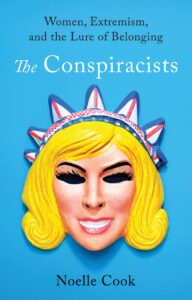 But the deeper I dug into the lives of the women I studied, the more it struck me that conspiracy theories were acting much like an organized religion. Tammy, one of the women in my book, The Conspiracists: Women, Extremism, and Lure of Belonging, often announces, “I’m a conspiracist,” like someone might say, “I’m an Episcopalian.” Tammy sees her conspiracism as a central part of her identity. She lets her faith in conspiracy theories shape her life in the same ways many people in organized religions use theology or church teachings to guide their attitudes and actions.
And she’s not alone. Conspiracy theories are everywhere in today’s world, especially online where they flood social media platforms. The real surge came during the pandemic when people were locked inside and went online looking for information about COVID-19, and the algorithms fed them antivaccination conspiracies. It was a short jump from there into the QAnon conspiracies and an entire online world of conspiracism. Many of the women I met talked about jumping down “the rabbit hole” in 2020 and then continuing to dig deeper. By the time Donald Trump began promoting his own conspiracy that the 2020 presidential election was stolen, they were primed to believe it.
This conspiracism doesn’t typically replace traditional religious faith so much as it is a separate belief system that operates alongside it. Many conspiracists in the United States identify as Christians. That’s especially true for evangelical Christians in charismatic denominations like Pentecostalism and non-denominational apostolic churches that feature modern prophets.
The cases where conspiracy theories actually replace traditional religions usually happen with what scholars call “conspirituality”—a mix of New Age spiritualism and anti-government conspiracy theories. Over the last several years, I have watched many women arrested for January 6 gradually transition into conspirituality. Most of these women started in Christian churches but slowly changed their spiritual views to embrace New Age theologies based firmly in conspiracism.
To get a sense of how this happens, consider the case of Yvonne, one of the women featured in my book. Yvonne spent years as an active member in an evangelical Christian church. When she started following conspiracy theories, her beliefs began to incorporate New Age spiritual concepts. She still believes in Jesus and exalts the Bible, but she no longer sees them as exclusive sources of spiritual authority. For Yvonne, Jesus is now one spiritual guide among many. The Bible is joined by other spiritual texts (including social media posts, memes, and YouTube videos—lots and lots of videos) that she consults for theological understanding. Her spiritual beliefs now include elements of Hinduism and Buddhism. But they are mostly based in what are often called “UFO Religions,” where the theology centers on aliens, inter-dimensional travel, and humans transcending into higher levels of consciousness and being.
Whatever the relationship to traditional faiths, conspiracism has its own belief system—even though the individual conspiracies are diverse, outlandish, and often contradictory. Conspiracists don’t require logical rigor or theological coherence. It’s mostly about feelings and faith.
That said, conspiracism is coherent enough to provide a broad explanation for life and why things happen, just like an organized religion. The overarching story behind the conspiracy theories is a simple binary of good versus evil. Conspiracists believe that things are bad right now because a powerful and shadowy group of evil elites controls the world for their own benefit. The exact identity of that group varies widely. For some it’s pedophiles who drink the blood of frightened children to get the “adrenochrome” required to restore health and prevent aging. For others it’s Satanists, legendary secret societies like the “Illuminati,” the “deep state” in the federal government, or simply “globalists.” Many conspiracists mix and match villains and complete the list with Hollywood stars, Democratic politicians, and Jewish people in high-profile positions.
The conspiracists identify with the forces of good. They see themselves as part of a network of righteous warriors working for the “white hats,” a group of earthly leaders, headed by Donald Trump, that they believe will expose the bad guys and end the evil. The team of white hats typically includes leaders and celebrities on the political right. In conspirituality circles, some of the good guys are referred to as “lightworkers,” a term that signifies a degree of spiritual divinity. Some conspiracists believe the heroes are spiritual entities, aliens, or humans with alien DNA. Yvonne is convinced she is one of those heroes: a “starseed” from another planet and dimension, who has agreed to come to Earth to save the planet, vanquish evil, and lead the true believers into the fifth dimension, which she envisions as heaven on earth. There are lots of starseeds out there. An internet search of the term “starseed” returned over 4 million results. Starseed content on Tik Tok has received over 1 billion views.
Although many people with mental illness fall into conspiracism, the millions who believe in starseeds or who think the 2020 presidential election was stolen are mostly “normal” people who believe extraordinary things. Their conspiracism is a mix of personality traits and life experiences. They may have experienced more than their fair share of hardships and trauma and use conspiracy theories as a coping strategy, but this is fundamentally about self-indoctrination, not faulty brain chemistry.
Like in many organized religions, conspiracy beliefs are based on a faith that does not require verification. Outsiders tend to think that conspiracists will abandon conspiracy theories when they don’t come true. That seldom happens because, even as the individual theories fail, the conspiracists retain faith in the larger conspiratorial vision beneath them. It’s quite similar to what happens in charismatic and non-denominational apostolic churches that feature new prophecies issued by current leaders. The fact that most of those prophecies never come to pass does little to discourage the faithful. The failures are rationalized by referencing God’s great plan that remains unknowable to humans. The mantra among conspiracists is “trust the plan,” a phrase that repeats in conspiracy communities every time things don’t work out.
That trust is also based on a belief that the details of the greater plan are shrouded in mystery and need to be discovered and decoded through the study of texts and signs. In this world, individual conspiracies act like scripture, providing messages and lessons that operate on several levels at once. Conspiracists don’t expect their decoding to be perfect. The process of discovering hidden “truths” is part of what draws people into conspiracism, allowing them to participate in the process of uncovering and building the lore and interpreting its meaning. When conspiracy prophecy fails, the conspiracists discuss what happened and inevitably chalk it up to an interpretive error and move on to the next conspiracy that captures the community’s attention. They tend not to get too hung up on any single conspiracy coming true, a practice that gives conspiracism remarkable flexibility and resilience in the face of disappointment.
For example, when the Palisades Fire consumed the homes of rich and famous people in Los Angeles, it undermined a host of conspiracies about the omnipotent Hollywood “cabal.” When I asked Tammy about it, she explained the fire with a new conspiracy theory gaining traction on the internet: the Hollywood elites had started the fires themselves to destroy the underground tunnels they used to traffic and eat children because Trump was about to bust them, and they needed to get rid of the evidence.
Conspiracists are convinced they possess special knowledge (sometimes divinely inspired) and that time will eventually vindicate them when the great truths are finally revealed in the future. In the meantime, they anticipate being ignored or ridiculed for their beliefs and even isolated from friends and family. They view these difficulties as the price they must pay so the truth can be exposed.
Like many evangelical Christians, conspiracists also believe they need to testify in public to share the good news. Conspiracists generally love to talk about conspiracy theories and teach the lore to new recruits. Many of the January 6 women I follow plaster their favorite theories on social media accounts that include both their conspiracy communities and their real-life friends and family. They see these interventions as a way of showing “the truth” to those who are “still asleep” in hopes of “waking them up.”
The most common method of testifying is on social media. Conspiracists repost memes on Facebook and Instagram and share links to conspiracy explainer videos on YouTube and TikTok. The women I follow often add comments to emphasize the parts of the theory they find most compelling. Yvonne created a separate blog for her evangelical Christian friends and family so she could explain her new belief system and answer questions they had about her conversion. She lost many friends as a result of the blog, which also caused one of her daughters to temporarily withhold access to her grandchildren. Yvonne interpreted her isolation as part of her ordained suffering; she repeated the conspirituality catchphrase that those ascending to the fifth dimension needed to have “no attachments” to the “3D world” when they make the final jump.
Meanwhile, the communities of conspiracists function like traditional churches. Fledgling conspiracists are welcomed into the online conspiracy spaces, introduced to the regulars, and shown their way around. Those online communities provide mentoring and instruction about conspiratorial beliefs, give encouragement to those struggling with the faith, and offer advice about how to deal with rejection by the people in their lives. When a new recruit starts losing friends and family as they go deeper in, the community rallies around them, providing comfort, emotional support, and a reaffirmation of core beliefs. The women I follow often refer to their online communities as their new “family” and other conspiratorial women as their “sisters.”
Conspiracy communities also rely heavily on peer pressure to keep believers in the fold. Former conspiracists I spoke with report being bombarded with pleas to return to the community after they left. Love bombing is common; so are threats of excommunication and warnings that leaving will lead to eternal damnation.
Conspiracism also has the same kind of apocalyptic resolution found in some organized religions. Most conspiracists are convinced we are living in the last days before a prophesized end times event. The type of apocalypse differs depending on the branch of conspiracism. For white nationalist conspiracists, it is a race war that ends in a white ethno-state. For conspiracy-minded Christian nationalists, it’s dominionism and taking control of the main institutions of modern society. For a wide range of conspiracists, the end goal is the defeat of the global cabal and the public execution of the political leaders and Hollywood celebrities they believe are at its center. For believers in conspirituality, the apocalypse involves a jump to a new age, whether that means an alien-led transmutation, a mass consciousness awakening in humanity, or a planetary shift to the fifth dimension. Like with the Book of Revelation, these different visions feature some kind of battle among humanity in which many people will die and only some will be saved. For now, the vast majority of these people are not stockpiling weapons because they think the “lightworkers” and “white hats” will do the hard part. They expect it to unfold like a movie they are watching in which they are both audience and characters.
Parallels like these between conspiracism and religion help explain why belief in conspiracy theories isn’t going anywhere any time soon. In fact, the trend is likely to grow stronger, fueled by algorithms, and now artificial intelligence, that convince users that whatever their social media presents them is a message from God—what scholars call “algorithmic conspirituality.”
Modern life has created something of a perfect storm for conspiracism. Great insecurity and a fast pace of constant change creates an ideal environment for its spread, and conspiracism meets the moment with its great adaptability. Technology and the radical transformation of the information ecosystem have allowed people to create alternate realities based around their own mix of beliefs, likes, and dislikes. That environment allows conspiracism to entice followers with a grab bag of explanations and solutions they can pick and choose from. It all works like a giant online trade show, where followers can take fliers and swag from different booths and ignore the ones they don’t like.
In this sense, conspiracism is the ultimate bespoke religion. It creates a personalized, a la carte understanding of reality and a corresponding set of spiritual beliefs to match. Regardless of the mix, every conspiracist can find online communities of supporters, no matter how “out there” a conspiracy may sound to nonbelievers. And those supporters are accessible all day, every day, and will discuss your beliefs and problems with you for as long as you like. That makes a big difference in today’s fractured society, where people are suffering from mass loneliness and starving for a sense of purpose and belonging.
However flawed conspiracism may be, and regardless of the fact that most of its prophecies never come true, it nevertheless speaks to millions of people worldwide, giving them the kind of faith and fellowship they once received from their traditional churches.
Noelle Cook is an ethnographer, author, documentary filmmaker, and public speaker who seeks to educate and inform about the growing problem of conspiracism in today’s world. She is also the associate producer of the 2025 documentary film The Conspiracists by Page75 Productions that is based on her research.
***
Interested in more on this topic? Check out episode 72 of The Revealer podcast: “The January 6 Women Insurrectionists and Their Conspiracy Beliefs.”