Why I Quit Church—and Why I’m Not Alone
An excerpt from “Damned If She Does: Why Women Quit Church and What It Means for the Future of Religion”
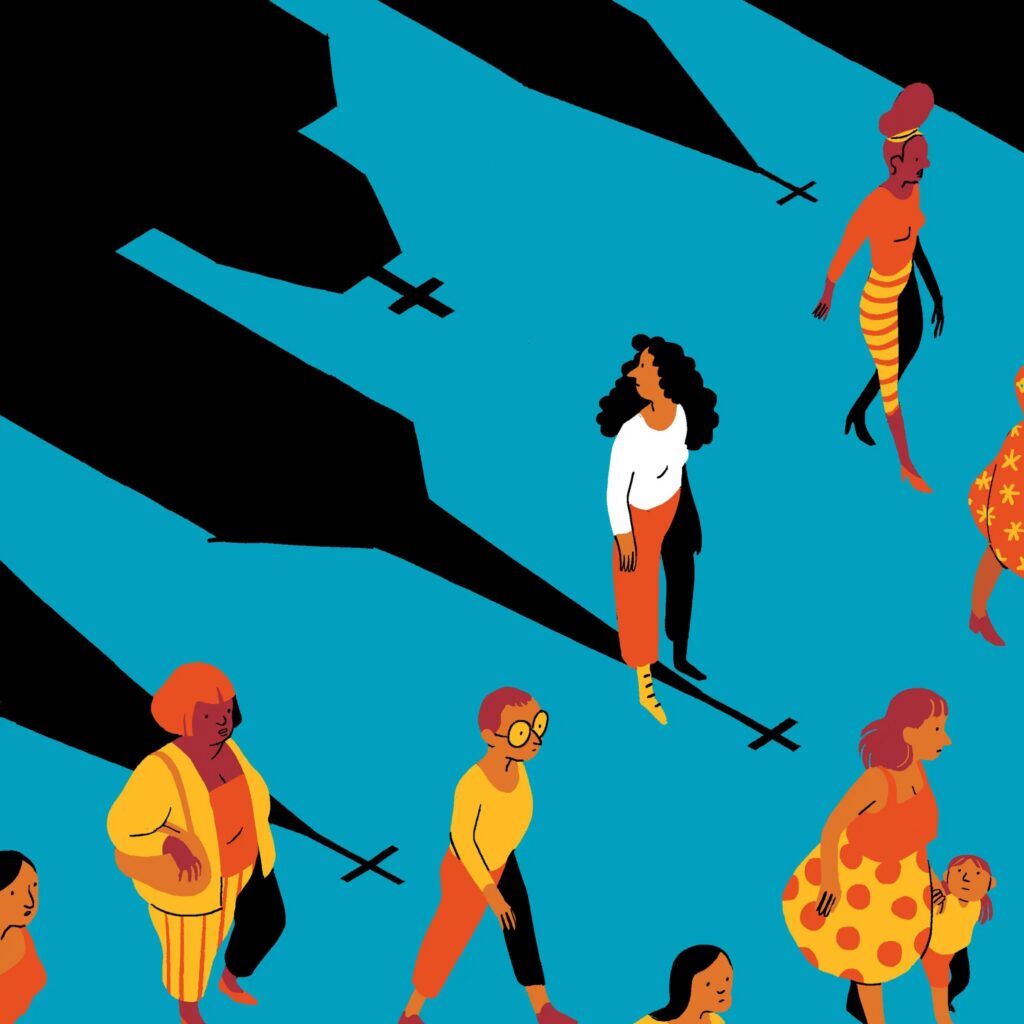
(Image source: Eleanor Davis/The New York Times)
The following excerpt comes from Sarah Stankorb’s Damned If She Does: Why Women Quit Church and What It Means for the Future of Religion (Copyright © 2026 Broadleaf Books). The book explores why American women have been abandoning religion in record numbers.
The excerpt comes from the book’s introduction, “Damned When She Did.”
***
For an agnostic writing about women leaving church, I’ve spent a surprising amount of time in sanctuaries recently. I want to know why people stay; I want to see who is left.
 I was once a deeply faithful United Methodist teen who thought she was being called into the ministry. My green, leather-bound Bible lived on my nightstand and traveled with me to church each week and to youth group meetings and retreats. But I was also the sort of bookish kid who ticked my way through the religion stacks at our local library. I read Linda Goodman’s Sun Signs and the nearly thousand-page Love Signs cover to cover, then went back to check out Krishnamurti, then Freudian case studies. I learned to read tarot cards. I tried (by book) to learn how to do past-life regression by hypnotizing my friends at sleepovers. And I was never shamed at my church for my exploring. I was a seeker, trying to find God, usually via my library card.
Then in my teens, I collided very briefly with a form of evangelicalism where I got saved a handful of times, never sure any of it stuck. I was coached that the Bible condemned gays (that included one of my dearest friends) and denied women’s role as clergy (me, I’d hoped). There was one right and absolute answer, and anything else, I was told, was not only wrong but condemnable. Confused and afraid, when I eventually studied the Bible in college with added historical context, I tried to reconcile a literal interpretation of the Bible with the assemblage of temporally distant and sometimes outright contradictory verses held within. By then, my faith had become so rigid it could not expand again to accept the Bible as a collection of stories holding all manner of meaning (poetic, historical, allegorical, and spanning various cultural influences). An inflexible thing, my faith splintered.
And it hurt as if someone had died. A part of myself surely did. At first, I had to reconcile a new way of seeing the universe with that grief and an awkward shame over no longer being a believer. Initially, I was angry about alleged truths that now seemed like plain lies.
For years, I thought it was just me who’d left a church I once loved. There was no social media and so no deconstruction group I could join for support as I reappraised my beliefs or worked through the loss. Maybe attending divinity school was my attempt at treating my spiritual disentanglement; maybe I did so by becoming a religion reporter, gathering up primary source accounts of faith, the way I used to check out books.
But about ten years ago, I noticed in Pew Research Center data that millennials, and increasingly women like me, were starting to disaffiliate at a clip similar to men (even though the same total numbers of millennial men and women had not yet left). I discovered I wasn’t just a solitary case. I was part of a small but growing trend. I proposed a book on the topic to publishers then, wanting to warn that American millennial women were starting to leave the church. No one wanted to publish that book a decade ago. And now I’m grateful I didn’t get to tell this story then. It was too early. The bright, clear outlines I now see were still fuzzy. It gave me time to heal and grow comfortable, even enthusiastic with my own agnosticism by hearing so many others’ wide-ranging stories of deconstruction, faith, and disbelief.
After years of such reporting, I now see our combined stories far more lucidly. I have a better sense of what was so harmful, so off-putting to many of us. I have a better sense of what was freeing about leaving.
Documenting these stories is not an attack on the church. Instead, this book is an attempt to describe phenomena reshaping where and how millions of women feel at home and find meaning. I would hope America’s church leaders would care.
Even after second-wave feminism’s inception in the 1960s, women typically stitched together churches’ social fabric—maintaining the community by caring for the sick and grieving and nurturing faith in the next generation. They prayed for the ailing, supported their church friends through the death of spouses and children, taught Sunday school, ran the nurseries and pancake breakfasts and fellowship coffee hours. They were offered a spatula and percolator, if not a pulpit.
These days, though, many churches don’t have enough members to fill a fellowship hall. Some are shuttering. Those still up and running may want to start flipping their own pancakes.
As some of our daughters come of age and some of our mothers (and grandmothers) quit too, the sweep of what we’ve gone through is becoming clear. And what we have experienced matters urgently for those who still care about the church. It matters to those choosing to leave now too and to a country that is rapidly changing in many of the same ways that drove us from the church in the first place.
If you are a person watching for signs of organized religion’s collapse and in a still-predominantly Christian country like the US, that means the church—you should know that women are the bellwether.
To understand the shifting religious climate in America, it is necessary to understand what is happening among Christians, particularly those opting out and shifting identity. Women are the sentinels, the proverbial canaries in a coal mine many wish they could still call home. They are the ones who sense the noxious fumes. As they stop singing the old songs, their silence provides a vital message. Theirs is no sudden exodus. The slide from faith has been building for decades. Talking to women who left, there’s a silvery thread of influences we can trace—events that eventually braid like a rope, dangling over a welcome escape hatch.
There’s no single reason American Christian women are breaking up with the church. It’s not a solitary wound that can be quickly mended. In most cases, many converging spiritual scars, moral protests, or logical objections meet in each woman’s life, eventually leading to a tipping point where she realizes she is better off fleeing than staying. Understanding what is happening on a national scale is like studying a pointillistic painting with another portrait tucked into each point. To really grasp the big image, the broad impressions—Christianity is contracting, women are leaving, the church’s gender gap is shrinking—it helps to walk right up and see the detail.
My rendering of this phenomenon begins in the 1980s, when evangelicalism and the consolidation of the Christian Right made it seem like the church’s influence could only ever expand until it became synonymous with our politics. What we couldn’t see then were the psychic and spiritual wounds carved along the way, how often women were casualties of our culture wars, or at least too sympathetic with the fallen to keep battling.
My book, Damned If She Does, is told in stages: departures made by women who were driven away—by hypocrisy and abuse. Some were shamed simply for being women. Inheritors of feminism, many faced remaining inequalities in our civil sphere, which only made discrimination starker in sacred spaces, especially as some churches doubled down on their patriarchal impulses.
For some, God and Jesus ceased to make sense, and the church, eventually, held little attraction. But usually, the issue was certain church people. Some found themselves compelled by Christian principles of love and compassion to stand up for people that their church or national Christian leaders condemned. This commitment put them at odds with Christian institutions that were increasingly aligned with a thirst for oppressive political power.
This form of Christianity became the public face of faith in America, trading virtue for influence, faith for religious nationalism, love of neighbor for lust for power. Whatever gentle and kind expressions of faith were happening in some individual churches, that politicized and power-driven expression of the church became a general turnoff. A root problem is that the Christian Right acted as though its ruthless tactics were holy, as though it held a singular claim on spiritual truth—all while leaders’ own sins became public, rampant abuses of power and of children’s bodies proved systemic, and these bearers of alleged truth fell to deceit and aligned with liars.
Perhaps this offers an added warning for faith institutions in other countries where religious nationalism is rising and comes with an almost concomitant patriarchal impulse to impose constraints on women’s liberties. Exchanging political power in order to oppress women and other people may one day lead to emptying your faith community of its vital force—the very people traded for dominion.
To understand American women’s impending divorce from the church, it’s wise to start when the Christian Right took other brides: Political clout. Prosperity. An opportunity to supersize in scale and affluence.
The collective experiences of these women indicate a recalibration of American values, a spiritual and ideological reorganization. Whatever Christian faith’s underlying influence in our civil sphere, this fresh vacancy leaves space to redefine or, perhaps, rediscover what ties have bound us as Americans all along. The combined tales of women in Damned If She Does are arresting, and they will have consequences for Christianity and the US, now and into the future.
Sarah Stankorb is the author of Disobedient Women, a USA Today national bestseller, and Damned If She Does. Her reporting has appeared in The Washington Post, The New York Times, Vogue, Elle, Marie Claire, Slate, and VICE, among others. Her work has received awards from the American Academy of Religion and the Society of Professional Journalists.