Why Guns and God Don’t Mix
White evangelicals’ embrace of gun culture, and their outsized influence in the firearms industry, makes them complicit in the American gun violence scourge
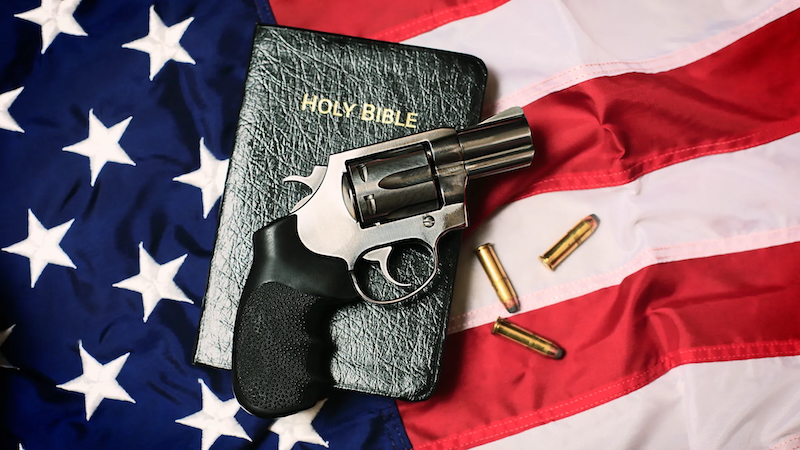
(Image source: CaseyHillPhoto/Christianity Today)
I encountered Jesus Christ at church. Then I uncovered an arsenal there.
I was worship leader at an evangelical megachurch in my native Massachusetts when the bass player for the church’s band showed up for rehearsal with a 9mm semiautomatic handgun. Later, I learned that his wife also carried a concealed weapon in her purse. They weren’t the only congregants showing up armed at the altar. Even the pastor confessed he kept a gun at home for personal protection.
It was a startling revelation—in 35 years of personal experience with evangelical Christianity, I’d never seen anyone bring a gun to church—and it roused me to launch a full-scale investigation. I spent 18 months immersing myself in white Christian nationalism, which forms the bedrock of U.S. gun culture: a fringe ideology less than a decade ago, but now a core value of the MAGA movement. I sought out and interviewed gun rights advocates—in particular, professing Christians who see nothing wrong with mixing God and guns—and even joined the National Rifle Association to learn more about the shadowy nexus of faith and firearms. What I found was deeply troubling: the Americans who own the most guns aren’t hunters or veterans or cops—they’re white evangelical Christians.
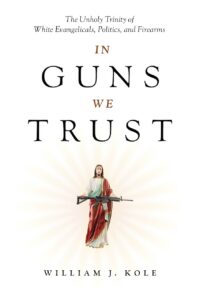 As I report in a new book, IN GUNS WE TRUST: The Unholy Trinity of White Evangelicals, Politics, and Firearms, we are awash in weapons. The U.S. has more guns than citizens—120 firearms for every 100 people, according to the Switzerland-based Small Arms Survey—and nearly five times more gun dealers than McDonald’s restaurants. Little wonder that our country is bloodied by more mass shootings than there are days in the year.
Yet what few realize is how many of these weapons are owned, concealed, and carried by those who profess to uphold life as sacred: white “born-again” Christians.
Fifty-four percent of white evangelical Protestants keep guns in the home, according to a 2022 survey by the nonpartisan Public Religion Research Institute (PRRI), compared with about a third of the general population. Gina Zurlo, who co-directs the Center for the Study of Global Christianity at Gordon-Conwell Theological Seminary in Massachusetts and edits the World Christian Database, thinks that’s an undercount and that closer to 65 percent of white evangelicals “own and regularly carry guns, even in church.” (In case you’re curious, only 10 percent of Muslims—who are all too often demonized in America as violent—own a gun, similar to the percentage of Jews who arm themselves.)
Statistically, the typical American gun owner is a cisgender, heterosexual, married white man who is politically conservative; middle-aged and middle-class; lacks confidence in the government; and lives in the rural South, West, or Midwest. He also considers himself individualistic and punitive, meaning he supports the death penalty for capital crimes such as murder. His guns—plural, as he usually owns more than one—are primarily for personal protection rather than for target practice or hunting. And he is often an evangelical.
Evangelicals also own and operate some of the major gun manufacturers. The AR-15-style rifle used to slaughter 21 innocents in Uvalde, Texas, in 2022 was made by Georgia-based Daniel Defense, established by an evangelical entrepreneur on a trinity of values: faith, family, and firearms. The company also manufactured some of the rifles used five years earlier in what is still the deadliest single mass shooting in U.S. history: a sniper’s massacre of 60 concert revelers on the Las Vegas Strip.
Perhaps most disturbing of all: because many white evangelicals have strong ties to President Donald Trump and the MAGA movement—and by extension, exert considerable influence on gun policy, reliably electing pro-gun politicians—they are blocking the commonsense gun restrictions that surveys show an overwhelming majority of Americans want: things like universal background checks and a ban on military-style assault rifles. And yet, since Uvalde, state legislatures have enacted more laws expanding access to guns than restricting it.
Evangelicals tend to see their Second Amendment right to keep and bear arms as God-breathed. Tightening access to firearms, they reason, is tantamount to rewriting holy scripture—something no self-respecting, God-fearing believer would dare contemplate. It’s an article of faith among many evangelical men that the Almighty expects them to be ready at a moment’s notice to defend themselves and their families against tyranny. Having a gun within easy reach fits that narrative perfectly, along with the patriarchy so many embrace and perpetuate.
Polls, meanwhile, consistently suggest a sort of white evangelical inferiority complex: a fear that their influence is waning and their religious beliefs are under fire. Too many respond by circling the wagons and arming themselves.
God and guns create a combustive mix that has given way to a locked-and-loaded Christianity—a brash rebranding of faith which pointedly ignores Christ’s teachings to turn the other cheek when confronted with violence. This in turn has produced a monumental shift away from the Christian traditions historically emphasized by mainline and progressive denominations, and personified by icons such as the Rev. Martin Luther King Jr. Rather than working to end poverty, bigotry, and racism, these evangelicals’ sense of mission and purpose all too often is reduced to a narrow, self-absorbed worldview in which their own welfare trumps concern for others. In Matthew 22, Jesus famously commands his followers to love their neighbors as themselves, but many white evangelicals’ love has grown as cold as the barrel of an AR-15.
In the runup to the 2024 elections, PRRI surveyed Americans about the greatest threats to democracy, and found strong support for political violence among those who insist the United States is a Christian nation. More than three in 10 white evangelicals agreed with the statement: “Because things have gotten so far off track, true American patriots may have to resort to violence in order to save our country.” Although a minority within their own cohort, among the nation’s estimated 60 million evangelicals, this militant third still comprises a bloc that’s nearly 20 million strong.
The United States has the dubious distinction of being by far the most religious and the most armed of all the wealthiest Western nations. And armed extremist militias and other fringe groups whose members at least nominally identify as evangelicals pose the biggest threat. “The growing presence of firearms in political spaces in the United States endangers public health, safety, and the functioning of democracy,” researchers at the Johns Hopkins Bloomberg School of Public Health’s Center for Gun Violence Solutions conclude in a recent report, warning that the threat of armed insurrection is rising.
Bottom line: America is a virtual armory sitting atop a powder keg of Christian nationalism. And white evangelicals are holding the match.
I was New England bureau chief for The Associated Press when a gunman armed with a military-style assault rifle massacred 20 first graders and six adults at Sandy Hook Elementary School in Newtown, Connecticut. Our teams spent more than six gut-wrenching weeks intensively covering the story. Meanwhile, Americans across the political spectrum clamored for change, and our collective outrage produced a momentary glimmer of hope. Surely the slaughter of so many innocents would be a tipping point: a transcendent moment we’d all look back on as the day we permanently holstered our weapons, came together to pass sensible gun control legislation, and reclaimed our sanity.
And it was, for a few days. My own church dimmed the sanctuary lights and convened a somber prayer meeting. We wept for Sandy Hook’s children and our own, and we cried out for healing and mercy. We, like so many in the aftermath of such tragedies, sent our thoughts and prayers to the families and survivors of the tragedy. And then we spoke of it no more.
That’s how it is with “thoughts and prayers”: the fleeting good intentions with which the proverbial road to hell is paved. Such words absolve us from doing anything to make sure such a horrible event never happens again. But if you really give a damn, you do something.
I’ll confess that all of this has rocked my world. A lapsed Catholic and avowed agnostic in my youth, I stumbled into evangelical Christianity in my final year at college and went all-in, even serving for three years as a lay missionary in Europe. Gradually, though, I distanced myself from the movement because of its harsh positions on immigrants, LGBTQ people, and the poor. Guns were the last straw. Today, I’m deconstructing my faith as an “exvangelical.”
As I write in the pages of IN GUNS WE TRUST, with apologies to the band R.E.M.:
“On my darkest and most cynical days—when my faith, like that of the doubting disciple Thomas, falters—that’s me in the corner, losing my religion.”
Cynicism, though, won’t save us from ourselves. Only optimism and activism can accomplish that. These convictions power one of my central arguments: we’ll never stop living—and dying—this way unless we find ways to engage, deliberately and intentionally, with white evangelicals on the gun issue.
Evangelicals are no more a monolith than any other cohort of Americans. Many, to be sure, have succumbed to the fear factor that’s driving gun sales and ultraconservative politics. But some are persuadable. I’ve had some success simply by asking them, What are you really afraid of?, and then listening thoughtfully.
We can also draw inspiration from the growing list of nations that have mustered sufficient courage and resolve to address their own gun violence problems.
Australia was first, in 1996, after a gunman killed 35 people and wounded two dozen others. Mass shootings there were virtually unheard of until this past December, when terrorists fatally shot 15 people and wounded dozens more who were celebrating Hanukkah on Sydney’s popular Bondi Beach. Undeterred, Aussies again sprang into action, tightening access to guns even further.
The United Kingdom and New Zealand followed. In 2020, despite the complexities posed by the pandemic, Canada banned more than 1,500 models of assault-style rifles. Since then, in rapid succession, Norway, Finland, and Serbia have cracked down on firearms access. The latest is Austria, which suffered its worst mass shooting since World War II this past June, when a gunman entered a school, killing nine students and a teacher and wounding 11 other people. Lawmakers, determined never to see a repeat, have greatly tightened access to guns.
As part of my research and reportage for IN GUNS WE TRUST, I visited the Scottish village of Dunblane, in some ways still reeling from its own unthinkable version of Sandy Hook in 1996. I wept as I walked in a light rain through a memorial garden for the 16 children who were slain and for the teacher killed trying to shield them. Back at my hotel, I scribbled down my thoughts:
Memorials like this—gardens and sculptures and cemeteries and trees and collections of stuffed animals, in memory of the victims of school shootings—can be found across America.
The list is agonizingly long: San Bernardino, California; El Paso, Texas; Newtown, Connecticut; Aurora, Colorado; Orlando, Florida; Charleston, South Carolina; Littleton, Colorado; Virginia Beach, Virginia; Coral Springs, Florida; Las Vegas, Nevada; Parkland, Florida. More are in the works in Buffalo, New York, and Uvalde, Texas.
Yet in all of Britain, there’s only one. This one.
In the days after the Dunblane school shooting, Parliament, spurred on by parents of the slain children and a scandalized public, swiftly outlawed the private ownership of most handguns and semiautomatic weapons.
There hasn’t been a mass shooting at a school in the U.K. since.
In my own vision of the future, of a U.S. that has finally broken free of its fealty to firearms, I reimagine the evening that my bass player brought his 9mm semiautomatic to worship practice. In the redeemed version of that story, there is no gun. There are no bullets. There is no holster. There is no fear. The objects of the highest caliber and capacity are Christian charity and compassion.
In this future we could build together, if somehow we could summon the collective will to do so, there is no yellow crime scene tape. There are no plastic numbers marking the locations of spent shell casings; no chalk outlines of human beings on the pavement.
There is only logic—and love.
William J. Kole is an editor for Axios and a longtime former Associated Press foreign correspondent who has reported from Europe, Africa, and the Middle East. Kole is the author of IN GUNS WE TRUST: The Unholy Trinity of White Evangelicals, Politics, and Firearms.