Waiting on November
Muslim migrants trapped in Mexico are pinning their hopes on the U.S. midterms. History suggests they shouldn't.
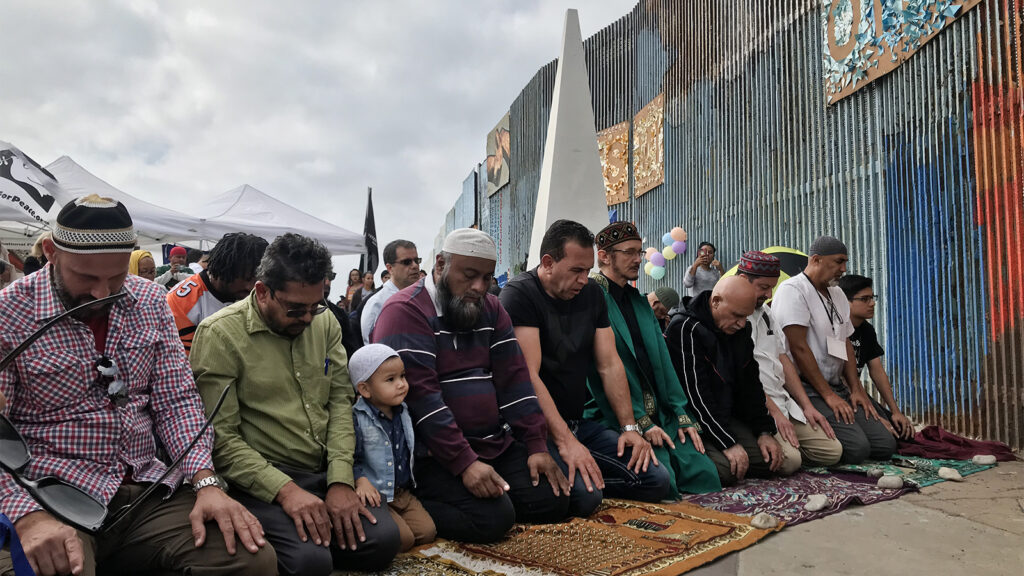
(Muslims pray at the United States-Mexico border in Tijuana. Image source: Religion News Service/Alejandra Molina.)
When Mag and I first met, all I heard was a shout.
As I walked up to Albergue Assabil, the first shelter for Muslim migrants on the U.S./Mexico border, he yelled in my direction asking why I was there.
The 33-year-old Mag (short for Magomed, a Russianized form of Muhammad) was leaning on a white pick-up truck in a black hoodie and matching sweatpants sporting a full, more-than-fist-length reddish beard with a slight white streak running down the side. He had been in Mexico since December 2024. Originally from Dagestan, a federal republic of Russia located in the North Caucasus region, he was on the road for two years since leaving his family back home for reasons he consistently referred to as “complicated.”
He arrived in Tijuana just before the border shut down completely in January 2025. He’s been stuck there since.
Now he spends his afternoons at the shelter, a few blocks from the rust-colored bollard fencing that marks the U.S./Mexico border, close enough to the wall to see the drag roads that Border Patrol trucks use to police the 50-to-100-foot no man’s land known as the “zone of enforcement” between the barriers on the Mexican side and those in the U.S.
Even with that view, so close and yet so far to his goal of living in Los Angeles, Mag is, by his own reckoning, waiting for one thing: November.
The 2026 U.S. midterm elections are still weeks away, but Mag — like many other migrants waiting in Mexico — has pinned his hope for a different life onto a single date on a calendar.
Like most at Assabil, and thousands more scattered across cities like Tijuana, Tapachula, and Mexico City, Muslim migrants who arrived in the last two years have adopted a shared shorthand for the future.
They are, as Mag put it to me, “waiting on November.”
But as Mag himself would admit, waiting may not be enough – and the democracy he hopes will self-correct and open a pathway for his presence may leave him and many others like him disappointed come December.
A Trapped Population
Humanitarian researchers over the last decade have called Mag and his compatriots at Assabil an example of “trapped populations,” people who cannot move forward, because the destination country has sealed its doors, and cannot return, because the reasons they left have not abated — let alone disappeared.
As one 2019 analysis put it, strict border controls mean that even migrants whose situations would qualify them for legal protection, such as asylum seekers, “often cannot access it and instead become trapped on the wrong side of a border they cannot cross.”
In such places as northern Mexico, the middle of the Mediterranean, northern Bangladesh, or northwest Turkey, populations of people are “stuck at, or drifting between, impenetrable borders, often with no way to escape to safer counties or to access help.” While waiting, they are exposed to a familiar catalogue of harms — trafficking, exploitation, and violence, compounded by the fact that their irregular status often means local populations and authorities don’t recognize or respect their presence.
Researchers studying such populations have reached for a wide vocabulary to describe them, with migrants variously called “stuck,” “entrapped,” “immobilized,” “stranded,” “locked up,” or “imprisoned.”
Olga Odgers-Ortiz, a sociologist at El Colegio de la Frontera Norte in Tijuana, argues that migrants in Mexico have entered what she calls, “the era of entrapment” — la era del atrapamiento migratorio.
In her analysis, entrapment is a specific condition where people are “forced to wait” in a place they did not choose and are compelled to remain “for an uncertain period while en route to achieving a goal.” More than merely being delayed, they suffer from a “structural stuckness,” produced deliberately by policy on both sides of the border.
Whatever its name, it is the condition in which Mag and others now live. They are not passing through Mexico. They are stuck in and around, up and down the country, in shared apartments, shelters, and rented rooms along Mexico’s migration corridor.
The Date That Changed Everything
Their stuckness has a start date as well. For most of the migrants at Assabil and shelters like it, it is January 20, 2025.
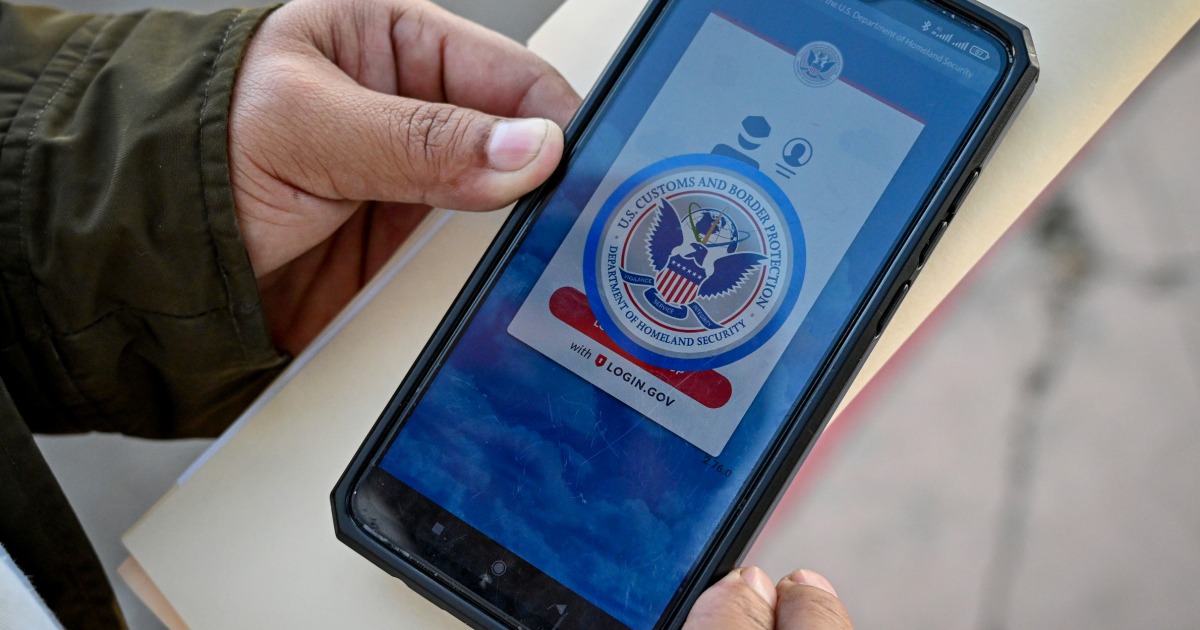
On his first day back in office, President Donald Trump shut down the U.S. Customs and Border Protection One Mobile Application (CBP One), the Biden-era system that let migrants south of the border request and schedule asylum screenings at official ports of entry. The app, for all its ills, processed hundreds of thousands of people.
By the government’s own accounting, more than 936,000 appointments were scheduled between January 2023 and December 2024. But when it went dark, every pending appointment was instantly canceled. Many of those whose appointments disappeared had organized and sacrificed months of their lives — and, for many, thousands of dollars paid to smugglers — to reach the border in time. Migrants at ports of entry across the border watched the app’s notification window change in real time, in whatever language they’d set it to, to tell them their appointment no longer existed.
(Image source: ABC/Getty)
For migrants who arrived in the final weeks of 2024 — betting, reasonably, that the system they read about would still exist when their number came up — the timing was brutal. They left home under one set of rules and arrived under another.
Abdul-Rahman, a 42-year-old Ghanaian man, arrived in Tapachula, Mexico in November 2024. He thought he still had a chance to get to the U.S. to join friends in the Mid-Atlantic region. He made his way from Ghana to the Caribbean, then to Guyana, Suriname, and Brazil, before crossing through Bolivia, Peru, and Colombia en route to the Darién Gap — the treacherous 60-mile (100-km) stretch of dense jungle, swamps, and mountains connecting Central and South America. Showing me videos on his phone, first with a smile as he splashed through the river and then, with fear and trepidation as he and others realized they would be spending the next 11 days in the tropical forest, sleeping on palm fronds and drinking from the very river they were trodding through. It was, he said, the hardest thing — by far — he had ever done in his life.
The journey was not over from there. Dumped out of the Darién Gap into a house in Panama for four days of tense waiting, he then continued trusting guides (guías) to help him navigate Central American highlands and cities, with some areas more friendly to migrants than others. Arriving at the Rio Suchiate on the southwestern border between Guatemala and Mexico in mid-November, he realized he was running out of time. The news came as he waited in the Guatemalan forest that Trump won the 2024 presidential race.
His hopes not yet dashed, he crossed the river at night via a raft strung together out of fence posts and tractor tires. A day later, he was sleeping in Tapachula at an apartment where other Ghanaians gathered in hopes of attaining a coveted CBP One appointment.
In late 2023, Mexico temporarily stopped issuing humanitarian visitor cards that granted free travel across the country to all asylum applicants. Because of this, asylum seekers were often legally required to remain in the state of Chiapas and apply for a CBP One appointment from Tapachula.
So, Abdul-Rahman bought a local SIM and, every morning, he would open the app, stare into his phone camera for the mandatory facial recognition scan and submit his request for an appointment at a U.S. port of entry. Every afternoon, when the daily lottery results were released, he received the same notification: No appointment granted.
As the weeks dragged on, Abdul-Rahman was burning through what savings he had left and was ducking authorities from the Mexican National Migration Institute (INM), which were patrolling the streets. Because he wasn’t registered with Mexico’s asylum agency (COMAR), he had no legal right to be in Tapachula. He lived in constant fear of being detained and bused back to the Guatemala border. To survive, he took informal, under-the-table jobs washing dishes, keeping his head down whenever a green-and-white INM truck passed.
And so it went, for two months, until January 20, 2025, when Trump issued an executive order that terminated the CBP One appointment scheduling system, rebranding the app “CBP Home,” which was stripped of its scheduling functionality, and explicitly repurposed as a tool for “self-deportation” where migrants could voluntarily register to leave the U.S.
Officially stuck, Abdul-Rahman registered with COMAR and has been in Mexico ever since.
Who Comes to Mexico, Stays in Mexico
Because nearly half of all asylum claims filed in the country are lodged at the COMAR office in Tapachula, which sees thousands come through its gates every day, average processing times have stretched toward six months or even a year. While their cases are pending, asylum seekers are generally barred from leaving the state and must return every two weeks simply to sign in and prove they haven’t left. Miss too many signatures, and the claim is abandoned.
Such intense containment policies and bureaucratic bottlenecks in Tapachula were directly driven by U.S. political pressure. Throughout 2023 and 2024, the U.S. leveraged economic and diplomatic pressure to compel Mexico to act as a buffer zone, effectively shifting the responsibility of stopping northern migration onto Mexican authorities.
And in the lead-up to the November 2024 U.S. presidential election, irregular immigration was a highly contentious political vulnerability. To reduce high encounter numbers at the U.S. southern border, the Biden administration pressured Mexico to clamp down on transit migration. Mexico responded by dramatically ramping up domestic enforcement. By October and November 2024, Mexican authorities were regularly intercepting and apprehending more migrants within their own borders than U.S. authorities were at the U.S. border.
Whither Democracy?
It may be tempting to read this as a story about one president’s decisions or one administration’s policies. But it’s more than that. The less-satisfying truth is that U.S. immigration policy has lurched under presidents of both parties for more than three decades, and each lurch has stranded a fresh cohort of people mid-journey.
The Obama administration deported more people than any prior administration while also creating Deferred Action for Childhood Arrivals (DACA). The first Trump administration built the “Remain in Mexico” program, formally the Migrant Protection Protocols, which returned roughly 70,000 asylum seekers to wait out U.S. court dates in Mexico. The Biden administration ended Remain in Mexico. Then, facing record border crossings, effectively replaced it with the 2023 “Circumvention of Lawful Pathways” rule, which made CBP One practically the only sanctioned route to request asylum at all.
Each of these changes were defended by their authors as more orderly, more secure, or more humane than what preceded them. Each also had the effect, intended or not, of moving the goalposts for people who were already mid-transit — people who, unlike the policymakers rewriting the rules, cannot simply wait out a bad news cycle.
Mag blames various people he sees as responsible for having to leave his friends, his barbershop, and his mother back home in Dagestan – Putin, local authorities, and federal security forces (siloviki) chief among them.
But he blames the U.S. for his and others’ current situation in Tijuana. “It is because of America that many of us are here in the first place,” Mag said, “and because of America that many of us cannot leave.”
This was, in part, why Mag wondered out loud to me in our conversations about the state of democracy in the U.S. On the occasion of July 4th — the country’s Semiquincentennial, celebrating 250 years since the Declaration of Independence — he mused on school shootings and Immigration and Customs Enforcement (ICE) detentions, corruption, and the growing gap between rich and poor. “To be honest,” he said, “it doesn’t seem that much different from Russia sometimes.”
Whether or not the U.S. is a functioning democracy is not Mag’s only question, of course. He also wondered if people on the other side of the border really have a choice in things and, if they do, whether or not they care about the impact that vote has on people like him.
The question he did not ask, perhaps because it is more painful — whose vote, cast in a country he cannot enter, decides if he can build a life?
Democratic accountability, the idea that policy bends to the will of an electorate, is supposed to be a source of stability and legitimacy. For a trapped population like Muslim migrants at America’s borders, it is the opposite. An electorate miles away, most of whose members have never heard of places like Dagestan or Tapachula, will decide the fate of thousands of migrants — not only this November, but in numerous Novembers to come.
But migrants like Mag have no vote, no lobbyist, and in most cases no lawyer to let it be known that their lives hang in the balance based on which box is ticked and which policies are put in place.
What November Holds
It is also worth asking, of course, how realistic such hopes are that hinge on this November’s midterms.
Based on the evidence, not very.
First, immigration policy doesn’t change by executive mood alone — it changes by legislation, and legislation requires Congress, and undoing a presidential policy by statute requires enough votes to override a veto.
Reporting from Houston Public Media on Temporary Protected Status (TPS) holders (a different but related population, awaiting the same election for a different reason) lays out the math. Democrats would need commanding majorities in both the House and Senate, since overriding a presidential veto requires two-thirds support in both chambers. Absent that scale, a change of committee chairs in a closely divided Congress does very little for someone standing outside a shelter in Tijuana.
Second, immigration is not a message Democrats are eager to run on. An NPR analysis of 2026 campaign advertising found that Republicans are spending significantly more money and running more ads on immigration than Democrats this cycle. Though there’s been talk of reining in ICE in states with heavy enforcement activity — New Jersey, Illinois, Minnesota — Democratic campaigns have largely moved past immigration to issues like affordability or health care, where they see clearer pathways to victory.
In other words, whether or not there is a decisive Democratic sweep, the odds are the border will remain effectively closed.
Things are still at stake in November, of course. Congressional control can impact funding and oversight, whether TPS survives for the populations that already have it, whether ICE can be reined in, and if departments processing asylum cases get more staff or fewer.
But the specific hope animating conversations and hanging on inshallahs at Assabil — that a change in D.C. reopens a door that a president slammed shut in January 2025 — asks the U.S. electoral system to do something it was not built to do, and that neither party is presently promising.
July 4th in Tijuana
Talking with Mag that July 4th, we discussed what he will do if November does not bring what he hopes. “Then I will have to make a stand,” he says. “Stay here or risk going into detention.”
What he means is that he will either have to make his way in Mexico or rely on human smugglers (coyotes) to drop him into the “enforcement zone,” the areas of sovereign U.S. soil that sit between the primary and secondary border fences, or heavily fortified “National Defense Areas,” patrolled by the U.S. Military. There, he would wait to be picked up by Border Patrol. He would then enter a heavily accelerated administrative pipeline involving immediate biometric, medical, and background screening, property seizure, and transfer to ICE custody and transport either to a high-capacity migrant holding hub or detention facility.
Migrants from nations with active repatriation agreements (such as Mexico or Central American countries) are frequently issued a formal deportation order and flown or bused back across the border within days in a process known as “expedited removal.”
For migrants from “hard-to-repatriate” nations (e.g., specific Asian, African, or South American countries — or Russia), deportation is more complex. Due to strict federal policies and limits on bond hearings, these individuals are held in administrative detention facilities for weeks, or months or even years, while deportation logistics are finalized.
Mag doesn’t want that. So, he’ll most likely remain in Mexico.
Khabril, however, has other plans. And he isn’t waiting. He’s heading over the border tonight. “It’s July 4th, it feels appropriate,” the young Iranian tells me outside Assabil — where he has only come by to say goodbye to a few friends, never having registered with the shelter’s staff. He’s waiting for a text from the coyote to whom he will pay a fee. The plan is for him to be dropped somewhere in the enforcement zone at night or early in the morning. He even hopes to catch a few fireworks while he waits for Border Patrol agents to take him into custody.
Our conversation is brief, as is Khabril’s time in Tijuana. “He lacks patience,” Mag mentions to me after Khabril gets the text and departs. “If there is one thing I’ve learned here, it is patience.” Referencing a passage from the Quran, Surah An-Nahl 16:127, Mag said, “and bear with patience, and your patience is only because of the help of Allah.” Mag says that while Assabil has been a place of waiting, it is also a place where migrants build daily practices of prayer and reinterpret their suffering to survive months or years without a fixed horizon.
With that, Mag goes to pray toward Mecca in a shelter two blocks from a wall he cannot yet cross, waiting on an election in a country that has not decided whether it wants him, run by two parties that, per the evidence, are unlikely to change his situation regardless of who wins.
That night, I watch from Tijuana as fireworks pop and sizzle their way through the sky on the other side of the border and see a single, small rocket fly up from the neighborhood where the shelter sits and migrants wait. Wondering if he can see those fireworks, I think about Khabril — and Mag and Abdul-Rahman and hundreds of others I’ve met in Tijuana, Tapachula, Mexico City, and elsewhere since I first started researching Albergue Assabil in 2022.
I also think about how, for people like them, democracy is less an abstract concept or a practiced possibility and more a schedule they did not set and a future adjudicated by voters they will never meet, who make decisions that will — as they have for decades — impact migrants’ lives forever.
Ken Chitwood is the author of Borícua Muslims: Everyday Cosmopolitanism Among Puerto Rican Converts to Islam. He is a postdoctoral researcher pursuing Habilitation with the Department for the Study of Religion at Universität Bayreuth, an Affiliate Researcher with the University of Southern California’s Center for Religion and Civic Culture, and a Visiting Scholar with the University of Edinburgh’s Alwaleed Centre for the Study of Islam in the Contemporary World.