"Unreconciled": The Shared Suffering of Clergy Sexual Abuse
A new play explores what a community knew about a priest who abused their children for years
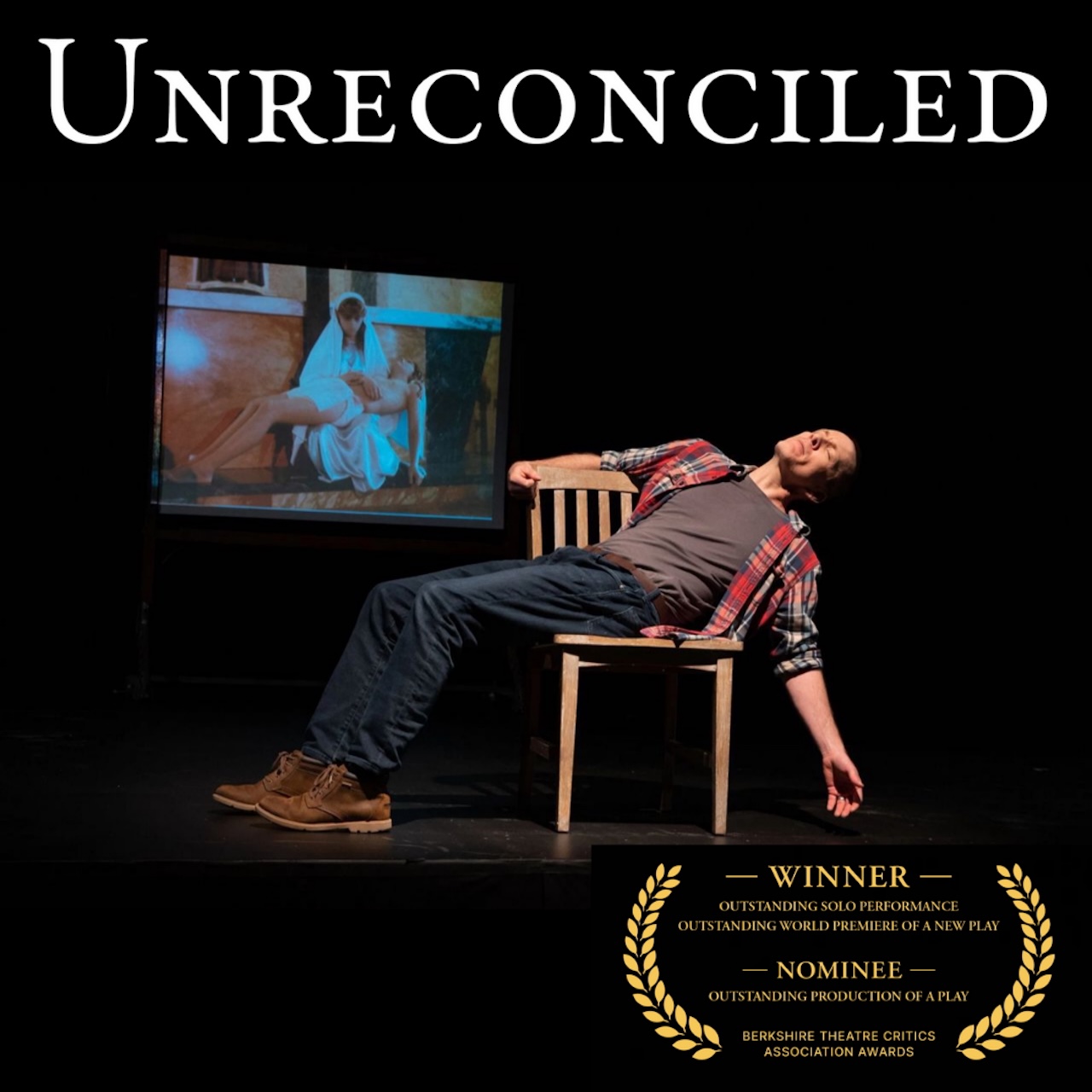
(Image source: The Barley Sheaf Players)
The play opens in Havertown, Pennsylvania. Footage from a 1985 basketball game projects overhead as our main character, Jay, remembers the zenith of his youth:
“This game is one of the biggest upsets in sports history, and I feel like I am a part of it. Like, maybe it wouldn’t have even happened if I didn’t care so much. I was thirteen when Villanova won the NCAA tournament and I was cast to play Jesus in an eighth-grade Passion Play at Annunciation. That spring, everything smelled of possibility.”
Over the 15 years that I’ve been working with survivors, few stories have hit me as hard as Unreconciled, Jay Sefton’s autobiographical play about Catholic clergy sexual abuse. (For clarity, I use “Jay” when referring to the character onstage, and “Sefton” for the real-life survivor-actor-playwright.) The one-man show has received critical acclaim since its 2023 debut, and it has now been staged nearly 100 times worldwide. Over the past year, I’ve traveled to performances in Pennsylvania, Ohio, and Massachusetts—each time entering the theater with my notebook, only to exit with a pile of tear-soaked pages.
While the specter of Jay’s abuse looms over the play, Unreconciled focuses more on its many witnesses, including classmates, teachers, parents, and other parishioners. Sefton even portrays his own abuser, Fr. Thomas J. Smith. It is this unique dynamic—the role that other community members played in one survivor’s abuse, as experienced (and now portrayed) by the survivor himself—that makes Unreconciled so extraordinary. By inhabiting all of these roles, Sefton drives home an essential truth that we typically overlook: clergy sexual abuse is a communal tragedy, not just an individual trauma.
Both Sefton and co-playwright, Mark Basquill, are also clinical therapists, and their broader expertise on PTSD and social suffering really shines in the play. We typically imagine abusers as monstrous outliers, and we tend to acknowledge only two types of “actors”: victims and perpetrators. But instead of dwelling in the legal categories of liability and fault, Unreconciled explores the ways clergy sexual abuse involves the entire faith community.
When viewed through this wider lens, audiences learn the pitfalls of imagining clergy abuse as some distant crime that only effects other people’s children. Far from being isolated to just his own life, Jay’s abuse implicates the shared culture, theology, and silence of his entire parish. By excavating this communal experience, Unreconciled uplifts the often-overlooked ways that everyday Catholics have created and sustained faith communities where abuse has flourished.
No Reconciliation after the Grand Jury Report
Within Roman Catholicism, “Reconciliation” is the formal name for the Sacrament of Confession. “Ego te absolvo,” Fr. Smith repeats throughout the play: “I absolve you of your sins.” But while the church might pretend that it has reckoned with the abuse crisis, Sefton calls our attention to the fact that many survivors are still waiting for healing and justice.
On the surface, the play’s title comes from Sefton’s experiences with the Independent Reconciliation and Reparations Program (IRRP). The Archdiocese of Philadelphia launched its IRRP in the wake of the 2018 Pennsylvania Grand Jury Report, which had sparked international outrage over Catholic bishops’ mishandling of abuse allegations. The IRRP process required survivors to document, justify, and ultimately sign away their abuse in order to receive monetary compensation from a relatively small settlement fund.
Payments from Philadelphia’s IRRP averaged $179,114 per survivor, an amount that is significantly lower than the penalties typically awarded in civil courtrooms. In total, the Archdiocese of Philadelphia spent $78 million on the program, 35% less than the $118 million cost they had expected and just a fraction of the more than $5 billion that American bishops have spent nationwide.
As we learn during the play, the IRRP’s impersonal, bureaucratic approach actually revictimized many survivors, including Jay. In a real-life op-ed, Sefton summarized the IRRP as a “fire sale of souls that preys upon the desperation of its victims.” The show’s title reflects the fact that Sefton is unreconciled with the institutional Church, especially its bishops and their lawyers.
As the performance unfolds, however, “unreconciled” takes on deeper and more complex hues, calling our attention to the other venues and relationships involved in a survivor’s lifelong quest for justice. Through visceral monologues and heart-wrenching flashbacks, the audience learns that Jay is also tormented by unresolved questions about the nature of faith and the silence of his parish community. These existential questions are constitutive of contemporary Catholic survivorhood. As Unreconciled underscores, the pain of not finding justice can be even more destructive than the abuse itself.
Worshipping Christ’s Suffering
Each spring, for nearly three decades, Fr. Smith directed his version of the Passion—the drama of Jesus’ final days, culminating in his crucifixion—at schools and churches across greater Philadelphia. From 1982-1987, the production was staged at Sefton’s parish, Annunciation of the Blessed Virgin Mary.
In 2003, another boy at Annunciation testified to Pennsylvania’s first grand jury on clergy sexual abuse, describing a pattern of abuse that was shared by most of the kids who were cast as Christ. Fr. Smith typically forced each Jesus into a locked room, made them undress before his kneeling face, sexually abused them, then pricked them with pins until they bled onto their loincloth—the sole article of clothing they were allowed to wear during the crucifixion scene.
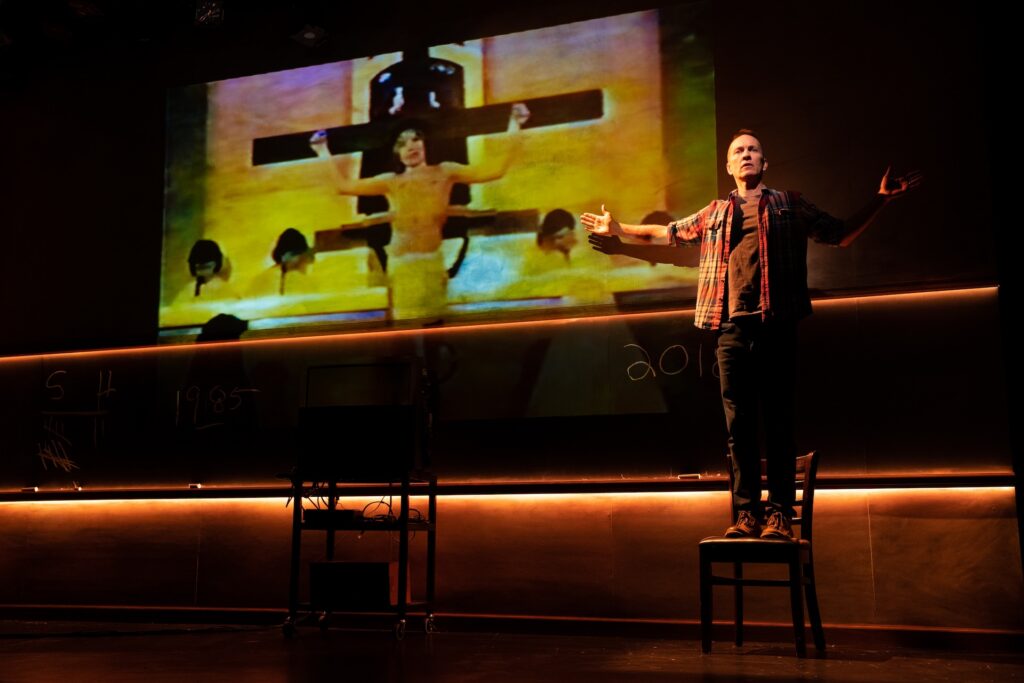
(Photographed by Andrew Greto, Courtesy of Jay Sefton)
The grand jury emphasized that Smith perpetrated his crimes under the guise of instructing the boys to “live the part of Jesus.” In Unreconciled, however, Jay’s emulation of Christ does not come across as a mere pretense. We learn that everyone—Fr. Smith, the boys, their female classmates, and the parishioners who came to the performance year after year—shared a deep and sincere value for the reenactment of Christ’s suffering.
Fr. Smith was transferred to another parish in 1987. In spite of a decades-long trail of rumors and complaints, he was even promoted to Regional Vicar. The Archdiocese of Philadelphia’s mishandling of Fr. Smith became a focal point of the criminal charges that state prosecutors later brought against Monsignor William Lynn, whose 2012 trial represented the first effort by American courts to hold Catholic officials accountable for ignoring and enabling abusive priests.
Lynn’s trial revealed that the Archdiocese had allowed Smith to remain an active priest even after formal allegations were filed in 2002. Several years later, they removed Smith from ministry, and in 2007 he was finally laicized by the Vatican. In 2022, after more than a decade of appeals and retrials, Lynn’s felony conviction was downgraded to a misdemeanor—yet another blow to Smith’s victims.
An Exhilarating Role
As Sefton’s Fr. Smith tells the audience, “AUTHENTICITY. That is what we are going for here. When we talk of the passion of the Christ, we must feel what He felt.” In the play, the audience gets to witness this authenticity through archival video clips, as captured by a professional videographer who Smith hired to document Jay’s 1985 performance.
The clips show us exactly how 13-year-old Sefton portrayed Jesus: washing the feet of his disciples; consecrating the Last Supper; hanging on the cross. As each of these scenes are projected overhead, adult Jay reenacts the role in front of us, reciting in unison with his eighth-grade self: “This is my body; eat it in remembrance of me. And this is my blood, poured out for you.”
But, like any great tragedy, Unreconciled also has moments of comedy, particularly when Sefton interrupts this pious footage with the ad-hoc perturbations of early adolescence. For example, as we watch him being nailed to the cross, Jay recalls thinking, “I wish I had hair under my arms” like the other boys.
Minutes later, when the Virgin Mary—played by Jay’s eighth-grade crush, Lisa Boyle (a pseudonym)—cradles Jesus at the foot of the cross, Sefton again lets the audience know that neither Jesus’s suffering nor Smith’s abuse were the only things on his mind:
“God, she smells amazing! Did she wear that just for me?… She just moved her hand, tingles shoot everywhere. This is worth it, this is so worth it!… A smile curls on her lips. Yes, she’s definitely into me! I think I’ll ask her out.”
Each time I’ve seen the play, the audience laughs at Jay’s narration here, but this scene also does some heavy lifting. By calling attention to his adolescent hormones, Sefton steadfastly refuses to accept the societal expectation that victims must deny their own sexuality. (Within our traditionally patriarchal framings of sexual assault, a victim who admits any sexual pleasure must have “been asking for it,” if not outright “wanted it.”) Far from hiding his youthful lust, Sefton draws our attention to the fact that he and his eighth-grade classmates were in the midst of a sexual awakening—a stage when their vulnerability should have been apparent to everyone in the community.
Communal Silence
During the first half of the play, Sefton repeatedly spares the audience from having to confront the full horror of his own abuse. By the time Jay takes us into the closet where he was abused—about halfway through the performance, via a brief stream-of-consciousness flashback—we’ve already heard the grand jury’s assessment of Smith’s sadism.
For me, the play’s most horrifying moment is at the end of that flashback, as eighth-grade Jay recounts what it felt like to step back into the world:
“I slip on the thick heavy robe that I start the play in, and fumble to unlock the door and leave the closet. A rush of cool air comes over me as my eyes adjust to the fluorescent lights. I see concern on the faces of the kids—not the parents, but on the faces of the kids. I don’t know if the parents are too scared to say anything, or if they are totally fucking fooled by this guy, but the kids aren’t fooled.”
Here, Sefton deftly communicates one of the hardest truths that I have learned from survivors: in many cases, other community members suspected—if not outright knew— that kids were being abused. Sometimes, other survivors have told me, it seemed like everyone knew—as was certainly the case, we now know, with Fr. Smith.
Unreconciled is an exquisite unearthing of this wider cultural knowledge—the innuendo and the knowing glances that were shared between classmates, friends, nuns, teachers, parents, and the broader parish community. Every character in the play inhabits the uncomfortable terrain between innocence and guilt; naiveté and complicity; passion and Passion.
From the viewpoint of survivors, most Catholics fall somewhere in between the irreconcilable roles of victims and enablers.
First, consider Jay’s classmates. Throughout the play, the audience gets brief glimpses of what they knew. In several scenes, one of his best friends, “Mikey,” repeatedly teases him about the abuse. “Yo Jay, yo Jay—you get blown by Father Smith yet?”
Then there are the nuns and parents. In one of the opening scenes, Jay’s teacher, Sister Mary Ann Paul, struggles to recruit other volunteers for the role of Jesus. And heartbreakingly, we now know, other adults also knew about Smith’s abuse—some firsthand, through the stories of their own children, and others secondhand, through gossip and rumors.
As the 2003 grand jury documented, even those families who reported Smith to the archdiocese maintained an unspoken code of silence. Parents who took steps to protect their own children did not warn other families.
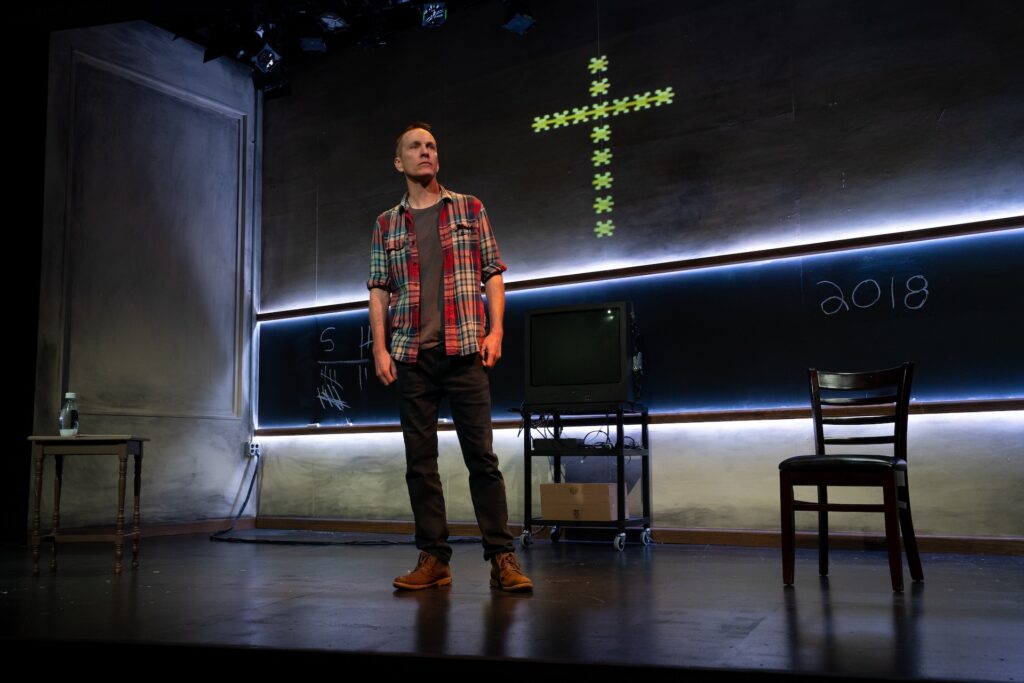
(Photographed by Andrew Greto, Courtesy of Jay Sefton)
When I asked Sefton about this code of silence, he reframed Catholicism’s longstanding culture of violence against children as an open secret:
“I often talk about it. If you just step back and look at the play itself, knowing what we know now—13-year-olds, mostly naked, year after year, hanging on a cross in front of the entire parish, lashed with real whips, and forced to get naked alone in a room with the priest—it’s like, how did we not know something was going on?”
What Jay and his classmates lacked, I contend, wasn’t the knowledge that Smith was a creep, but rather the language to describe a priest’s abuse within the culture of American Catholic life. While the word for “blowjob” might have been abundant in their 1980s vernacular, “clergy sexual abuse” was not.
In fact, the cojoining of “priest” and “sex” was long unspeakable for Catholics. The Church claimed that all clergy were chaste and celibate, and Catholic theology uplifted priests as semi-divine beings.
Even more importantly, many American Catholics wanted clergy to exert authority over children. All across the country, parents paid for Catholic schools precisely because nuns and priests promised discipline. As the preeminent historian James Fisher recently wrote, two essential components of twentieth-century Catholicism were teaching kids how Christ suffered and exerting physical dominance over their fragile bodies.
The Depths of Parental Guilt
Jay’s father, Joe, is the most loquacious character in Unreconciled. At the start of the play, he explains to us that “Jay-bird” got his name from Joe’s uncle, Monsignor John J. Sefton, whose priestly calling had honored the entire family. Provocatively, Joe is also the one who first names Jay’s horror for what it was:
“No one ever called what happened during the Passion Play ‘abuse,’ so I didn’t either. Until 2007, when I received an email from my dad with the subject line: THE BASTARD. ‘Hey, Jay-Bird, I just saw this in The Inquirer. Please call me. Love, Dad.’”
From that moment on, Joe became Jay’s biggest advocate: encouraging his son to step forward, hounding the archdiocese for transparency, and vociferously calling for justice.
But Joe’s character also wrestles immensely with his growing sense of guilt. Should he have noticed that something was wrong? Could he have stopped it? Was this what parents signed up for by sending their kids to Catholic schools? Joe’s irresolvable doubts define the play’s moral compass.
Jay’s mother, by contrast, seems to be stuck in eternal denial. When Jay has finally worked up the courage to speak with her about Fr. Smith, she reflexively snaps, “Do you think you were abused? Because I don’t!” Through her ensuing monologue, we learn that Jay’s mom had overlooked some now-obvious warning signs, including Jay’s unbridled fury after travelling with Smith, his uncontrollable temper during the Passion play, and his urgent demand that she stop inviting Smith to dinners at their home.
With considerable subtlety, however, Sefton also hints that his mother—and other Catholic parents, more broadly—might have had their own reasons for complicity and inaction. “I think people nowadays are just looking to be victims,” Jay’s mom complains to the audience, “But I don’t think they really know what it means to be one—to be abused.”
Sefton’s portrayal of his mother is thus both tender and unsparing. What emerges is a tragic portrait of intergenerational suffering, wherein even parents who understood the dangers of child abuse nevertheless failed to protect their own kids from the Church.
Our Shared Complicity
Lest we’re tempted to “blame the mother for everything,” as Jay’s Mom quips, Sefton reserves his most unflattering characterizations for the Church—not only for the bishops and their lawyers, but also for the many everyday Catholics who continue to ignore victims and survivors. In the play, the character “Maureen” represents the many Catholics who still deny the fact that priests harmed children within their own communities.
In the penultimate scene, Maureen is smoking outside of the church while talking to Joe’s ghost, who has come back to attend Mikey’s funeral mass—the same Mikey who was Jay’s friend from eighth grade, the one who ribbed him about Smith. Mikey, we learn in this scene, ended his own life after the 2018 Grand Jury Report. (Victims of clergy sexual abuse are much more likely to commit suicide, and many Catholic survivors have taken their own life even after coming forward publicly as adults.)
But even as Maureen reminisces with Joe’s ghost about Mikey and Jay’s childhoods, she is unwilling to see the past for what it was:
“Really nice of the church to let ‘em have his funeral here…Ya know, I still called him Mikey when I seen him?—like as if he was a kid. They tell me Mikey jumped off the Commodore Barry Bridge—so sad. I don’t know if youse heard, but a lot of people are sayin’ they shouldn’t let ‘em have the funeral here—in case it was a suicide and all. I thought the Church was very forgiving in that. Especially after what he said about Father Smith. I remember Father Smith. He was a very kind man, sermons that were short, sweet, very optimistic. I liked that! And those great plays—right?”
Unable to bridge the chasm between Maureen’s memories and the reality of Jay’s abuse, Joe’s ghost quietly assents to her version of history. “Yeah,” he whispers.
The Healing Power of Theater
Given Unreconciled’s commitment to these hard truths, I worried that other people from Jay’s hometown might resent the play. But just the opposite has happened. Earlier this year, Sefton returned to Havertown to perform a two-week run. Every show was sold out.
When I asked Sefton what the Havertown performances were like, he described them as cathartic. Through the healing power of theater, Jay’s hometown has begun to voice secrets and suspicions that they had long kept silent:
“Every show was filled with former classmates, their parents, guys that played Jesus, and other people from my old neighborhood. I heard from parents who’d intervened on behalf of their own kids, and who’d kept their kids from hanging out with Fr. Smith because they knew something was up. But I don’t blame anyone. Like, we’re all human…we all have moments we wish we could change.”
In my conversations with Sefton this summer, the survivor-playwright was adamant in his refusal to criticize anyone from his adolescence—not his classmates, not his teachers, not his parents, not Fr. Smith, not even the “Maureens” of our world. Sefton’s ethical stance here—his radical empathy for everyone from his childhood—underscores the play’s most profound message: clergy sexual abuse is a shared tragedy.
Instead of condemning the characters from Jay’s past, Unreconciled examines the entire town’s suffering. Even if their collective silence enabled Jay’s abuse, the play invites us to reflect, what good does it do to blame an entire community?
Collective Trauma
Throughout Unreconciled, multiple characters warn us, again and again: “Attention must be paid.” The line comes from Death of a Salesman, Arthur Miller’s 1949 masterpiece that returned to Broadway this year. Linda—the spouse of Willy (the titular salesman)—laments to their children: “He’s a human being. And a terrible thing is happening to him. So attention must be paid. Attention must be paid to such a person.”
As a theater critic for the New York Times observed, “When people hurt, as Willy does, it is inhuman to look away.” To my ears, this is also the message Sefton is trying to communicate to Catholics today. Within Unreconciled, “ATTENTION” is a perpetual reminder, a mantra of sorts, which underscores how often we fail to notice, let alone engage with, the trauma and suffering of people who are right in front of us.
In the closing scene, Joe’s ghost laments the shared suffering that binds all of us to victims:
“My son may think this story, the one that youse are now a part of, is about him. Well, it’s only partly about him. It’s about you. It’s about me. It’s about everyone sittin’ in the pews, the audiences, sayin’ our prayers, putting our dollars in the collection plate…
How could we not have known? Really. What’s a grown man doing wrestling with my son? But I’m thinkin’ he’s a priest, like my uncle, a good man, doin’ the work of the Lord. And he spent a lot of time with the boys. A lot of time with them doing things that we overworked, underpaid fathers just didn’t have…
So, you let a priest wrestle with your kid in the living room. And you let your kid go to the Poconos, down the shore, and come home drunk as a skunk. And you let your kid play Jesus in the school play and stay in the tomb of his room for a month afterwards. And you let your kid—Oh, God—you let your kid go.”
This final monologue is its own modern-day Passion. All eyes are on the son, who now perseveres for and stands in the role of his dad. Merged into one by their shared suffering, the father and the son try to imagine what a real reconciliation might look like. The result is transcendent: a son—again onstage, but this time firmly in control of his narrative—forgives not only his father, but also his teachers, his classmates, their parents, even his abuser. In spite of its title, Unreconciled forgives us all, in the end, for having sacrificed generations of kids on the cross of American Catholic childhood.
Brian J. Clites is the Archbishop Paul J. Hallinan Professor II of Catholic Studies and assistant professor of Religious Studies at Case Western Reserve University. His current book project, Surviving Soul Murder (forthcoming, NYU Press), argues that survivors’ lived experiences are essential to understanding American Catholic culture.