Skeptic's Corner
The Myth of Meritocracy Is a Dagger in the Heart of Democracy
The secular faith in meritocracy, our democratic religion, is an acid eating through our democratic institutions
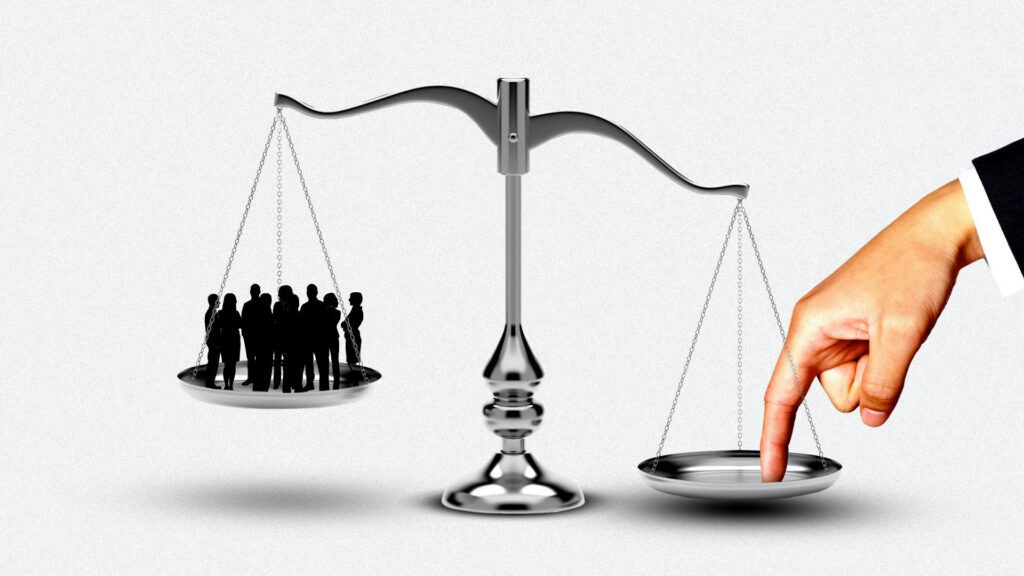
(Image source: Axios)
In the recent film Young Washington, a young man, left destitute and alone after the death of his father, looks to the frontier to make his fortune. And make his fortune he does, as surveyor, officer, fighter and, eventually, Father of his country. The film makes clear that, in America, anyone can succeed if they are dashing, determined, and willing to work hard.
Oh, and although the film does its best not to mention it, Washington’s success was also connected to him enslaving people to build his wealth.
Young Washington tiptoes around Washington’s “inheritance” of ten people he had enslaved because it wants the hero of democracy to have risen to prominence through effort, brilliance, and virtue—though merit. That’s because Americans love to believe that meritocracy is a core democratic principle.
As the story so often goes, in the benighted past, people (like British aristocrats) were born into an immutable social class, peasant or aristocrat, king or commoner, and those on the bottom were doomed by birth to remain oppressed with no hope of advancement. The democratic revolutions, however, changed all that, instituting freedom, equality, and opportunity for all. In our meritocratic democracy, there is no doom by birth, for everyone may rise through hard work, industry, and effort. As Benjamin Franklin said, “God helps those who help themselves.”
Or at least the phrase is often attributed to Franklin. In actuality it is much older. You even hear echoes of the phrase and the idea in the Book of Job, when his “miserable comforters” blame Job’s misfortunes on his spiritual and moral failures. “For the company of the godless is barren, and fire consumes the tents of bribery.”
Rather than being a democratic innovation, the myth of meritocracy has a longstanding pedigree. “You get what you deserve” is a popular idea, not least among those who are the most powerful. But popularity does not necessarily mean “democratic,” and in fact the rationalization of such outcomes—the belief that the best people (however defined) climb and the worst people (however defined) fall—is corrosive to any democracy. This meritocratic ideology justifies inequity and delegitimizes accountability. They tell us, for example, that the wealthy real estate heir and reality television star deserves to rule over us like a king because he is wealthy and famous.
“When you’re a star, you can do anything” is a statement of privilege and power. It’s also a claim to a certain kind of merit. And when those identified as meritorious can do anything, when democracy is about the impunity of the specially gifted, rather than about the rights of everyone, it isn’t democracy anymore. The secular faith in meritocracy, our democratic religion, is in fact an acid eating through our democratic institutions. If we want to save the country from demagoguery, from hate, and from fascism, we need to reject our deeply held, sacred conviction that success is its own justification.
Merit as Bludgeon
The belief that merit will always find its reward is a deeply entrenched American faith, and as such cannot really be disproven through statistics. Nonetheless, there is much evidence that this faith in meritocracy is false. In a 2022 policy brief, for example, economist Bhash Mazumder found that 60% of income differences between two families would be expected to remain a generation later, “suggesting that for a family living in poverty, it might take five generations before their descendants (on average) would be close to the national average of income.” The timeline for someone whose family lives in poverty to rise to actual wealth would be much longer than that. That’s a picture of a world in which merit weighs significantly less than one’s family’s wealth.
In his 2019 book The Meritocracy Trap, law professor Daniel Markovits goes even further, arguing that we are living in a dystopian age in which “meritocratic inequality comprehensively divides the rich and the rest, so that they each lead lives that the other can hardly recognize.”
Markovits believes that the meritocratic ideal in which hard work and intellect are rewarded has led the affluent, and the super affluent, to double, triple, and quadruple down on educational investments, pouring resources into their children who then go on to highly skilled, time-intensive, and astronomically well-paid jobs. Markovits estimates that the investment in elite education over the course of a rich child’s adolescence effectively functions as a massive bequest, but in the form of human capital rather than (as in earlier times) land. That massive investment is then rewarded with huge payouts; in 2024, CEO’s made 281 times the salary of the average worker. In 1965, they made only 21 times as much.
The ever-increasing selectivity of elite education means it is increasingly available only to the already rich; the median family income of a student at Yale was $192,600 in 2017. Those students then graduate with opportunities denied to almost everyone else. “Meritocracy undermines democracy, elevating the working rich into a ruling class,” Markovits concludes.
Markovits believes that our problem is not a failure of meritocracy, but its apotheosis. On meritocratic grounds, the children of the wealthy really do have more skills and more education because their families could afford to invest in human capital. As he sees it, the rise of Trump is an unfortunate but understandable backlash against this meritocratic class—a rebellion of the common (white) man against economic inequality and the moral injury of being told that that economic inequality is justified.
The Meritocracy Narrative of MAGA
Markovits doesn’t fully wrestle, though, with the ways Trump presents himself as a hyper-meritocrat. Trump, after all, spent decades marketing himself as a shrewd businessman whose wealth accumulated through his mastery of what his best-selling self-help book referred to as The Art of the Deal. Trump regularly boasts about attending the prestigious Wharton School and about the success of his television show The Apprentice, in which he played himself as a big deal boss. In 2019, deep into his first term, polls found a majority of voters believed he was a successful businessman.
Of course, you could argue that those voters were misled; Trump was the wealthy heir of a real estate tycoon and his business career is full of bankruptcies and shady deals. But (as Markovits points out) most successful meritocrats come from wealthy families.
In any case, the point is less whether Trump is really meritorious (of course he is not) and more whether he is seen as meritorious. He is by many. More than that, he frames his own political program as an aggressive, hyper-vindictive assertion of hierarchical meritocracy.
This is perhaps most obvious in Trump’s attacks on Diversity, Equity, and Inclusion programs. DEI initiatives were traditionally designed to boost hiring of historically marginalized groups, like Black people, women, and LGBTQ people. But Trump denies any marginalization ever existed. He signed an executive order which supposedly “ensures merit-based and efficient contracting and employment” by barring federal contractors from DEI practices. In effect, this casts suspicion on any company employing anyone who is not a white man.
Trump also pushed a range of companies and organizations to end DEI practices. One that folded shamefully was the American Bar Association, a pillar of snooty meritocracy that Trump attacked, not for being too elitist, but for being insufficiently meritocratic—since for him meritocracy and racism are one and the same.
In line with meritocratic thinking, Trump also assumes that poor people are lazy and must be disciplined. He has enacted brutal work requirements for Medicaid recipients—including for those in early-stage cancer or suffering from HIV—forcing them to work while sick or forfeit health insurance. The new laws also add administrative burdens to make sure that no unmeritorious shirking poor people are receiving benefits. Experts estimate that between 5 million and 10 million people will be pushed off Medicaid rolls in 2028. Poor people, from the view of Trump and his rich cronies, are slackers; if they weren’t, how could they be poor? The new requirements function as a devastating assertion of hierarchy in the name of meritocracy.
The Circle of Meritocracy
We Americans across the political spectrum often think of meritocracy as an antidote to entrenched power. If anyone can work hard and become successful, then ideologies that claim white people are naturally superior, or that men are naturally superior, crumble. Either you believe in merit or you believe in inheritable, God-given virtue, one or the other.
That seems logical. But logic doesn’t have a whole lot to do with how people think about the myth of meritocracy in practice. Donald Trump, for example, sees no contradiction between meritocracy and eugenics. Trump often babbles about how his (white) heritage ensures his success. “I had a good gene pool from the stand point of that so I was pretty much driven,” he said in one interview from before his political career. Similarly, he’s accused immigrants of having “bad genes,” which leads them to commit crimes. (Immigrants commit fewer crimes per capita than citizens.)
For Trump, genes determine industry, intelligence, and character, which yield success. Ergo, success reveals both good character and good genes.
But Trump is hardly alone in his belief that success demonstrates merit and that established hierarchies are therefore righteous.
Hollywood, for example, is generally talked about as liberal-ish in both right wing and mainstream media. Yet big budget movies often mirror Trump’s intuitions about heredity and virtue. Films like Aquaman (2018) and Black Panther (2018) are stories about rightful kings who defeat unsavory rebels; their virtue confirms their noble birthright, their noble birthright confirms their virtue, and then both are cosigned by their physical prowess in beating the snot out of their challengers. Nor are these aberrations; superhero and action movies in general celebrate individuals who succeed through superior intelligence, strength, and virtue; the narratives reward merit as defined by success and success as defined by merit.
Blockbuster protagonists inevitably have a plot arc where they must overcome self-doubt and learn to believe in their own goodness and awesomeness to defeat the villain and save the world. This kind of magical merit thinking—in which self-affirmation leads to and embodies virtue—fits neatly with that uber-American form of Christianity, the Prosperity Gospel.
Originating in early 20th century New Thought movements, pioneers of Prosperity Gospel like Protestant pastor Norman Vincent Peale embraced the “power of positive thinking,” whereby upbeat relentless optimism and hefty donations to church leaders ensure health, wealth, and God’s favor. Accident, illness, and privilege are all washed away as potential barriers; all that really matters is believing you will find success. And if you’re not successful, it’s your own fault for not believing hard enough; QED.
The Prosperity Gospel is hugely popular; one recent survey suggested that 3 of 4 churchgoers believe God wants them to prosper financially. But even that only hints at the reach of this kind of meritocratic thinking. Another metric is the $12 billion self-help industry, a veritable vat of meritocratic faith.
One extremely successful self-help guru is Jordan Peterson, a rabid right-wing pundit who advises people to “Walk tall and gaze forthrightly ahead” because “Doing so will not only genuinely increase the probability that good things will happen to you—it will also make those good things feel better when they do happen.”
Another is Marianne Williamson, who ran for the Democratic presidential nomination in 2020 and 2024 on a progressive platform including reparations and opposition to the genocide in Gaza. But as a peddler of self-help, she’s claimed that people suffering from AIDS need to “forgive everybody” in order to recover, and argued that “Excess fat is not just inert cellular tissue. It is a repository of twisted, distorted thoughts and feelings.” Illness and fat bodies are caused by spiritual failures—just as Health and Human Services Secretary and anti-vax crank Robert F. Kennedy Jr blames illness, not on germs, but on poor diet.
The throughline for all of these meritocratic comforters (of Job and of us today) is the same; individual success, health, and happiness is a gift of individual genes, virtue, faith, or organic food consumption. People get what they deserve—which means that if you fail, there is something wrong with you.
Meritocracy vs. Democracy
The myth of meritocracy as just deserts doesn’t undermine traditional hierarchies in the name of a more democratic polity. It buttresses them. In a society in which rich white, straight, able-bodied, Christian men succeed because of institutional advantages, meritocracy insists that poor people, Black people, women, LGBTQ people, disabled people, and fat people have all sunk to their natural level. If there is prejudice against them, it is deserved, for aren’t all hardships the result of one’s own free choices? Protest and advocacy—core aspects of democratic accountability—are delegitimized. As Jordan Peterson says, you must “Set your house in perfect order before you criticize the world.” And who among us has a house in perfect order? Only those with the funds to pay people to keep it so. That means that none of the rabble should ever criticize anything, since the only real failure and fault is in individual lapses in merit.
The myth of meritocracy also destroys the basic assumption of equality and dignity on which democracy depends. The Declaration of Independence states that “all men [sic] are created equal, that they are endowed by their creator with certain inalienable rights.” But meritocracy insists that we are not all equal—that some of us are better than others, and that therefore we do not all have rights. Instead, we all have opportunities. Those who seize those opportunities have shown they are the select and shall prosper. Everyone else goes on the dung heap with Job.
There are policy changes that could help undo the hammerlock that inequity has on our democracy. Markovits suggests denying charitable tax status to universities unless they “draw at least half of their students from families in the bottom two-thirds of the income distribution.” This would force a major expansion of enrollment and open up elite schools to a much wider range of students. He also recommends eliminating the social security payroll tax cap, which, among other things, subsidizes high earners, since businesses don’t have to pay the tax on most of their salaries.
These proposals and other approaches to income redistribution—a wealth tax, Medicare for All, raising the capital gains tax—could be effective at creating a more equitable society. But they all face an uphill climb.
That’s partially because the wealthy have disproportionate influence on policymakers. But it’s also because even those who are not wealthy have a huge ideological investment in the idea that success is a sign of merit and that merit leads to success. When Hollywood movies, presidents, religious leaders, and self-help books all trumpet the same doctrine, it’s difficult to find leverage to argue that it is harmful bunk.
If we want to salvage our democracy, though, we need to get rid of that harmful bunk. Fat people aren’t fat because they’re spiritually broken. Immigrants (who again commit crimes at lower rates than citizens) are not driven to illegality by bad genes. Successful people are not morally superior and don’t necessarily work harder than anyone else. A lot of life is luck; a lot of life is privilege. We are all better off if we focus on lifting everyone up rather than on justifying the fate of those who fall.
A true democracy isn’t claiming equality of opportunity and then rationalizing and sacralizing whatever ghoulish asshole happens to climb to the top of the heap. A true democracy is one in which everyone has enough food, education, stability, and dignity to participate in civil society and advocate for their own rights, and for everyone’s. If the republic is going to thrive, we need a faith in all of us, not just in superheroes, oligarchs, and kings.
Noah Berlatsky (he/him) is a freelance writer in Chicago. His poetry collection Not Akhmatova (Ben Yehuda Press, 2024) is about Jewish diaspora; his newsletter Everything Is Horrible is about politics, culture, and how everything is horrible.