The Antidote to Christian Nationalism Is Christian
Drawing on research in religious nationalism and democracy around the world, a scholar of American Christianity makes the case that defeating Christian nationalism will take a mobilized Christian resistance — joined by people of every faith and none
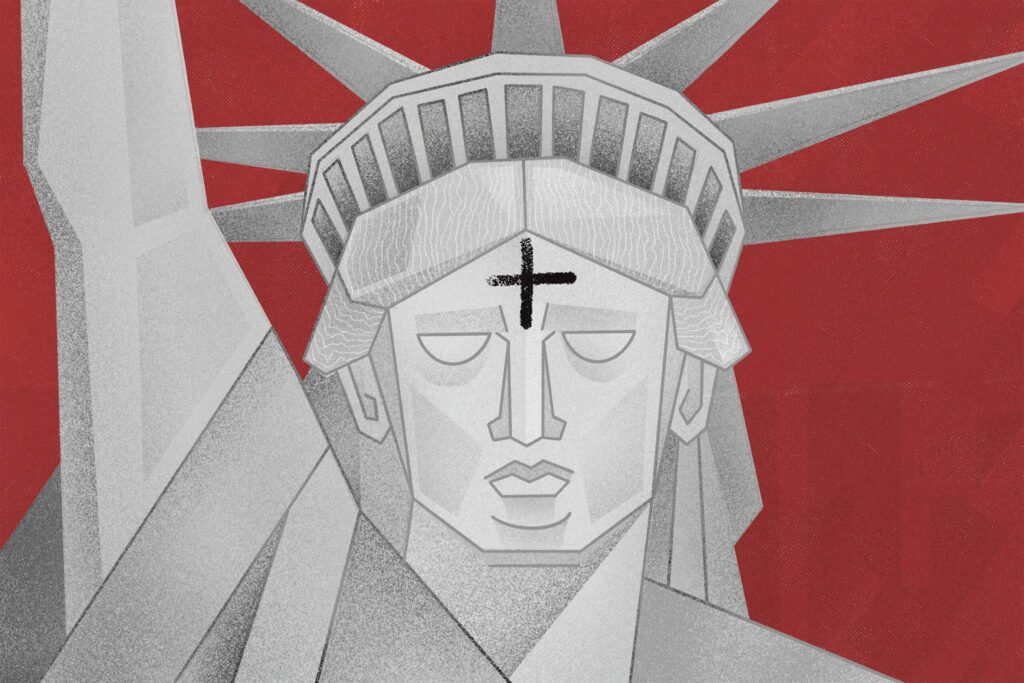
(Image source: The Journal of Illiberalism Studies)
Every year, the Varieties of Democracy (V-Dem) Institute in Sweden compiles a report on democracy around the world, and the latest report is not for the faint of heart. This is no provincial or partisan operation: drawing on the work of 4,200 scholars and tracking more than 600 attributes of democracy in 202 countries, the report is rigorously numerical and standardized. And the 2026 report is a doozy. In effect, much of the world is moving toward authoritarianism.
The opposite of authoritarianism—the tyrannical rule of the one or the few—is not simply democracy, because democracy is susceptible to rancid populism and tyrannies of the majority. The opposite of authoritarianism is liberal democracy, a system in which the branches of government check and counter each other, in which no one, not even the president, is above the law, and in which constitutional rights protect political, racial, ethnic, religious, and sexual minorities—as well as the socially disfavored and the annoyingly outspoken. To live in a liberal democracy is an enormous privilege, because liberal democracies are fragile creatures, rarely lasting more than a few centuries at best.
What the 2026 V-Dem report makes plain is that we are presently in the throes of a global “third wave of autocratization,” the backlash to the “third wave of democratization” that swept the planet in the late-twentieth century. The number of liberal democracies in the world, which had peaked at 45 in 2009, is now down to 31. So severe has been this current wave that, for the average global citizen, it has wiped out all democratic gains since 1978. Only 7 percent of people today live in a liberal democracy, while 74 percent live under autocracy.
The most damning element of the report concerns the United States. It relies on data collected throughout calendar year 2025, the first year of the second Donald Trump administration. Though the U.S. has historically been “one of the major democratic strongholds” in the world, because of what happened in 2025, V-Dem downgraded it out of the list of liberal democracies for the first time in over 50 years.
Since 2000, only six countries have registered larger one-year drops on V-Dem’s democracy index: Burkina Faso (2022), Fiji (2000), Myanmar (2021), Thailand (2006), Thailand (2014), and Tunisia (2022). The first five of those were coups, and, in 2022, Tunisia had a self-coup—a leader illegally seizing unconstitutional power. The 2024 U.S. election was legitimate and certified, and, at the end of 2024, the country was still a liberal democracy by the V-Dem metrics. It was the incoming Trump regime’s dramatic and destructive governing style in 2025 that registered on the democracy Richter scale with a force comparable to a coup d’état.
Let’s not mince words: American democracy is experiencing a crisis unlike anything it has faced before. An authoritarian executive is making a serially unconstitutional set of power grabs, and a majority of Republicans appears ready to follow him down the path to dictatorship. Constitutional norms and checks and balances are failing. We desperately need help shoring up our atrophied, once-liberal democracy.
But help requires diagnosis, and this is where the V-Dem report, for all its numerical precision, largely ignores a major variable that has pivotally shaped how we got here: religion. In many countries, movements of religious nationalism—the fusing of religious devotion with a restrictive devotion to the homeland—play starring roles in the dismantling of democracies. From Buddhist nationalism in Myanmar to neo-Ottoman Islamic nationalism in Türkiye, from Hindu nationalism in India to radical religious Zionism in Israel, religious nationalist movements are linking arms with populist and reactionary politicians to enact their autocratization agenda.
Here in the U.S., as the phrase Christian nationalism has worked its way into popular culture and political discourse—beginning in earnest with the 2020 publication of Andrew Whitehead and Samuel Perry’s Taking America Back for God and Katherine Stewart’s The Power Worshippers—the concept has gone down among the American commentariat like a bone sideways. Many American Christians object to the term, arguing it is too broad-brush and accusatory, especially when modified with the ethno-racial adjective white, as in white Christian nationalism.

(Image: A sign reading “Jesus is my savior. Trump is my president.”
But if we laid aside our American exceptionalism and looked at the U.S. from a global perspective, we could describe our situation accurately: an authoritarian president has been consolidating power in the executive branch, trampling the constitutional rights of minorities and vulnerable migrants, supported unswervingly by a loyal and devoted network of Christian nationalist pastors, media outlets, and power-brokers. The secret sauce of Trump’s two election victories has been the blending of the racial anxieties of the shrinking white majority with the cultural anxieties of the shrinking Christian majority.
Keenly aware of the national and global threat to democracy but not quite sure what to do about it, my friend and colleague Susan Hayward, a scholar and pastor, and I set out in 2023 on an unusual research project. We aimed to bring together experts from outside the U.S. to teach us how to counter our Christian nationalism-fueled slide into authoritarianism. We gathered experts on Buddhist nationalism in Sri Lanka and Myanmar, Hindu nationalism in India, religious Zionism in Israel, Islamic nationalism in Türkiye, and Christian nationalisms in Brazil (Pentecostal), South Korea (Evangelical), Russia (Orthodox), and Poland (Catholic). Those conversations forged friendships and collaborations that culminated in a 2025 podcast series, American Unexceptionalism: Global Lessons in Fighting Religious Nationalism. The project also unexpectedly altered the trajectory of my career and sense of vocation.
As we discussed religious nationalism and authoritarianism with front-line scholars and democracy activists, we discovered new insights and new questions about American politics and the strange Puritan-evangelical-Catholic Christian nationalism that has evolved on these shores. Sometimes we can only see ourselves accurately through the eyes and experiences of others.
For example, as we compared and discussed these movements, we landed on a rough taxonomy of two major styles: colonizer religious nationalism (where the ideological roots lie back in a proud imperial age, as in Indian Hindu nationalism, Turkish Islamic nationalism, and Russian Orthodox Christian nationalism) versus liberationist religious nationalism (where the roots lie in a proud revolutionary or post-colonial moment, as in Brazilian Pentecostal, Korean evangelical, and Polish Catholic nationalism). It matters a great deal whether a movement was conceived in an experience of power and entitlement or one of deprivation and resistance. Both types of religious nationalist movements can be potent threats to democracy, but their self-understanding and presentation differ sharply.
But here’s the crazy thing about American Christian nationalism: it has the traits and genealogy of both. Christian nationalists rhetorically tap into the anti-colonial and liberatory roots of the U.S. founding: the Founders “endowed by their Creator with certain unalienable Rights,” stand up to a tyrant. But the United States was also an enslaving and colonizing power, sending out armies of bureaucrats, soldiers, and missionaries to build an empire in the Philippines, Guam, and Puerto Rico, all while slaughtering Indigenous peoples and importing, enslaving, and disenfranchising African and Caribbean people. American Christian nationalism is hereditarily a mix of the liberatory variety and full-blown Christian imperialism. That’s why it wants to lock down the borders, expel the foreigners, and save/conquer the world all at the same time.
Over the course of our research and podcasting, we developed a globally sourced playbook for countering American Christian nationalism. Many of the experts and activists we interviewed were members of diaspora communities, studying or teaching in the United States for a season. They offered insights into religious nationalism in their countries of origin as well as shrewd first-hand commentary on American Christian nationalism, observed from the vantage of living as minorities here.
One phrase we kept coming back to was vulnerable majorities. That’s the target demographic for religious nationalism and the path to democratic collapse. We shouldn’t conceive “majority” simplistically here: it can be religious, ethnic, tribal, sectarian, or ideological—and it’s almost always some combination of those. Nationalist movements hijack democracies by telling vulnerable majorities, “Your power is waning. Heresy, foreign religion, and apostasy are creeping in. We have to maintain a lock on power, no matter what.” Hence, the tyranny of the majority. In the early 1990s, about 90 percent of Americans identified as Christian; today it’s 62 percent. In 1990, 75 percent identified as white; by 2023 it was 58 percent. Trumpism occurs at the juncture of two vulnerable majorities.
However, the pathway out of democratic backsliding also goes through majorities. There is no renewing (or reforging) of a democracy without a majority coalition—and, when overcoming incipient authoritarianism that controls some levers to rig elections, it often must be a supermajority. Just as the coalition to defeat the Trumpian trajectory of autocracy must include white people who renounce the white-power agenda and stand in solidarity with their non-white friends, so too it must include Christians who renounce the Christian-power agenda and stand in solidarity with their non-Christian friends.
One of the resounding conclusions from these conversations is that, in the struggle for democracy against mobilized religious nationalism, religion is both poison and antidote. Nearly all religious traditions—and many sub-traditions and sects within them—have found ways to accommodate coercive and supremacist visions that facilitate co-opting the government, yet people within those same traditions organically resist those impulses. Religions contain multitudes and polarities.
Perhaps the most important lesson Susan and I learned from our sojourn among these battle-hardened experts was that we need religion to counter religious nationalism. We need theology to counter theology. We need religious authority to counter religious authoritarianism.
Religious nationalist movements weaponize religion. They dominate the public square, wielding the symbols and scripture references of religion to stir up resentment and fear. If their public claims to religion are not contested and challenged, they will win that argument.
Pragmatically, the supermajority coalition we build must include a great many of the 62 percent of Americans who are Christian. So, we must find ways to persuade Christians away from the logic of authoritarianism. We need clergy on the front lines of protests, countering the obsequious Trumpian court of prophets and pastors. We need social media influencers using Christian ideas to counter the legion of Christian nationalist influencers. The propaganda that is driving our fellow citizens mad is theological, so our response must be theological.
Lest anyone think this mobilization is itself a weaponization of religion: I am part of that sizable portion of Christians who find Christian nationalism theologically loathsome, and have as far back as I can remember. I know many other Christians like me from across an incredible span of Christian traditions who similarly detest seeing Christians abuse power. Like my Muslim, Jewish, Buddhist, and Hindu friends who I see heroically resisting religious nationalism in their own communities, I reject Christian nationalism out of religious conviction and commitment to my God. The goal in stirring up religious resistance to religious tyranny is not to co-opt or exploit religion. That resistance already lives deep within these traditions—part of the diversity and pluralism within religions. It does not need to be conjured but given some urging and space to speak.
Put differently, no one is more responsible for countering American Christian nationalism than American Christians. While this won’t apply to every reader: if you identify as an American Christian, what we need right now is for you to stand up against Christian nationalism—in your own family, or through your online reach. Whether you speak out from a pious love of God, enraged at the invocation of God’s name to harm others, or from love of neighbor and concern for your Muslim, Jewish, atheist, gay, and non-white friends as they are targeted by your fellow Christians, these are perfectly and organically Christian reasons. Jesus taught that love of God and love of neighbor are the highest of all motives.
For readers who do not identify as Christians, liberal democracy needs your active citizenship right now too. You can support (and spur) your Christian friends to join the theological fray. The goal of awakening the Christian resistance to Christian autocracy is not to enshrine a new, progressive form of Christian nationalism but to contribute Christian voices and votes to a multi-faith and non-faith alliance for pluralism and democracy. This anti-autocratization coalition will need to be made up of Christians, but also atheists, Jews, Muslims, Buddhists, Hindus, Sikhs, and people who don’t identify as anything at all when it comes to religions.
As an American Christian myself, I shall end on a personal note. In the course of doing this research with Susan and creating American Unexceptionalism, my own sense of vocation began to change. I am a widely cited researcher and expert on American Christian nationalism, but I am also a Christian. My evangelical ministry background and seminary training are part of what made me alert to the perils of Christian nationalism and the radicalizing forces in the American evangelical landscape. But through my academic career, my books, lectures, and podcasts had been voiced in the arm’s-length authority of my religious studies training: neutral, analytical, diagnostic.
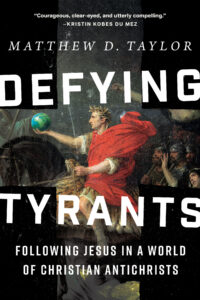 My new friends, the diaspora researchers and activists confronting global religious nationalism, shook something loose in me: my theological voice. Horrified by Trump’s 2024 re-election, inspired by my theologian and activist friends’ courage, and convinced that the present megalomania in Washington is theological in nature, I have written a book of theology. It’s titled Defying Tyrants: Following Jesus in a World of Christian Antichrists, and it will be published on October 6th. It’s my punchy rejoinder to American Christian nationalism, voiced from my evangelical ministry background and training. I can say, without irony, that my interreligious friendships stirred an evangelical instinct deep within me, except that now my desire to proclaim the gospel is directed back toward my own coreligionists. It is, by far, the most vulnerable and emotional thing I have ever published.
I have no earthly idea whether this book will do any good in the global confrontation between religiously amplified authoritarianism and liberal democracy, but I believe now is a time for risking. Now, while we still have some of the structures and guardrails of democracy intact, is the time to stand up to the Christian regime that is autocratizing at the speed of a coup d’état. Now is the time for Christian scholars to join the intellectual confrontation with Christian nationalism. Now is the time for Christian pastors and priests to grab their clerical garb and put themselves at the heart of protests to protect democracy. Now is the time for awkward and even confrontational dinner-table conversations about those most taboo of American topics: politics and religion.
The hopeful news in the 2026 V-Dem report is that all is not lost. As we discovered in American Unexceptionalism, pro-democracy coalitions, made up in part of resistance theologians and multi-faith networks of religious activists, have recently scored wins in Brazil, South Korea, and Sri Lanka. The global cause of democracy is not dead, just down for the count. Equipped with tools and strategies learned from previous generations of democracy activists and fellow resisters of religious nationalism, we can help propel the fourth wave of democratization around the world.
Matthew D. Taylor is a senior visiting scholar at the Center on Faith and Justice at Georgetown University. He is the author of The Violent Take It by Force and the new book, Defying Tyrants.