“Leviticus” and The Rise of Queer Religious Horror
A new horror film brings to light the real-life trauma of conversion therapy
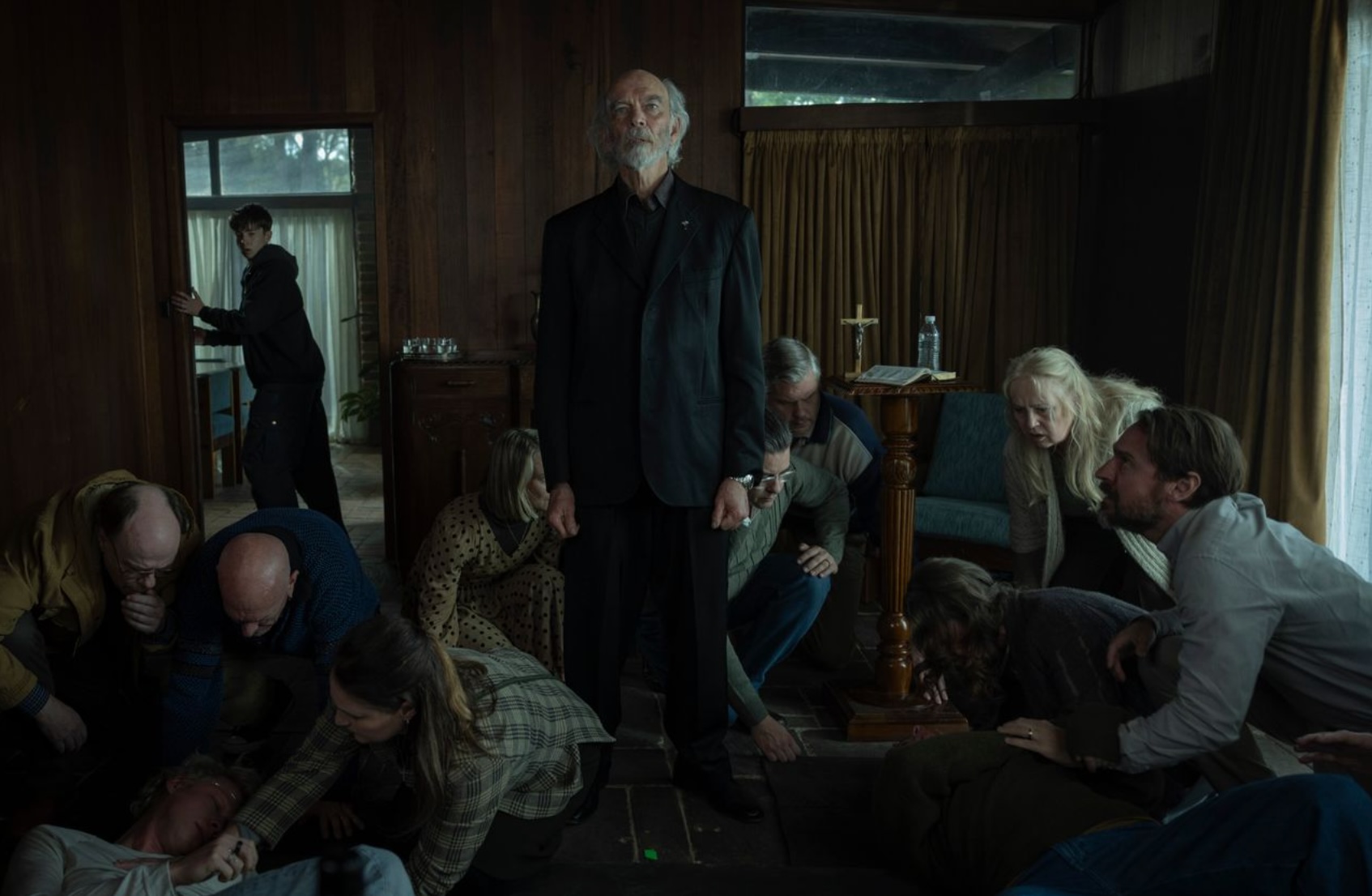
(A scene from “Leviticus.” Image source: The Hollywood Reporter)
On the night I saw the Australian religious horror film Leviticus (2026), I went to church.
It had been months since I—a queer woman raised in a conservative Catholic parish—sat beneath stained glass, but the release of the supernatural film written and directed by Adrian Chiarella coincided serendipitously with the 2026 Outreach conference, a meeting I was attending for the LGBTQ+ Catholic resource group founded by Fr. James Martin in Washington, DC. As part of the conference, Cardinal Robert Walter McEldroy said Mass, and I sat in the back. Just one hour later, I was inside an AMC watching Leviticus on its premiere weekend.
Attending church always unearths my long-seeded anxiety about religious shame, but ironically, it wasn’t Mass that shook me that day. It was Chiarella’s psychological horror film that brought me to tears.
 In the film, teenager Naim (Joe Bird) and his mother Arlene (Mia Wasikowska) have just moved to a rural town in Australia after Niam’s father died. Arlene finds solace in the town’s devout religious community led by local pastor Rod (Ewen Leslie), but Naim remains skeptical and begins a relationship with Ryan (Stacy Clausen), another boy at his school. But after Naim sees Ryan kissing pastor Rod’s son Hunter (Jeremy Blewitt), in a fit of betrayal he reveals Hunter and Ryan’s relationship to their parents.
Pastor Rod brings in a “deliverance healer” (Nicholas Hope) who performs a ritual that closely resembles an exorcism to expunge both boys’ homosexuality. At one point, the healer’s homophobic “cleansing” ritual causes both Ryan and Hunter to collapse, convulse, and vomit on the floor, and as Naim later witnesses, to become haunted by an unseen force that takes the form of the person they’re most attracted to.
This unseen, presumably demonic force targets Ryan first, attacking him in a photo booth. Naim follows Ryan to a local skating rink and hears him laughing and kissing someone inside. But when Naim checks the printed photo strip, he discovers that Ryan was in the booth alone. Ryan tells Naim that whoever or whatever was in the booth with him looked just like Naim, that it lifted him into the air, and choked him before he broke free.
Hunter is next, seduced outside the gas station where he works by someone that only he can see. Naim tries to save him but Hunter is dragged into the darkness, and his severed head is discovered in a field the next day. Naim tries to tell the police that he saw Hunter attacked by something mysterious, but instead of helping, they take him to his mother. His mom, terrified of losing another loved one, brings her son to the deliverance healer who performs the same ritual on a resisting Naim.
Naim and Ryan are left fighting an invisible demon that looks exactly like each other, but no one will believe them, except for Hunter’s sister Izzie (Davida McKenzie) who mentions that a girl one town over died in a similar way to Hunter after she met with the deliverance healer. The girl’s surviving partner Jessica (Shannon Berry), who also underwent the ritual, lives at a local hospital because the demon only attacks people when they are alone. Surrounded by flashing lights, Jessica tells the boys that there is no undoing the demonic curse.
Naim and Ryan keep mistaking the demon for each other and end up maimed—ears torn apart and clumps of hair yanked from their head, before Naim learns that the entity is terrified of fire. He is chased by the demon to where he and Ryan kissed at the start of the film—a dilapidated warehouse that Naim sets on fire, temporarily trapping the demon inside. The real Ryan has not been seen recently, and Naim—terrified that he killed the person he loves—helps with the missing person search.
But in the process, his mom lets slip that she knew her son would be haunted by this unseen force for the rest of his life. She believed the demon would instill a fear in him that would keep him safe from the real homophobic violence that she believes killed Hunter. Better to be straight and haunted, the mom reasoned, than gay and vulnerable to violent bigots. Horrified, Naim abandons his mom at a gas station and flees town with Ryan. He sees the entity standing in a field as the bus drives past but chooses instead to sleep on Ryan’s shoulder, finally breathing a sigh of relief.
While the ending is a relatively peaceful one—hopefully the demon remains trapped in the small, devoutly religious town that Ryan and Naim are leaving behind, the film’s psychological horror holds another layer for people like me who have religious trauma. At the heart of this film is the horror that Ryan and Naim cannot trust their own desires, and that Naim’s mom believed a life spent in fear, constantly running from a demon trying to kill him, was what would keep her child safe.
The Rise of Queer Religious Horror
While the film is terrifying to people who do not have religious trauma and who were not subjected to conversion therapy, within this subtext it becomes what I believe is the first concrete example of a new genre of film—queer religious horror—that realizes the real-life evil and violence of religious homophobia. Queer religious horror is strikingly similar to incel horror, a film genre that identifies the monster as men who assume they are owed women’s affection. In the same vein, queer religious horror points to religious systems, institutions, and people that instill shame and justify queerphobic violence with their religious beliefs as the true evil.
In some ways, queer religious horror mirrors, as earlier articles in The Revealer have shown, how Catholic horror reflects the true colonial atrocities committed at the hands of the Church. But while the film appears on first watch like other demon possession flicks, the true horror in Leviticus is the conservative Christian community that stands by and watches as a demon kills Hunter and maims Ryan and Naim. Instead of fighting to rid the town of an unseen demon, the faithful welcome it in to rid their community of queer people.
Like many religiously conservative parents who hold anti-LGBTQ beliefs, Arlene repeatedly argues that she brought her son to the conversion therapist to protect him from the real violence—the people who she believes killed Hunter. The true irony is that the real danger that Hunter, Ryan, and Naim face is actually their parents who voluntarily put a target on their children’s back. Homophobic persecution and violence is on full display in the film—Ryan and Naim are repeatedly beaten by school bullies and an angry mob. But the thing that draws the most blood is the demon these townspeople invoke.
Conversion Therapy’s Violence
What Leviticus does well is depict the real-life violence of conversion therapy. Because the demon takes the form of who the person is most attracted to, it instills a deep fear that one cannot trust their own sensory experiences or desires. Naim can never truly know if it’s the demon in disguise using his own attraction to lure him to his death. The effect is to make Niam and Ryan fearful not only of a demon but of their own sexuality.
This mistrust of bodily perception and sensation is at the heart of conversion therapy and is why conversion practices are routinely linked to depression, PTSD, and suicidality in LGBTQ+ children and adults.
Thankfully, it never appears that Naim or Ryan believe they deserve this punishment. But the film does showcase how demons like conversion therapy have real-life physical and psychological effects. Naim and Ryan witness Jessica, the surviving girlfriend, snapping a rubber band repeatedly against her wrist to stay awake. Jessica’s wrist is bloody, and that specific form of self harm is a direct reference to a type of aversion therapy many LGBTQ+ children and adults are taught, where one snaps a rubber band whenever they feel attraction to someone of the same gender.
And even if the demon is trapped inside Naim and Ryan’s rural town, the fear that the person they love is actually a demon, that their desires put them at risk, still lingers—just as the sense of guilt, shame, and profound mistrust in our bodies persists into adulthood for people who grew up in homophobic religious communities.
A Growing Reckoning with Anti-LGBTQ+ Religious Violence
Conversion therapy survivor and scholar Lucas Wilson believes this film is part of a cultural shift in openly discussing and critiquing religious violence like conversion therapy. In his book Shame-Sex Attraction about conversion therapy survivors, as well as in online spaces, a growing number of LGBTQ+ people are talking about the “demons” of religious stigma and self-harm that they have long kept silent.
“I feel like in the past 10 years,” Wilson told me over Zoom, “there’s been this emergence of queers reclaiming their narratives and moving in a direction that is just offering a really strong critique of religion.”
“If you’re thinking about horror, [then this is about] the horror of religion and the horror of being queer in religious, high-control Christian space,” Wilson added.
 Many LGBTQ+ people from religious communities have had trouble not only coming out, but also feeling safe to discuss the religious trauma and abuse they experienced.
“There’s been a lot of silence and shame and secrecy surrounding conversion practices for a very long time, and a lot of people didn’t come out and share their stories,” Wilson said. “For a lot of other folks, they didn’t come out in multiple senses. They didn’t come out of the closet in general, and then on top of that they didn’t come out as folks who underwent conversion therapy.”
But today, as literary and film depictions of conversion therapy enter mainstream media, including The Miseducation of Cameron Post (2018), Boy Erased (2018), Pray Away (2021), and They/Them (2022), Wilson believes more people are recognizing that the shame they were taught is not a personal failing, but the product of their communities’ violence. In turn, horror films allow viewers, regardless of how they were raised or how they identify, to understand the danger that conversion therapy and religious homophobia pose.
“I think that the horror genre is such a phenomenal approach to talking about conversion therapy because there is an inherent horror to the experience that you’re subjected to,” Wilson explained. “It’s this ontological attack; it’s that your very being, these constitutive parts of who you are, are challenged, and folks are trying to erase them. Of course, they can’t be erased, and of course, we’re never not going to be queer, but that doesn’t mean that the harms aren’t real. That doesn’t mean that the consequences aren’t palpable and tangible in many ways.”
A Cultural and Religious Reckoning after Chiles v. Salazar
The rise of queer religious horror is especially timely after the United State Supreme Court ruled on March 3 in Chiles v. Salazar that Colorado’s Minor Conversion Therapy Law, which outlawed conversion therapy in the state, violated the First Amendment Rights of a Christian counselor. In response, LGBTQ advocacy groups like the Human Rights Campaign and American Civil Liberties Union condemned the Supreme Court’s decision. A number of religious groups also asserted that conversion therapy is not only a form of emotional and physical abuse but spiritual abuse as well.
Amid the rise of Chrisitan nationalism, queer religious horror is part of a growing reckoning about how the institutions that many were raised to believe upheld morality are actually the greatest threat to society. “When you leave those systems, you have this critical distance that allows you to see that for so long, what you thought was good and just and right and righteous was the exact opposite, and I think that a lot of these new films and books and whatnot are shining a spotlight on this inverted sense of morality that for so long we were convinced was good, was right,” Wilson explained.
Despite conservative Christians arguing that LGBTQ+ people are a threat to children, it is religious spaces, institutions, and leaders that routinely put children at risk of grooming and sexual assault. In Leviticus, adults in Rod’s congregation stand by as children are tortured during the conversion ritual and as they witness the unseen demon hunt and kill the children. It is these adults who are responsible for the abuse and deaths of queer children, much like today’s Christians who do not oppose conversion therapy or who witness homophobic violence in their congregations, and say nothing.
Leviticus is a timely reflection on the evils of conversion therapy through a new, accessible genre of film—queer religious horror—that sparks not only dialogue about religious homophobia and violence, but also encourages more people to share their stories and to destigmatize religious trauma. As Wilson concluded: “I think that all these representations are invitations for people to share their stories and to raise awareness, and to show that this is not something that’s an isolated case here and there, but a pervasive phenomenon that affects thousands and thousands of people.”
Emma Cieslik is a public historian and freelance writer based in the Washington, D.C. area.