Is Religious Liberty in America Real?
Anti-Muslim hostility in the U.S. reveals a weakness in American pluralistic democracy
(Image source: Freedomforum.org)
On May 2, 2026, a Southern Californian beach filled with a crowd of believers preparing for a religious ritual. Regular vacationers found themselves sharing the sand with a massive sacred event that temporarily turned the popular spot into a worship space.
The worshippers were Christians participating in a large-scale baptism organized by the group “Baptize the World.” It was one of many hundreds of such events that occurred synchronously across the world on Pentecost Sunday, a Christian holiday celebrating the descent of the Holy Spirit upon the Apostles and followers of Jesus. The scene was complete with an inflatable cross, “Jesus is King” signs, drones, and underwater cameras.
“One could view it as a branding and marketing success,” said Nina Fernando, executive director of the Shoulder To Shoulder Campaign, a national multifaith coalition dedicated to ending anti-Muslim racism, who happened to be at the beach that day. “And just because I…a fellow Christian, don’t align with the group’s theology or tactics, in a democratic country that values religious freedom, they have the right to gather at the beach in community and practice their faith with the ritual of baptism.” However, Fernando wondered how those same Christians might react if the beach filled up with a crowd of religious Muslims who wanted to pray there. “I wonder if those very same Christians would give them the same respect their group was afforded that day? Or would they react confrontationally?”
This is a salient question in a purportedly pluralistic democratic country, and it invites comparisons to other public religious rituals. For example, in March 2026, after thousands of Muslims prayed at the War Memorial Stadium in Little Rock, Arkansas on Eid-al-Fitr, a celebration at the end of Ramadan, negative reactions abounded. Soon after the event, RAIR Foundation USA (Rise Align Ignite Reclaim, an organization self-described as defending the U.S. Constitution, borders, and what it calls “Judeo-Christian values”) published an article that referred to the prayer as “conquering” the stadium in a process of “calculated Islamification.” Likewise, in late 2025 and early 2026, there were multiple media reports of Christian activists interrupting Muslim prayers held in outdoor public spaces in Florida and Texas. The harassers shouted, “You need Jesus,” mocked the Kaaba (a Muslim holy site in Mecca), waved bacon (a weaponization of Muslim dietary restrictions), and warned the praying Muslims that they would “go to hell.”
While many Americans are unfamiliar with the plethora of religious practices observable across the United States, the case of Islam is singular; the fixation on Islam and Muslims that drives anti-Muslim rhetoric transforms something as mundane as Muslim prayer or clothing into a security threat. As a result, some Americans feel entitled to confront and harass Muslims for practicing their faith.
This anti-Muslim obsession often affects ordinary religious practices. In Texas, Governor Greg Abbott recently threatened to withdraw funding from the Dallas Fort Worth International Airport (DFW) because it planned to construct ritual ablution facilities–essentially, a hygiene facility where believers can comfortably wash their feet to purify themselves before prayer. Abbott argued that provision of these “discriminatory religious ablution facilities” would privilege Islam over other religions, since Muslims would be the most obvious users of these amenities. Practicing Muslims perform ablution, or wudu in Arabic, up to five times a day. “[These facilities] exist to benefit the Muslim population alone. Government-owned airports cannot favor one religion over all others,” read a statement from the Office of the Texas Governor. However, it is factually incorrect to say the facility would benefit Muslims alone, as members of other traditions, such as Zoroastrianism and Sikhism, also wash their hands and feet before prayer.
Abbott also compared providing a wudu facility to Jim-Crow era racial segregation: “Airports can no more offer Muslim-only bathroom spaces than they can maintain white-only bathrooms.” But placing an accommodation for a religious minority in the same category as whites-only bathrooms is an unconvincing move, given that the George Bush Intercontinental Airport (IAH), where similar facilities are in operation, affirms that all travellers and airport staff are welcome to use them. And yet, in one rhetorical move, the governor transformed a religious minority from one that receives religious accommodation to one that discriminates against others.
Designating the airport ablution facilities as “Muslim-only” and like “whites-only bathrooms” is useful in boosting anti-Muslim sentiment that has been percolating in the United States for years. Meanwhile, Abbott recently signed a law that requires the Ten Commandments (to be precise, the Protestant, King James Bible version of the Ten Commandments, which is different from Catholic, Orthodox, and Jewish versions) to be on display in every classroom in all Texas public schools (SB10). Christianity in public spaces, like schools, is apparently perfectly fine. Abbott defended this law by arguing that the Ten Commandments are rooted in Texas history. But majoritarianism is not democracy. Rather, a constitutional democracy is supposed to restrain majorities. The ongoing parents’ litigation against Texas school districts that are implementing SB10 will test the efficacy of the constitutional safeguards designed to protect minorities.
If protections and accommodations depend on which religion people practice, then religious liberty cannot be understood as truly functional in the United States. The contrast between the treatment of Christian and Muslim religious practices in public institutions and spaces shows that the issue is much larger than discrimination against Muslims; the disparity exposes a weakness in American pluralist democracy itself. Religious liberty is meaningful only when the most reviled minority religious group–and not the religious majority—can freely practice their faith in public. If the state or the religious majority can encroach on that ability, the right to practice religion freely and equally is not secure for anyone.
To paraphrase the poem by German Lutheran pastor Martin Niemöller, even if you are not Muslim, dear reader, one day the government may also come for you.
***
That Muslims are the most reviled and surveilled religious minority group in the United States is difficult to dispute. Various state legislatures have actively demonized Islam for years. Since 2010, 44 state legislatures have considered 223 proposals to “ban Shari’a.” Legislators targeted Shari’a—a comprehensive Islamic code for private and personal behavior—in 44 state legislatures; they considered 223 proposals. So far, thirteen states have passed 20 such laws, which prohibit state courts from considering or applying foreign, international, or religious law. While many of these bills refer to “foreign law” without naming Shari’a directly, their objective is clear, given that they originated from anti-Muslim political circles.
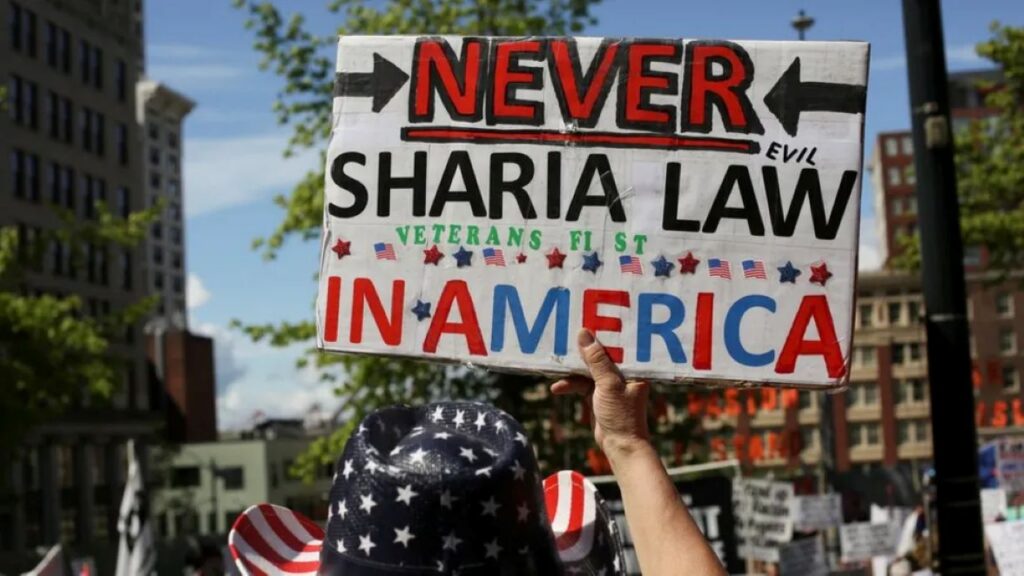
(An anti-Islam/anti-Shari’a sign. Image source: BBC)
Halakha, the Jewish religious legal system, has parallels to Shari’a in concept and scope. The literal meaning of its name in Hebrew, like Shari’a in Arabic, is “the path.” Neither Halakha nor Shari’a supersedes U.S. law. But American law generally permits parties to choose private arbitration—including arbitration administered by religious courts—before addressing such disputes in secular courts. In a recent case, two Orthodox Jewish grocers brought their case before the Jewish Beth Din court, which did not elicit an outcry from other Americans. Indeed, there has never been a concerted effort in the United States to ban Halakha. This contrast indicates how normalized the anti-Shari’a rhetoric and action has become.
For most practicing Muslims, following Shari’a means making personal choices to please God. Ali Khan, a gastroenterologist who is a congregant at the Madina Institute in Little Rock, recalled encountering religious accommodations when he was in New York: while visiting a hospital there, he mistakenly stepped into a “Shabbat elevator” that is programmed to stop on every floor, so that observant Jews did not need to press the buttons on Shabbat. Outside of Shabbat, the elevator operates as usual. He also saw an “eruv,” a wire affixed to existing poles that delimits how far observant Jews can carry things on Shabbat. The elevator and the eruv wire didn’t cause controversies, reflected Khan. New Yorkers did not imagine these accommodations as threats to equality, even though adaptations like the Shabbat elevator can create delays for those who do not use them.
“Under Shari’a we have acts of worship: praying, fasting during Ramadan, giving charity—zakat—going to Hajj; all those fall under Sharia. So an anti-Sharia bill is saying to Muslims, ‘You can’t practice Islam,’” says Syed Atif Rizwan, associate professor of Islamic and Interreligious Studies and Director of the Catholic-Muslim Studies Program at the Catholic Theological Union in Chicago.
Detractors of Shari’a, which is undergirded by an ethical framework, narrow it down to criminal law in American public discourse, explains Rizwan. They often focus on a category of severe punishments for transgressions such as adultery and stealing known as Hudud. However, classical Islamic law made these punishments almost impossible to carry out due to an extremely high evidentiary threshold; for example, to prove adultery, one must present to the court four independent witnesses who have viewed the act. However, American legislators who propose and legislate the bans overlook these subtleties. Banning Shari’a (which effectively has the same result as prohibiting Muslim prayer and other religious practices) may then sound to many non-Muslim Americans like protecting their country from a foreign criminal legal system that threatens democratic values.
For Khan, Shari’a is many things: it is holding his patients’ hands after giving them a cancer diagnosis. It was washing his father’s body in preparation for burial and supporting his widowed mother. It is being loving and faithful to his partner. Finally, it is living authentically and honestly. “Truly, banning Shari’a is like separating my blood from my body, how do you do that?” he asked. And this is a real concern for Khan: in April 2026, State Rep. Marcus Richmond, with two co-sponsors, introduced the House Resolution 1016, titled the “Arkansas Property Rights Protection From Sharia Law Act.” Fortunately for now, the Arkansas House Rules Committee swiftly rejected it.
Singling out the Islamic religious and legal code through prohibitive legislation implies that Islam is inherently incompatible with American democracy. This, in turn, creates a hierarchy: some faiths are apparently legitimate, but others aren’t. Ironically, anti-Sharia laws have always been functionally redundant: American courts already possess the tools to prevent religious law from overriding constitutional rights and public policy. The legal threat associated with Shari’a is largely imaginary. Why then would legislators and think-tanks spend precious time on this manufactured issue?
***
The consequences of portraying Islam as a dangerous foreign ideology are much broader than the symbolic attempts to ban Shari’a or hindering Muslim prayer in public. Ordinary Muslims, simply living their lives in America, face innumerable repercussions. Muslims who engage in activism, especially those who advocate for Palestinian rights, can reasonably expect that their ordinary political participation may be interpreted as holding foreign allegiance or sympathizing with extremism. The story of Mahmoud Khalil illustrates this vividly. Khalil, a Palestinian Muslim and a permanent resident and a spouse of an U.S. citizen, rose to prominence as a graduate student at Columbia University, where he participated in pro-Palestine protests in 2024. The authorities never criminally charged him in connection with the protests, but in March 2025, ICE agents arrested him and told him that his green card had been revoked.
To justify his detention, the government issued a Notice to Appear invoking INA §237(a)(4)(C), a rarely used provision permitting deportation when the secretary of state has reasonable grounds to believe a noncitizen’s presence could cause “potentially serious adverse foreign policy consequences.” Strikingly, Secretary of State Marco Rubio acknowledged in a memo that Khalil’s “beliefs, statements, or associations” were “otherwise lawful,” but claimed that his presence undermined U.S. foreign-policy goals concerning antisemitism and protection of Jewish students. Khalil was released from the ICE Processing Center in Jena, Louisiana, after 104 days, but his legal battles continue; he is currently appealing his final order of removal before the Fifth Circuit Court of Appeals.
Importantly, Khalil’s case was not isolated. Immigration enforcement targeted other Muslims who were pro-Palestine activists: Badar Khan Suri, Leqaa Kordia, Rümeysa Öztürk, and Momodou Taal.
When an individual’s rights depend on whether they agree with state policy and on their citizenship/immigration status, those rights cease to be universal. They become privileges granted at the state’s discretion. Pro-Palestine advocacy is merely a recent iteration of the mechanism of discrediting Muslims’ lawful political protest. In fact, as the United States waged wars in Afghanistan and Iraq, federal authorities subjected Muslims, especially those of Arab and South Asian background, to surveillance and counterterrorism scrutiny. And the National Security Entry-Exit Registration System (NSEERS) created a specific, state-sanctioned suspect category for non-citizen males from 25 countries living in the United States. Out of those 25 countries, 23 were majority-Muslim. More than 13,000 individuals who complied with the NSEERS program faced deportation charges. The FBI and the Joint Terrorism Task Force (JTTF) also questioned Muslims on their views on the war in Iraq; a 2003 FBI memo disclosed by the New York Times instructed local and state police to monitor anti-Iraq-war protesters.
***
All of these examples put together create a striking pattern. Muslim public prayer becomes a provocation as the government portrays Muslims’ lawful democratic right to protest as sympathizing with extremism and undermining foreign policy goals. While in theory, Muslims can enjoy religious liberty in the United States, in practice, this liberty becomes tenuous when the state reframes Muslim religious practices as actions that do not warrant legal protection, but, rather, need to be restricted through legal frameworks. The same dynamic hinders Muslim advocacy: while Muslims’ political speech technically remains constitutionally protected, the speech itself becomes evidence of extremism, as seen with Khalil and many other pro-Palestine Muslim protesters. Formal legal protections may remain in place (as they do so far), but where Muslims are concerned, officials can make the protections ineffective in practice. And when the exercising of universal rights becomes precarious (or no longer possible) for some, religious pluralism frays for all.
It is not an overreach to say that the liberties we take for granted are not secure at all. Rizwan explained it bluntly: “In my view, we’ve never had real democracy in the U.S.” While democracies frequently fail to ensure that all people have actual freedom to exercise their formally guaranteed rights, the patterned discriminatory experiences of American Muslims suggest that there is a systemic failure on this count in the United States. One could ask whether this is a bug or a feature of the system. After all, historically, “people” in “We the people” did not include the enslaved African Americans who, in the eyes of the law, were considered property. Modern democracy has coexisted with profound exclusions from the very beginning.
It is not the existence of proclamations on paper, like what is found in the Constitution, that gives religious liberty and political participation importance; it is how these values are lived out, and who gets to live them out. That is the true test of whether pluralistic democracy and religious liberty exist in today’s America.
Rev. Anna Piela, Ph.D., is an American Baptist pastor and co-founder, with Rev. Michael Woolf, Th.D., of the interfaith solidarity network Challenging Islamophobia Together Chicagoland. They are the co-authors of the book Confronting Islamophobia in the Church: Liturgical Tools for Justice (Judson Press, 2026).