Infertility, Loss, and Jewish Reproduction
An excerpt from “Gestating Judaism: The Corporeal Technologies of American Jewish Religion”

(Image Source: Almy)
The following excerpt is adapted with permission from Cara Rock-Singer’s Gestating Judaism: The Corporeal Technologies of American Jewish Religion (© 2026 by The University of Chicago Press. All rights reserved). The book explores how reproductive practices contribute to the transmission and reinvention of American Judaism, arguing that reproductive bodies are central to the religious, intellectual, and political life of American Judaism.
***
Infertile Matriarchs
Infertile Matriarch—oxymoronic, isn’t it? It’s a fraught phrase, with resolution baked in. Genesis and the prophetic book of Samuel feature women who were barren but eventually conceived, cementing their place in the Jewish family story as imahot (matriarchs). Unlike the biblical matriarchs, whose problems are resolved within a matter of verses, Devorah, a Modern Orthodox woman whom I met through my research, felt like she was transformed into “a person who miscarries” and suspended in uncertainty. She was willing to do “whatever works” to conceive and bear children, turning to biomedical doctors as well as Kabbalists, witches, and prayers to God that she would find resolution like the imahot. “Thank God,” she would add with the distance of many years, this period was only temporary.
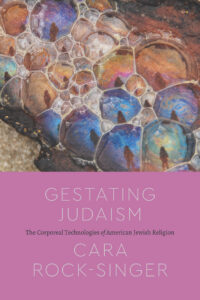 My book, Gestating Judaism: The Corporeal Technologies of American Jewish Religion, explores contemporary American religious and political life through Assisted Reproductive Technologies (ARTs). ARTs typically refer to “new” medical techniques such as in vitro fertilization (IVF), but I extend the category to include the so-often-overlooked, unacknowledged, or covered-up networks of knowledge, materials, and human and nonhuman agents that do reproductive and “non-reproductive labor.” “Non-reproductive labor,” as Sara Ahmed describes it, is “the work you have to do to stop the same things from happening again.” Though prayer, amulets, and the Hebrew Bible are not exclusively Jewish and are used in a variety of contexts, they are nevertheless components of the reproduction of Jewish religion, including people and their collective wisdom, the Torah. Through my account of Jewish ARTs, I hope to facilitate the formation of more expansive religious and political coalitions built on the recognition of the mundane and extraordinary collaborations that do the ongoing work of building, maintaining, and remembering worlds.
Reproduction is much messier than the scaffolding of horizontal and vertical lines shown on pedigree charts or family trees. Early in the process of drafting my book, I shared a short paper using Devorah’s story with a writing group of fellow feminist ethnographers. Sitting around a kitchen table as the flowers began to poke through the soil after a long upstate New York winter, I shared what I had drafted. The feedback was simpler and more profound than I had anticipated: “Why don’t you stay with the loss?” I had allowed Devorah to shepherd me to her happy ending. I let myself recognize Devorah on the terms she had come to identify with: she had become “Mother” and buried that “Person Who Miscarries.” My colleague’s question surfaced from a buried but still wounded place, an afterlife of her own miscarriage. Other women nodded, nudging silent references to childlessness and the injuries that come with motherhood into the space my account’s neatly closed circle had opened. Trapped under social expectations of womanhood were collections of wiped-away tears, pockets of shame, misunderstood and undervalued choices, circumstances without easy resolution. My colleagues encouraged me to wade into her loss, to immerse in the blank genealogical spaces and spend time dwelling in a period when no productive lines could be drawn on a pedigree, when no point of closure could be traced in biological or narrative time. I needed to conceive of her story differently. I needed to try again.
To stay with the loss, it is necessary to swim against the current, to not be swept onward without lingering in the darkness. In the text below, I revisited Devorah’s story with the help of the biblical book of Lamentations, which mourns but does not promise deliverance. Like the biblical lament, I deliver Devorah’s story in an acrostic, which is a classical memory device. I hope it will remind me to not forget the loss.
Abyss. I was driven on and on in unrelieved darkness; Struck again and again, without cease, on me alone (Lamentations 3:2– 3). Biomedical reproductive technologies are the quintessential technologies of hope, which rely on an enlightenment epistemic tool kit linking seeing with knowing, controlling, and resolution. “We did a whole bunch of tests,” Devorah recounted, but they found nothing wrong. An identifiable problem might have meant an actionable treatment, but with no answers there seemed to be no resolution. Her stress grew. “I . . . probably wasn’t getting pregnant because I was so unbelievably stressed,” Devorah hypothesized. “But at the time I felt like I had become an infertility statistic.” Stripped of specificity; reduced to a number; one among the faceless flock; a figure of failed futurity.
Broken. My flesh and skin worn away; my bones shattered. All around me misery and hardship built; I have been made to dwell in darkness, Like those long dead (Lamentations 3:4– 6). Her body poked and prodded, medical shots in the dark tried to make the darkness dissolve. She took Clomid, an estrogen-inducing drug that stimulates ovulation. Pregnant! “Miscarried immediately.” Pregnant! It happened again. Could they even be called miscarriages? Devorah corrected herself with the technical term, “chemical pregnancies.” The losses were so early they might not even “count” as anything out of the ordinary, a menstrual period a few days late. The losses compounded: “It was all torture.”
Cycles. I was walled in and I cannot break out; I was weighed down with chains. And when I cry and plead, my prayers are shut out; I was walled in, my ways hewn with blocks, my paths became a maze (Lamentations 3:7– 9). The doctors looked for answers, peeling back the layers of her flesh with visualizing technologies. The details of gynecological procedures met her hazy recollection like a blunt edge: “Oh God, it’s so hard to remember, it’s such a blessing not to remember, but I think I had a test called a hysterosalpingogram, where they push dye through your fallopian tubes to see if they’re open and make sure or whatever, and sometimes it just makes you get pregnant after that, which actually happened to me, but I miscarried.” The procedure, which involves clamping the cervix, can cause spotting. “I remember calling the Rav [rabbi] and asking shailas [questions] about that kind of stuff and being very, very concerned that I would be niddah [in a state of sexual separation caused by uterine blood] and miss my window of ovulation, and I was going to be very, very angry that that was going to happen.” It felt like a trap: the medical procedure to help her become pregnant would cause her to suffer halakhic infertility, the condition whereby the laws of family purity became an impediment to conception. The body’s rhythm, syncopated by that doctor’s clamp, fell out of step with the halakhic cycles.
Devastation. He has bent His bow and made me / The target of His arrows (Lamentations 3:12). Once, on Thanksgiving, it happened. Devorah’s body had a way of knowing the time was ripe: she felt a pain in her side each time she ovulated, which was a helpful communication for a woman trying to conceive. But for a woman trying to conceive who had not yet gone to the mikveh, the ritual technology meant to align her fertile period with sexual intimacy instead left her barren. Her firmly held obligation became a punch in the gut.
Exhausted, a precious waste. He has shot into my vitals the shafts of His quiver (Lamentations 3:13). “I just remember lying in bed just crying, and crying, and crying, crying because here was a perfectly good ovulation and I was missing it because I hadn’t gone to the mikveh. And I remember my mother-in- law got into bed with me and just lay there hugging me.”
Failure. My life was bereft of peace, I forgot what happiness was. I thought my strength and hope had perished before the Lord (Lamentations 3:17– 18). Loss after loss. Blood and tears marking time. “I’m choking up just remembering that. It was . . . horrible.”
Grief. To recall my distress and misery was wormwood and poison; Whenever I thought of them, I was bowed low (Lamentations 3:19– 20). The bitterness remembered brought tears.
Hope. But this do I call to mind, Therefore I have hope: The kindness of the Lord has not ended, God’s mercies are not spent. They are renewed every morning—Ample is Your grace! (Lamentations 3:21– 23).
Devorah described her own ambivalent relationship to God during her period of suffering: “I was angry at God on the one hand and seeking God out really intensely on the other hand.” She sought God’s comfort and help to spur her creative process by visiting a Mekubal, “a Kabbalist guy,” in Monsey, NY, who put an incantation in a piece of her jewelry “that was going to save me.” It was “some total magic mumbo- jumbo stuff . . . and I was totally into it!” She had borrowed an amulet with Kabbalistic verses on it, to put under their mattress. “Basically, I remember saying to [my husband], you know, ‘It may do nothing, it may do something, who cares?! It’s certainly not going to hurt!’” And as she told me about how she got pregnant soon after, and about how the amulet went missing once her daughter was born, her affect revealed a mix of skepticism and belief: “I don’t know what happened to it. My . . . like . . . spiritual side says it works and therefore it left. And my realistic side says it fell in a crack between the bed and my cleaning lady swept it up and threw it away. I don’t know, but it’s gone. And that was weird. . . . And after I went to that Kabbalist in Monsey, I got pregnant with my daughter pretty quickly. Again, who knows?” Devorah neither believed nor disbelieved: perhaps Kabbalah had courted God, who interceded. But maybe not. What mattered, at the end of the day, is that something worked, as it had for her mothers before her.
“We have time for one more question,” the moderator announced. This time, I was at a workshop I co- organized, “Gendering and Embodying the Jew,” a gathering of scholars who use the tools of gender and embodiment to work against the reproduction of nationalist frames to delimit politics in the study of modern Jews. I presented my paper on Devorah, in which I thought I had incorporated the lesson my colleague had taught me of staying with the loss, attending to the iterations of pain that built up with each miscarriage. I thought I had transcended my impulse— however born of compassion— to present the sweet, palatable parts and let the miscarried remain buried.
Christina Crosby must have motioned with her curled hand or otherwise silently announced herself. She had come to the conference with her partner Janet Jakobsen, whom we had invited to bookend papers on Jewishness with her expertise on sex, gender, and secularism. It was Christina, however, whom I needed in that moment: “I just want to talk about loss, which we started with and then left.” I knew instantly she was right. “In the story that was told, that you were told, the loss began a highly, and was highly affective, I gather . . . there was a lot of emotion in the telling of that story, [but] once she became pregnant and had more children, that story was over. But I cannot believe that that story is simply over. Because to have so much focus on carrying a child, to mis-carry is to lose, a child. The possibility of that child. So how could there not be mourning that is sustained? The triumphal narrative may not attend to it, but I cannot credit that it’s gone!” The room quieted, overcome with the profundity of her truth. I mustered an answer, acknowledging how saturated with emotion Devorah remained even as her daughter neared adulthood. “She is crying and it’s thirteen years later, and I bet she would cry now, twenty- something years later,” I suspected. “I’m sure, I’m quite sure,” Christina stated, before the moderator called time. The episode ended, but it still feels so live even after all this time. Christina died a year and a half after the spring 2019 conference.
Christina Crosby and the woman I am calling Devorah seem like they should be parts of different stories. Instead, in Gestating Judasim, they are kin. They come together as parabolic teachers who speak to and beyond the particularity of their own losses. Crosby’s was a queer presence: a lesbian and feminist theorist who defied heterosexual imperatives of family and inheritance and a paraplegic whose spine was severed in a bike accident shortly after she turned fifty in 2003. Crosby quite literally knew of the laments so often read figuratively: Her teeth had been broken on gravel (Lamentations 3:16), as her face hit the pavement. Her memoir A Body, Undone describes impenetrable clouds of grief, like her severed spine, through which neither prayer nor energetic signal could pass. She knew tears and blood splattered on the earth; filth and refuse that could no longer be hers alone. Maidens’ grief. Snared. Lost. Puny, vulnerable, interdependent self. Willed onward by love in the “Hour of Lead,” “our unhoused selves” and our house destroyed. And, not too many years later, the grave. Perhaps, lying on the road or in the ICU bed, covered in deep clouds of anesthesia, her contracted life pierced by “a very bright light,” she met those lost, miscarried worlds. The other side of hope is Indeterminacy.
From the accumulated wisdom of loss, Crosby continues to teach me that “you are not required to set aside the messy, dark, grieving, perverse, incapacitated, angry, or shameful parts of yourself to be admitted to the public world.” Rather than treating those pieces, those miscarried worlds, as ammunition in a political dual, Crosby models an ability to “productively disaggregate…unity,” to live with “messy, variable, and complex” worlds without denying difference. In Gestating Judaism, Crosby’s wisdom joins with that of my ethnographic teachers and my biblical and rabbinic forebearers as I work to weave together multiple narratives that cut across each other, buoying each other, without becoming stuck.
Cara Rock-Singer is the Lama Shetzer Assistant Professor of Judaic Studies at the Frankel Center for Judaic Studies at the University of Michigan, Ann Arbor, where she is also affiliated with the Gender and Women’s Studies Department and the Science and Technology Studies Program.