How Jewish Food Became American
A review of "Recipes for the Melting Pot: The Lives of The Settlement Cook Book"
(Image source: Pasadena Magazine)
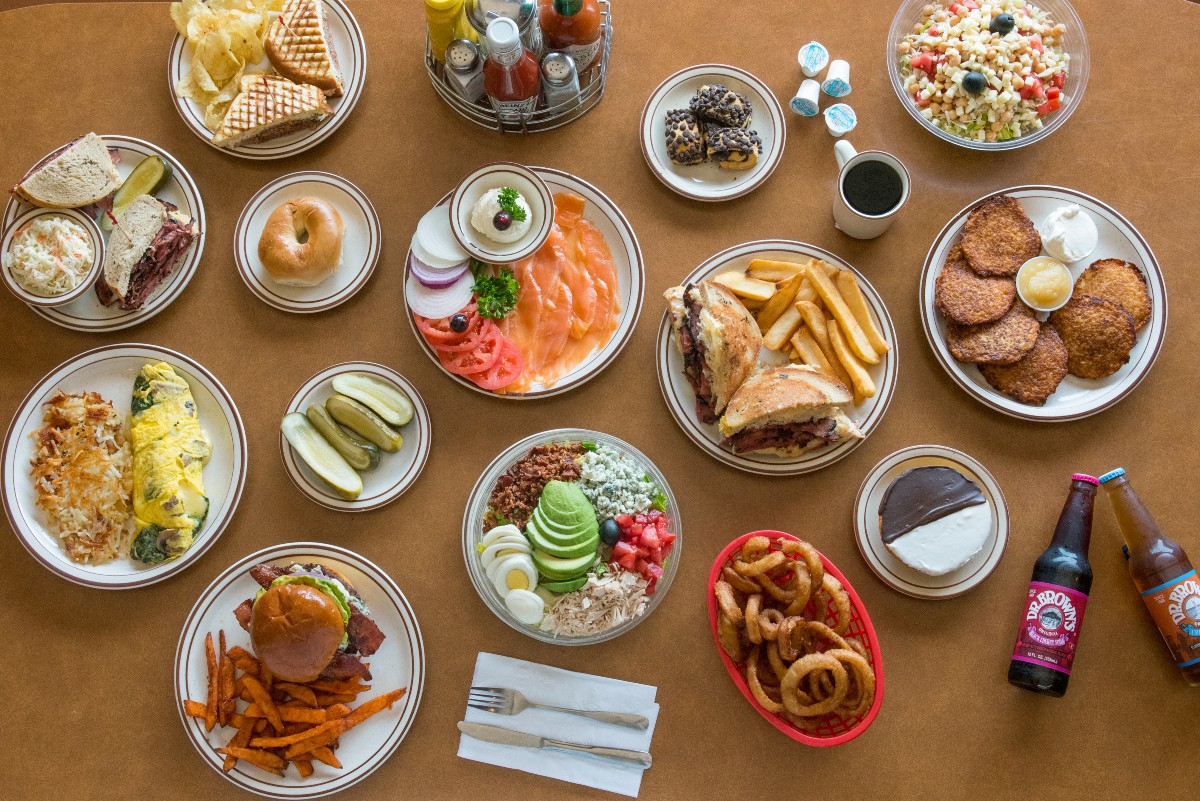
Like many immigrant communities in the United States, Jews are often recognized and celebrated for the foods they contributed to the American culinary scene. Bagels, dill pickles, and deli sandwiches piled high with corned beef have become recognizable not just as Jewish, but also as American foods. These dishes are now available everywhere from grocery store shelves to high-end restaurants. But neither Jews, nor their foods, became American overnight. And in the new book, Recipes for the Melting Pot: The Lives of the Settlement Cook Book, Nora Rubel, the Elizabeth Denio Professor in the Department of Religion and Classics at the University of Rochester, highlights a cookbook that played a central role in how Jews, and their foods, became American.
The Settlement Cook Book was not part of my own American Jewish childhood, but that is mostly because I was raised in the late twentieth century, after its primary era of impact. My family had a few Jewish cookbooks, including one printed by our Reform synagogue’s Temple Sisterhood. We ate plenty of traditional Ashkenazi Jewish foods, like noodle kugel, smoked whitefish, and stuffed cabbage. Most of those recipes came from friends, family, and Jennie Grossinger’s The Art of Jewish Cooking, which was first published in 1958. We also ate plenty of non-Jewish foods like spaghetti, chili, and tacos. The meal we ate most often before heading to Shabbat services on Friday evenings was fried chicken fingers doused in Frank’s Red Hot sauce and served with the traditional Buffalo wing sides of celery, carrots, and blue cheese. Clearly, as our mixing of meat and dairy reveals, we did not keep kosher. In fact, one of my father’s favorite dishes to bring places was his shrimp dip.
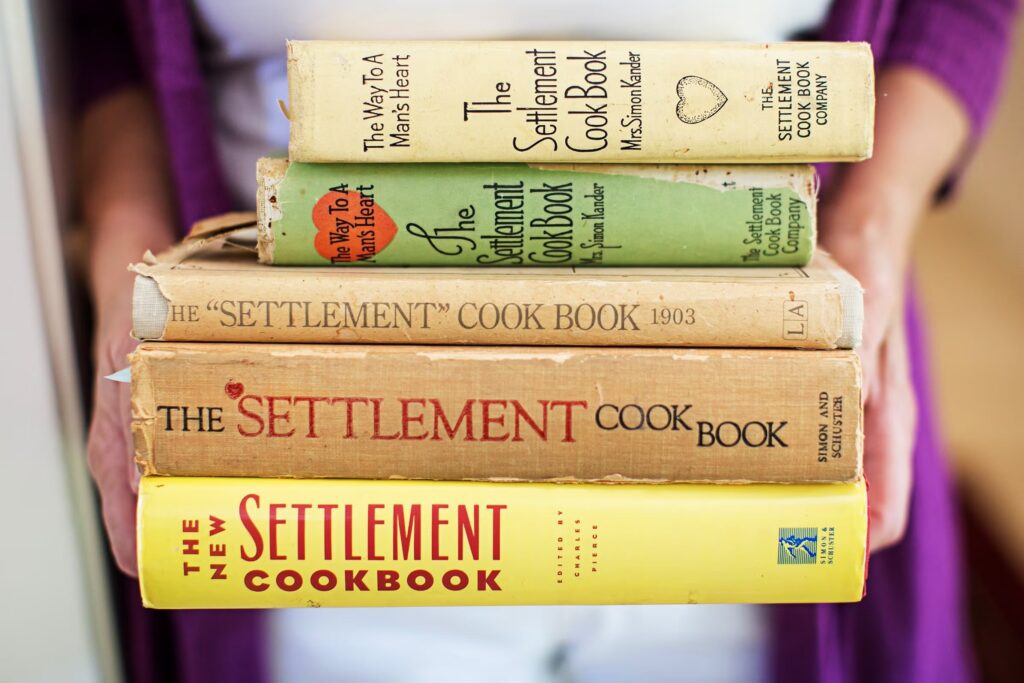
 As Rubel illustrates in Recipes for the Melting Pot, my family’s approach to Jewish food was pretty normal for American Reform Jews in the twentieth century. We ate Jewish foods, but we ate lots of other foods too. This was also the approach of the enormously popular, The Settlement Cook Book. From its first printing in 1901, as The Way to a Man’s Heart – The Settlement Cook Book, the cookbook presented a distinctly American, and as Rubel argues, less distinctly Jewish, approach to food. As Rubel describes the development and success of The Settlement Cook Book, she makes a compelling argument that this pluralistic approach was a major factor in its status as the most successful “charitable” cookbook in American history, meaning its proceeds were donated to charity—with forty editions and over 2 million copies sold.
Rubel describes Recipes for the Melting Pot as a biography of a cookbook, a refreshing approach that enabled Rubel to follow The Settlement Cook Book through more than a century. As she tracked the changes in the cookbook’s structure, recipes, headings, and titles over time, Rubel argues that the cookbook was not just reflective of changes in American Jewish life, but was also a catalyst that shaped Jews, especially women, through vastly different eras. The Settlement Cook Book was revised and reprinted throughout the twentieth century, so the book functions as a history of both American Jewish life and American foodways during a period of rapid transformation. Rubel excels at weaving these stories together using The Settlement Cook Book’s recipes and receptions through the years.
For generations of American women, both Jewish and not, The Settlement Cook Book was a staple as they prepared meals for growing families. The Settlement Cook Book includes not only Jewish recipes, but also standard early twentieth century New England-influenced American fare like pea soup, beef stew, boiled hominy, as well as Italian and Chinese recipes, reflective of what Rubel refers to as the “culinary pluralism” of its editor, Elizabeth, or Lizzie, Black Kander. This approach meant that early editions of The Settlement Cook Book included instructions for soaking and salting meat to make it kosher and also included recipes with non-kosher ingredients like oysters and lobster.
Rubel argues that the Jewishness of The Settlement Cook Book is coded, by which she means Jewish aspects of the cookbook went unnoticed by non-Jewish readers but marked the book as clearly Jewish among Jews. The cookbook’s Jewishness shows up in recipes for “cracker or matzos balls” and brisket, which Jews would recognize as Jewish but were likely not recognized as such by most non-Jewish readers. Because Jews saw the cookbook as Jewish, it has held a special place in the hearts and kitchens of American Jews for over a century, even if they do not cook with it anymore. Renowned Jewish food writers like Mark Bittman and Joan Nathan grew up eating dishes from The Settlement Cook Book because the cookbook had been a staple for their mothers. But the coded nature of the cookbook’s Jewishness also ensured that its reach extended well beyond the Jewish community, as demonstrated by the cover image of Recipes for the Melting Pot, which shows a young Lucille Ball holding a copy and studying a recipe while her husband, Desi Arnaz, drinks from a glass as he peeks over her shoulder. Throughout Recipes for the Melting Pot, Rubel toggles between the cookbook’s development and use in Jewish communities and its reception among the broader public. She aptly demonstrates how the cookbook’s subtle Jewishness was a key to its success among both audiences.
Rubel provides a thorough overview of key movements from the nineteenth century that predated and informed the cookbook’s publication. She also narrates a thorough history of religious food reformers like Protestant minister Sylvester Graham, who saw diets of restraint as a key aspect of promoting moral behavior among Christians and Americans. And, she describes the broader settlement project, which sought to uplift the urban poor, who were primarily recent immigrants in the late nineteenth century. Like Jane Addams, a leader in the settlement movement, Rubel argues that Lizzie Black Kander had a “cosmopolitan perspective” and promoted “a measured appreciation for immigrants’ cultural heritage, holidays, and folklore.”
Kander began her work with the Ladies Relief Sewing Society of the Reform Temple Emanu-El in Milwaukee in 1878. The society changed its name to the Keep Clean Mission in 1895 and then changed it a year later to the Milwaukee Jewish Mission “to avoid the implication that immigrants were dirty.” The mission was initially housed at another Reform synagogue, Temple B’ne Jeshurun, which is where Kander began teaching cooking classes. She saw these classes as part of her “preventative philanthropy,” and hoped that they would help immigrants become self-sufficient. This kind of philanthropy was common at the time, and aligned with other popular movements of the era, like eugenics, which Kander saw as a public good. In 1900, the Milwaukee Jewish Mission merged with the Sisterhood of Personal Service, another Jewish charitable organization, and they formed the city’s first settlement house, which was known as “The Settlement.” In the only commercial kosher kitchen outside of New York City at the time, Kander taught thousands of women how to cook as both Americans and Jews.
The Settlement Cook Book began as a pedagogical tool. Kander responded to the needs of her students, mostly Jewish immigrants from Eastern Europe, with recipes developed by herself and her similarly middle-class Reform Jewish friends in Milwaukee, printed in a book, so they didn’t have to copy the recipes down during the cooking classes. The resulting cookbook served as “both an American text and a projection of multicultural America—one that made space for American Jews.”
Rubel tracks key moments in the cookbook’s history, from the inclusion of pork in main dishes for the first time in 1907 to the eventual addition of garlic, but only in non-Jewish recipes, after many years of avoiding it entirely due to antisemitic tropes about Jews as “garlic-eaters.” In the pre-WWI era, The Settlement Cook Book moved beyond Milwaukee and began to circulate throughout Jewish communities in the Midwest, and Kander added more Jewish recipes in response. This era also saw the cookbook’s transformation from a pedagogical tool for The Settlement in Milwaukee to a true cookbook with almost 500 pages of recipes, which enabled its wide adaptation.
Many aspects of American life shifted after the first World War, and Kander continued to update The Settlement Cook Book in response. Rubel traces the transition in the tone of The Settlement Cook Book as it shifts from promoting Americanization to a broader focus on homemaking, in keeping with the needs of American families in the 1920s. During Prohibition, the recipes for cocktails and liquor-based dishes were removed, and in 1933, in a supplement called “The Repeal Recipes,” Kander restored old favorites like “Beer Soup” and included recipes for mixed drinks including a Mint Julep and Gin Fizz. As Jews moved to the suburbs, the cookbook moved with them, and recipes reflected and inspired their upward mobility as housewifery gained traction as an identity that gave women purpose.
Kander was honored at the 1939 New York World’s Fair for being one of Wisconsin’s “Outstanding Women,” which confirmed her reputation as a national figure and, as Rubel puts it, “a fixture of American culinary life.” And though Kander’s legacy continued, 1940 marked her end as the “charismatic visionary” of The Settlement Cook Book.
Rubel provides a window into the drama among The Settlement Cook Book board members and the eventual shift into stable leadership with Sarah Ettenheim. Ettenheim oversaw a deal with Simon and Schuster, which published the thirtieth edition of the cookbook in 1951. The 1954 edition included a preface for the first time and removed most of the explicit references to Judaism. In addition to these changes, Rubel also notes the many ways the cookbook reflected the changing times of the mid-twentieth century. Amidst the rise of supermarkets and convenience foods, the book featured recipes with Jell-O and canned soup. Then, as the feminist movement grew through the 1970s, the original title “The Way to a Man’s Heart,” was moved from the cover to small print on the inside cover. By the time it was released as The New Settlement Cookbook: The First Classic Collection of American Ethnic Recipes in 1991, “The Way to a Man’s Heart” was nowhere to be found. And, as trends in Judaism and the place of Jews in the United States continued to shift, Rubel demonstrates that The Settlement Cook Book’s successors were more explicitly Jewish, kosher, creative, and diverse. In more contemporary Jewish cookbooks, the shellfish and pork recipes of The Settlement Cook Book have been replaced by whole sections of Jewish holiday recipes and a wide variety of kosher recipes from Jewish communities all over the world.
(Image source: Taste Cooking)
Rubel’s innovative biographical approach to The Settlement Cook Book enables her to tell a larger and more compelling story about how Jews and their food became American. This method broadens the lens beyond what we might see by only looking at the life of Lizzie Black Kander or her successor Sarah Ettenheim. Rubel’s lens includes all of the Milwaukee Jewish women who supported the book’s publication and contributed its recipes, the Eastern European immigrants who took Kander’s classes and shared what they learned with their families, the generations of women who purchased the book and used it in their homes, and the innumerable Jewish food writers and cooks who made careers for themselves in the space created by The Settlement Cook Book. Rubel’s Recipes for the Melting Pot serves as an essential companion for those who treasure The Settlement Cook Book and is a vital resource for those unfamiliar with the cookbook’s legacy as a key tool used by Jews on their pathway to becoming American.
The most recent editions of The Settlement Cook Book no longer include “The Way to a Man’s Heart,” but Rubel compellingly argues that the cookbook completed its mission, having worked its way into millions of hearts, of all genders, all over the world during its century in print.
Adrienne Krone is Associate Professor of Environmental Science and Sustainability and the Bishop James Mills Thoburn Chair of Religious Studies at Allegheny College. She is the author of Free-Range Religion: Alternative Food Movements and Religious Life in the United States (UNC Press, 2025), and her current project is an ethnographic and historical study of Jewish community farming.