Hindu Nationalism's New Frontiers, from Sri Lanka to the United States
Hindu nationalism no longer needs India's borders—just a diaspora, a grievance, and a network willing to supply the vocabulary
(Image source: Sabrang)
Although Buddhists make up more than 70% of Sri Lanka’s population, a Hindu nationalist group in the country’s northern Jaffna peninsula has begun using a political vocabulary that would be familiar thousands of kilometers away in India.
In 2023, Siva Senai, a Hindu nationalist organization, wrote to then-Sri Lanka president Maithripala Sirisena warning of “Love Jihad,” a conspiracy theory popularized by Hindu nationalists in India, which claims that Muslim men deliberately marry Hindu women to convert them to Islam to alter the country’s religious balance. In Sri Lanka, Siva Senai has used the claim to demand action against what it describes as the conversion of Hindus by Muslims and Christians, and to push for anti-conversion legislation.
The accusation was part of a broader campaign by Siva Senai against what it portrays as a threat to Sri Lanka’s Hindu population, which makes up about 13% of the country. Around the same period, the organization protested the planned visit of Indian Christian evangelist Paul Dhinakaran to Jaffna, putting up posters declaring: “Jaffna is Siva Bhoomi [Land of the Hindu God Shiva]. Evangelists do not enter.” After Siva Senai and others alleged that Dhinakaran had entered the country to conduct religious conversions, Sri Lankan immigration authorities detained him and ordered him and his team to leave.
This language and imagery are striking in a country where the politics of religion have historically been dominated by Buddhist nationalism. Yet Siva Senai is not an isolated group. Another organization, Rudra Sena, has described Christian conversion as a form of “Hindu genocide” and established religious programs for Hindu children that it says are intended to protect them from “proselytizing traps.”
A December 2025 report by the Washington-based Center for the Study of Organized Hate (CSOH), Contours of Emerging Hate in Sri Lanka, found that Hindu nationalist organizations have been expanding their presence in Sri Lanka since 2016. The report documents their use of social media to circulate narratives about religious conversion, demographic threats, and the alleged persecution of Hindus, while also tracing connections to Hindu nationalist groups and media platforms in India.
Sri Lanka’s experience points to a broader transformation: Hindutva, the ideology that sees India as fundamentally a Hindu civilization and seeks to organize political life around Hindu majoritarian identity, is increasingly travelling beyond India’s borders. Through social media, religious organizations, political networks, and diaspora communities, its language and symbols are being taken up in places with vastly different histories of religion, ethnicity, and conflict. What travels is a political toolkit: narratives of Hindu victimhood where alleged demographic threat can be grafted onto local grievances—turning existing ethnic and religious tensions into new forms of Hindu majoritarian politics all around the globe.
The Origin of Hindutva Groups in Sri Lanka
Since the end of its civil war in 2009, Sri Lanka has seen the rise of new forms of extremism and religious fundamentalism. The brutal decades-long conflict between the Sri Lankan state and Tamil separatists was primarily driven by ethnic, rather than religious, divisions—with the majority Sinhalese (mostly Buddhist) and minority Tamils (mostly Hindu and Christian) locked in a struggle over political autonomy. But in the war’s aftermath, religious nationalism—particularly majoritarian Buddhism—became a central force in Sri Lanka’s politics and public discourse. Under successive governments, constitutional provisions that grant Buddhism a “foremost place” in the state have reinforced a majoritarian framework that privileges the Sinhalese-Buddhist identity, even while the constitution guarantees freedom of religion to all citizens.
This environment has been fertile ground for multiple currents of religiously framed hostility, most visibly anti-Muslim campaigns led by ultra-nationalist Buddhist actors such as the Bodu Bala Sena. These groups have exploited anxieties around Islamist extremism, particularly after the 2019 Easter Sunday bombings, to push narratives depicting Muslims as a threat to national security and cultural homogeneity.
The emergence of Hindu nationalist organizations in Sri Lanka should be seen as part of this same post-war transformation, says Ammaarah Nilafdeen, Sri Lanka Researcher at CSOH. “Though smaller and less institutionally entrenched than Sinhala-Buddhist ultra-nationalist formations, groups such as Siva Senai and Rudra Sena have localized and adapted elements of Hindutva ideology—itself a transnational current associated with right-wing Hindu nationalism in India to advance their own agendas.”
Attorney-at-law and former Human Rights Commissioner of Sri Lanka, Ambika Satkunanathann, points to the growing influence of Hindu right-wing groups within the Tamil community, both on social media and in offline spaces: “These groups deploy anti-Christian and anti-Muslim rhetoric to portray these communities as ‘enemies.’” She added, “The Tamil community needs to realize that rightwing Hindu groups are not working for the benefit of the Tamil community. With making Muslims and Christians into enemies, the groups are enabling abusive state action against Tamils and undermining Tamil demand for rights.”
The United States Commission on International Religious Freedom and the governments of the United Kingdom and Australia have also raised concerns about the activities of Hindu nationalist groups in their respective country reports on Sri Lanka in recent years.
Despite opposing Buddhist expansion in Hindu-majority areas, Hindu nationalist groups have, over the years, aligned with Sinhala-Buddhist ultra-nationalists around shared grievances against Muslims and Christians. As Nilafdeen notes, “these pragmatic alliances enable coordinated messaging and action.” What is particularly alarming, she adds, is how religious extremism can override deep ideological differences when mobilized against a common perceived adversary.
Hindu Nationalist Groups and the Linkages to India
The Rashtriya Swayamsevak Sangh (RSS) organization is the ideological core of Hindutva, anchoring a vast network of affiliated organizations in India and abroad, including India’s ruling Bharatiya Janata Party (BJP), which draws directly from Hindutva thought.
Beyond cultural nationalism, Hindutva is rooted in territorial and civilizational claims shaped by history and mythology, most notably the vision of Akhand Bharat—an “undivided India” imagined as a Hindu ethnostate encompassing present-day India and parts of South Asia, including Sri Lanka. Hindutva groups have campaigned to rewrite Indian textbooks to reflect this.
Over time, Hindutva has gained traction not only within India but across the Hindu diaspora, with the RSS inspiring affiliated or ideologically aligned groups in multiple countries. This regional diffusion has informed parallel narratives in Sri Lanka, where elements of Hindutva discourse have been selectively adapted and localized.
According to current Commissioner of the Human Rights Commission of Sri Lanka, Gehan Gunatilleke, “Hindu antagonism towards Muslims in India, often manifesting in discrimination and violence, has influenced and encouraged mirror antagonisms towards Muslims in Sri Lanka.” Gunatilleke notes that the rise of Hindu nationalism in Sri Lanka is reshaping internal dynamics within the Tamil community. As Sri Lankan Tamils are divided between Hindu and Christian identities, the privileging of Hindu identity risks deepening religious rifts within the ethnic group.
The most active Hindu nationalist group in Sri Lanka, Siva Senai, was founded in 2016. Framing itself as a defender of Hindus against alleged threats from other religious communities, the group is led by its founder, Maravanpulavu Sachchithananthan, a former UN official turned Tamil nationalist.
Speaking to The Revealer, Sachchithananthan said Siva Senai’s work is guided by three objectives: 1) countering what he calls “evangelistic and love jihad aggressions,” 2) protecting Hindu places of worship from “encroaching” non-Hindu structures, and 3) building a Hindu vote bank through organized political mobilization. He has also claimed that Hindus are structurally disadvantaged in Sri Lanka, arguing that while Buddhism receives state support and Christians and Muslims receive backing from overseas, “Hindus get nothing.”
In the same interview, Sachithananthan denied any links between Siva Senai and external organizations, including those in India, a claim that is difficult to believe. In a 2016 interview for India-based outlet The Hindu, Sachchinananthan stated that the group was created after consultations with several Hindu nationalist organizations in India. He further reinforced their involvement: “Organizations such as the RSS, VHP and the BJP are very supportive of this move. I have met the leaders and discussed this in detail.” Moreover, Shiv Sena leaders in India also publicly expressed support for the Sri Lankan group’s aims.
Alongside Siva Senai, two other Hindu nationalist groups—Rudra Sena and Ravana Sena—are active in Sri Lanka’s Northern and Eastern provinces. Formed in 2020, Rudra Sena describes itself as an organization against the conversion of Hindus and Buddhists to Christianity and Islam.
Ravana Sena, founded in 2016, takes a more explicitly anti-Muslim stance; its founder, K. Senthuran, says the group emerged in response to what he saw as the district’s gradual “takeover” by Muslims. While its online presence is limited, it remains active offline, organizing protests and commemorative events across the Eastern Province.
The influence of Hindutva ideology from India on these groups is clearly visible, particularly through the adoption of Indian Hindu nationalist vocabulary and symbolism associated with the RSS. This includes the prominent use of the Bhagwa Dhwaj—the saffron flag linked to Hindu nationalism in India. Hindu nationalist media and digital platforms further amplify groups such as Siva Senai, extending their campaigns—including opposition to religious conversion—to audiences in India and across the Hindu diaspora.
Travelling Across Borders
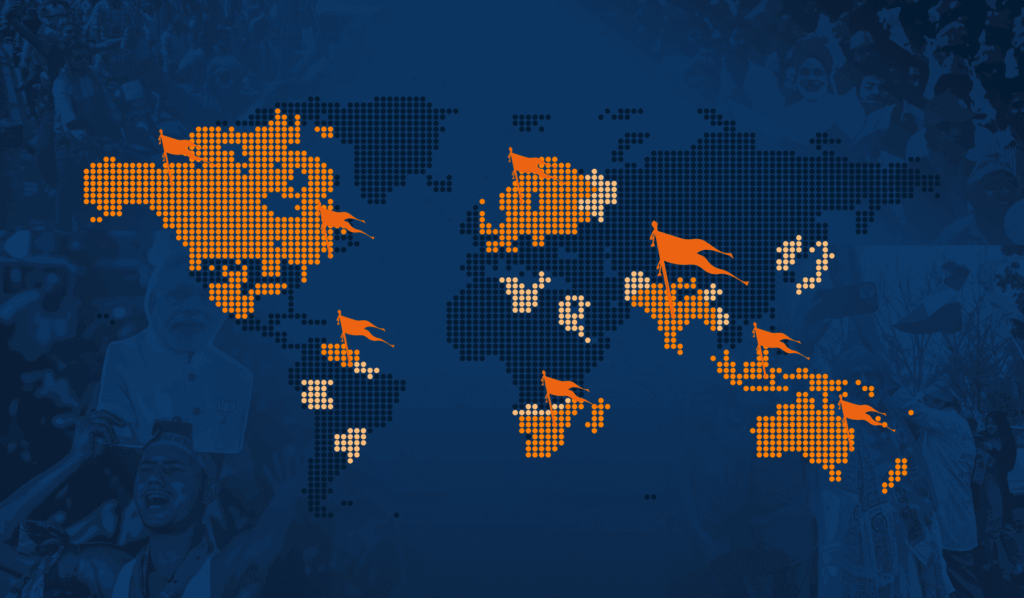
Sri Lanka is not an outlier. It is one node in a wider pattern of Hindu nationalist ideas, money, and organizational templates moving outward from India and taking root wherever there is a Hindu population, however small. The idea of exporting Hindu nationalism overseas is not new: as early as 1953, RSS leaders spoke of a “world mission” to spread their Hindu vision of one family across the globe, and cultivating Hindutva abroad has been part of the organization’s mandate ever since. What has changed is the infrastructure.
In 2019, EU DisinfoLab, an organization that tracks disinformation campaigns, uncovered a large network of fake news sites built to spread pro-Modi, Hindutva, and anti-Pakistan narratives, with 265 of these sites across roughly sixty-five countries traced back to a single Delhi-based entity, the Srivastava Group.
(Image source: Center for the Study of Organized Hate)
Beyond fake news sites and social media, religious organizations and political movements carry Hindutva ideas and symbols across borders, where they can merge with local political causes.
In Nepal for instance, a Hindu-majority country, nationalist groups are campaigning to reverse the secular order established after the monarchy was abolished in 2008. Since then, Hindu nationalist groups have increasingly converged around demands for a return to a Hindu state and monarchy.
Their central claim is a familiar one from India: secularism enables the conversion of Hindus by Christians and other religious minorities. CSOH found Hindu nationalist groups circulating warnings that Nepal could become a Christian country and that Hindus could eventually become a minority, despite census data showing that Christians still make up only 1.7% of the population.
The Diaspora as Second Front
Beyond South Asia, the Indian diaspora has become an important constituency for Hindu nationalist politics, with overseas groups helping build support for the BJP and its agenda. Among them is the Overseas Friends of the BJP (OFBJP), which claims to have 46 chapters worldwide. In 2020, its U.S. chapter registered as a foreign agent under the Foreign Agents Registration Act, citing its work to promote the BJP’s interests in the United States.
In 2022, a bulldozer—a symbol associated with the demolition of Muslim homes in India—was driven through an Independence Day parade in Edison, New Jersey, while a separate event in Anaheim, California saw a shouting match between Modi supporters and protesters opposing anti-Muslim violence in India.
More recently in August of 2026, the RSS’s international reach became visible in New York City, where its chief, Mohan Bhagwat, addressed around 5,000 people at Madison Square Garden as part of the organization’s centenary-year global outreach. The event drew protests from interfaith, civil rights ,and Hindu groups, while New York City Mayor Zohran Mamdani said he opposed the rally, describing the rise of a movement based on an “exclusionary vision” as deeply troubling.
With the rise of Hindu nationalism in the United States, Varun Soni, dean of religious life at the University of Southern California, observed that Hindu nationalism is splitting the Indian expatriate community much as Donald Trump’s presidency polarized the wider American public. And the costs of speaking out against Hindu nationalism have been high. In September 2021, organizers of an American academic conference on Hindutva received rape and death threats, and Rutgers University historian Audrey Truschke—who researches Indian nationalism—faced such severe abuse afterward that venues hosting her began hiring armed security.
Australia and New Zealand have seen their own versions of the same dynamic play out on university campuses. Thirteen academic fellows resigned from the Australia-India Institute at the University of Melbourne, alleging interference from the Indian High Commission aimed at suppressing research that painted an unflattering picture of India. In New Zealand, Massey University professor Mohan Dutta—himself a Hindu—was told by police that little could be done about the abuse he faced after raising concerns about Hindu nationalism, since most of it originated in India itself.
Canada has produced the most violent recent flashpoint. In November 2024, violence broke out between pro-Khalistan Sikh protesters and Hindu congregants outside the Hindu Sabha Mandir in Brampton, Ontario, during a visit by Indian consular officials, leading to arrests and days of unrest that spread to other Canadian cities. But scholars who examined the footage pointed out that most coverage missed half the story. A priest at the temple was recorded leading the crowd in a call-and-response chant warning against Hindu-Muslim unity.
Scholars of migration have a term for what connects Jaffna, Janakpur, Brampton, and New York City: “long-distance nationalism,” an expression coined by political scientist Benedict Anderson to describe transnational political activity carried out by migrants on behalf of a homeland where they no longer reside. Researchers who have studied the Hindu diaspora specifically argue that this is not simply nostalgia finding an outlet. Political scientists Christophe Jaffrelot and Ingrid Therwath have shown that the network of Hindu nationalist organizations abroad were not organic replications but were, in a literal sense, exported by a centralized body based in India.
The scale of that export is measurable: between 2014 and 2021, the Vishwa Hindu Parishad of America ran twenty-one chapters across fourteen states, while the Hindu Swayamsevak Sangh operated 222 local chapters across thirty-two states and 166 cities, reaching tens of thousands of families. Sri Lanka’s Siva Senai and Rudra Sena, judged against those numbers, are still a minor node — but they are plugged into the same network, amplified by the same India-based publications, and increasingly fluent in the same vocabulary of demographic threat and civilizational grievance.
What connects all these cases—Sri Lanka’s Tamil north, Nepal’s Hindu heartland, and Hindu communities in Toronto, Leicester, and New Jersey—is not a single command structure so much as a shared ideological toolkit that adapts to whatever local fault line is already there. In other words, it no longer needs India’s borders to function. It needs only a diaspora, a grievance, and a network willing to supply the vocabulary of Hindutva. Vocabulary of hate.
Anuj Behal is an independent journalist based in South Asia. His reporting spans religion and human rights, labor injustice, and issues of diaspora and migration across the region.