God's Divided Country
A review of the book “A God-Shaped Nation: Five Hundred Years of Religion in America”
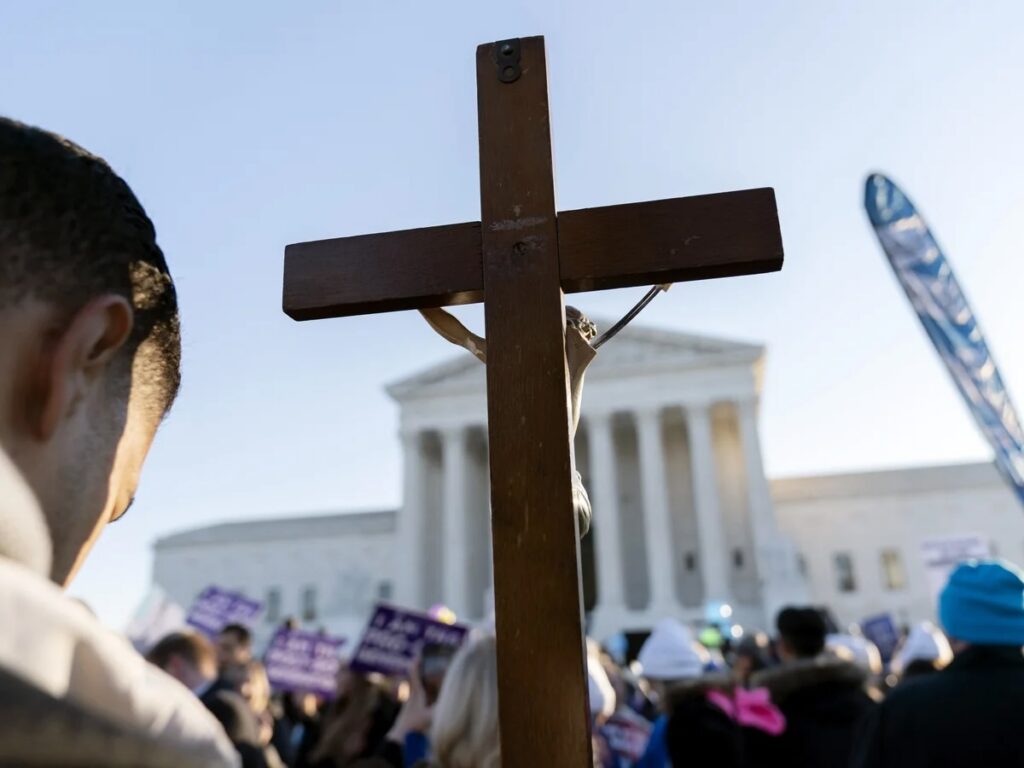
(Image source: José Luis Magaña/AP/The Guardian)
While journeying through the United States in 1831—a trip initially meant to produce a report on U.S. prisons—Alexis de Tocqueville wrote about his observations of American religious life. Americans “seem to be a religious people,” he noted in the face of the country’s diverse sectarian landscape. Several years later, in 1835, he declared that religion was “the first” of America’s “political institutions” because it served to “regulate the state by regulating the family” and to govern “public morality,” which included everything from marriage to courtroom oaths to postal holidays. The social cohesion religion provided was essential to holding together such a wide variety of groups, Tocqueville argued, but it also required that the specifics of each religious sect recede into the private sphere, leaving a broad religious morality to harmonize otherwise fractious differences.
Such proclamations did little, however, to reveal where the boundaries of “public morality” might lie or who might be excluded or harmed by the underlying assumptions of what was a largely white, Protestant social order. Yet Tocqueville had firsthand experience with such exclusion and harm: In December 1831, while travelling through Memphis, he had witnessed the movement of a large group of Choctaw who were being forcefully expelled from their native lands under Andrew Jackson’s Indian Removal Act. Many were sick or injured, and Tocqueville reports seeing a woman with a broken arm that had frozen for lack of care in that harsh winter.
The Choctaw—as well as other indigenous, Black, and ethnic and religious minority communities—were a part of the American social order held together by the religious norms Tocqueville outlined, but they were rarely protected by it, even when they tried to present themselves in ways amenable to the white Christians in government. The Cherokee, for instance, had argued against removal on the grounds that they were a civilized and increasingly Christian community that had a right to the land they had occupied from time immemorial. Removal would not only violate their rights, Cherokee leaders argued, but severely damage their progress toward Christianity and “civilization.” But it didn’t matter: the Supreme Court rejected the Cherokee argument, seeing them instead as “wards” of the reigning government.
 The tensions revealed by Tocqueville’s observations are at the heart of Brook Wilensky-Lanford’s new book, A God-Shaped Nation. A broad overview spanning five hundred years of religious history in America, the book begins with first contact between the Spanish and indigenous peoples of the Caribbean and continues chronologically through the English colonies all the way to the early days of Trump’s second term in 2025. According to the author, the book has three main goals: to reveal how religion “emphasizes and naturalizes” group differences, to examine the changing dynamics between religion and political power, and to cast light on why so many Americans see religion as a private matter. While doing so, the book examines a host of less prominent religious trends and movements, from the Native American Ghost Dance ceremonies aimed at indigenous empowerment to the plight of Japanese Buddhists during World War II, to tell a more inclusive story of American religion.
A God-Shaped Nation is a work of popular history, rather than a strictly academic one, and as such it relies more on the power of storytelling than the accumulation of data, and Wilensky-Lanford proves herself an able narrator, weaving together large swathes of American history into a remarkably entertaining and instructive set of stories. Each chapter is made up of a set of contemporary accounts that proceed side by side, each focusing on the most relevant and interesting details and characters, presented in fast-paced narratives. In every section, Wilensky-Lanford shows a tremendous understanding of what makes history exciting without sacrificing contextual details.
As with any survey, one can quibble with the book’s scope. For instance, more indigenous history would have been welcome (though there is a respectable amount). And sometimes, the deemphasis of academic historical categories can be confusing, as in those sections dealing with the “Great Awakenings,” which are barely labelled as such, potentially making it difficult for readers who are expecting familiar road signs to orient themselves. Such flaws are largely unimportant, however, compared to the freshness Wilensky-Lanford offers, for she frequently takes unexpected excursions and almost always looks at familiar historical moments in new ways. Her treatment of the Salem Witch Trials, for example, expands the truly astonishing context of that grim episode—the horrendous destruction of wars with natives, the English, and the French, and the resulting trauma, paranoia, and even hallucinations—such that readers will surely never see the trials in the same way.
For all the interest of these earlier narratives, however, A God-Shaped Nation is at its best and most relevant when tracing more recent history, particularly the rise of the Religious Right in the 1980s and its subsequent development into the movement that gave us Donald Trump. This story is too rarely told in surveys of American history, but it is vitally important for understanding the current political and religious climate of the United States and where we might go from here. And each of the book’s three goals is deeply intertwined with that story.
As Wilensky-Lanford tells it, the Religious Right was born in the aftermath of Brown v. Board of Education, when there was stiff resistance to desegregation in many areas. Conservatives, particularly Protestants, created private schools—often called “segregation academies”—that excluded Black students. These schools came under increasing scrutiny, however, and in the 1970s the IRS insisted that they desegregate or lose their tax-exempt status. In 1978, this rule was tightened by requiring such private schools to prove that a certain percentage of their student body was non-white. This, Wilensky-Landford argues, proved to be the catalyst that led conservative Protestants to take up political arms. Feeling their “values” were threatened by the government, these leaders sought to create a wide Christian voting bloc that could influence the political sphere. To do so, however, they needed to form alliances outside of Protestantism, and they saw Catholics as a powerful and thus necessary ally. But Catholics were less affected by the IRS crackdowns of ’78 and were unlikely to be swayed into an alliance over segregationist concerns—concerns that evangelical leaders realized might prove a liability if made overly explicit.
What did galvanize Catholic politics, however, was abortion. Prior to building the coalition that came to be known as the Religious Right, Protestants displayed a diverse range of views on abortion, with many believing in a woman’s right to choose or simply distancing themselves from legal debates altogether. As Wilensky-Lanford shows through numerous examples, evangelicals had been rather aloof to much mainstream American culture, with figures like Francis Schaeffer publicly arguing that “humanism” and “secularism” were worldviews antithetical to Christians, who ought to form their own separate culture. Yet evangelicals soon came to embrace the call to a “culture war” to reshape mainstream America by building conservative Christian political power. A God-Shaped Nation explores leading figures such as Jerry Falwell—Baptist preacher, television host, and segregationist—and his Moral Majority organization, and how the new movement set itself up on a platform of “color blind” advocacy for “state’s rights” and “religious freedom”—language that largely referred to segregationist causes without directly saying so—while also publicly speaking out against abortion as a means of enticing Catholics into the fold. The Religious Right was thus born as a concentrated political power and soon coalesced into a significant voting bloc that began courting representatives and winning elections largely through “single-issue” voting. There was no shortage of politicians willing to form alliances with the new movement, and before long the coalition was celebrating a new ally, Ronald Reagan, who would bring their platform of traditional “family values” to the highest U.S. office.
Wilensky-Lanford outlines briefly how, in the 2000s, the Religious Right began to absorb other movements, such as the Tea Party and libertarians. This new ecology of religious freedom, family values, and open markets soon birthed “free-market fundamentalism,” a movement that championed corporate freedoms in the name of religion. A God-Shaped Nation takes a close look at the political results of that shift, such as the Supreme Court ruling that allowed Hobby Lobby to forgo payments for birth control and abortion in their employee’s health plans.
It was in this environment that Donald Trump found his base. Many saw him as an unconventional choice for the Religious Right, but Wilensky-Lanford argues that once the movement had fully embraced the culture war, it was willing to champion anyone who could help its “Christian worldview” dominate and destroy “secular humanism.” Trump proved willing to further those goals at the expense of everyone not in the coalition (composed primarily of white Christians), and so it embraced him.
This story is essential for understanding the political powers behind the present regime in the White House, especially as it draws a direct line between figures like Trump and the old specters of racist Confederate Christianity, Lost Cause mythology (the attempt to justify and continue the Confederate cause), and the segregationist agenda. Wilensky-Lanford shows that these are not speculative or paranoid associations (as is sometimes claimed), but historically demonstrable ties.
This current of a basically racist and exclusionary alliance between religion and political power is only one of the many streams of American religious life, however, and A God-Shaped Nation is replete with alternatives. Powerful examples include the Black Protestant minister and activist William J. Barber II’s attempts to build a movement for racial, social, and environmental justice, and the preaching of Episcopal bishop Marrianne Budd, who directly called on Trump and his administration to treat immigrants with mercy. Beyond the Christian world, Wilensky-Lanford highlights moments of resistance from Muslims, Native Americans, Buddhists, and others.
In her emphasis that religious diversity in America has always been more than conservative Christianity, Wilensky-Lanford does much to show how we might build a better understanding of religious freedom and harmony. That task, she believes, must include telling stories: “When it comes to religion in America,” she writes, “we need more stories, not fewer.” But it must also include a willingness to bring religion into the public square. Tying the belief that religion should be a private matter to the Protestant view that the relationship with God is primarily an individual one, Wilensky-Lanford urges us to be more vocally religious in public so as to combat narrower religious movements and narratives: “With the rise of the religious right in the 1980s, and its transformation into ‘free-market fundamentalism’ in the 2010s, a particular strain of conservative Christianity has taken up more political space than our predecessors would have thought possible or desirable.” As such, more voices are needed, whether it be Muslims praying in public, Buddhists performing rituals in protest, or Christians standing up against state violence.
These arguments are compelling, and we would do well to heed the advice, lest one religious narrative continue to dominate U.S. politics. Certainly, diverse religious voices dedicated to alternative models of society are needful in the present moment. A God-Shaped Nation does much to further such voices via the variety of stories it tells and the fresh angles it employs. Yet that project can at times feel in tension with the book’s goal of tracing more dominant trends. Wilensky-Lanford’s narrative largely follows the traditional emphasis of Protestantism and the English colonies, for instance. And while that’s essential for many of the stories Wilensky-Lanford wants to tell, such as the rise of the Religious Right, it means there is less room for other, less mainstream stories. The book does an admirable job of balancing this tension, but emphasizing the wide diversity of American religion can only go so far without further breaking the mold of traditional religious histories. Luckily, others have been doing just that, such as Thomas Tweed with Religion in the Lands That Became America. The two books work well together.
Overall, A God-Shaped Nation is an admirable history. Besides being wildly entertaining and well-written, its goals are significant, even vital, to the present moment, and it will do much to encourage alternative religious voices in a political environment dominated by the poison and vitriol of Christian nationalism. It also reminds all of us that such movements have a history: they were nourished in America’s unwillingness to address past wrongs. But there is nothing inevitable about the dominance of the Religious Right. Changing our national trajectory will take the reevaluation of assumptions, new forms of action, and especially new stories. And stories are what A God-Shaped Nation does best.
Ben Woollard is a writer based out of northern California. His work has appeared in JSTOR Daily, Comment, Lit Hub, The Asian Review of Books, and elsewhere.