Skeptic's Corner
Democracy Requires Religious Pluralism
The new book "Kaleidoscope" shows why we’re going to have to fight for both
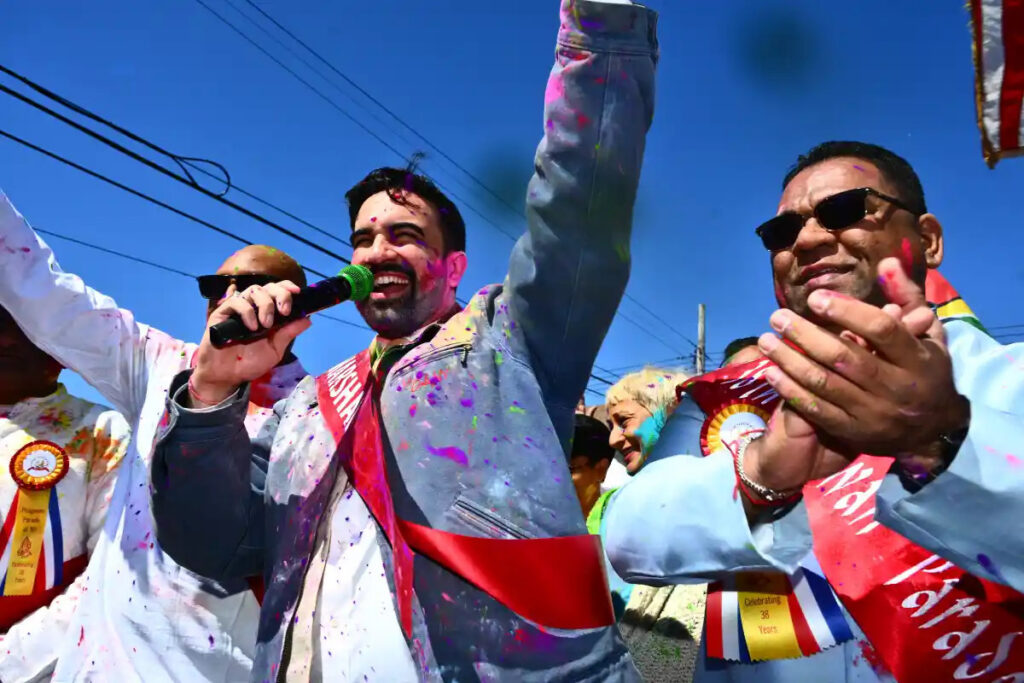
(New York City Mayor Zohran Mamdani celebrates the Hindu festival Holi in March 2026. Image source: QNS)
Should America be a multi-religious society? Or should it be a confessional monolith for Christians?
These questions have been at the core of American democracy at least since the Puritans fled England seeking religious freedom and a chance to impose their own views on, and/or exterminate, native people. As the First Amendment suggests, freedom to worship is also freedom to speak, freedom to think, and freedom to participate in public life. When that right is abrogated—whether because certain views are seen as inferior, or because the people holding those views are denigrated because of ancestry or skin color— then one has become, at best, a second-class citizen. Religious tolerance and multi-racial democracy are inseparable. The alternative to both, in the U.S., is the Christofascist program of our current orange tyrant.
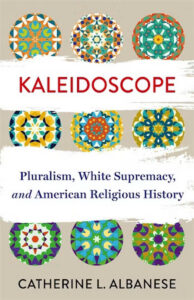 The choice here, and its centrality to American religious history, is at the core of religion scholar Catherine L. Albanese’s new, late-career collection of essays, Kaleidoscope: Pluralism, White Supremacy, and American Religious History.
The 86-year-old Albanese, now an Emerita Professor of Religious Studies at U.C. Santa Barbara, has spent her career studying some of the less mainstream byways of American religion, including New Age spirituality and transcendentalism. The current volume strives for a principled eclecticism, working to show—across nine disparate essays—that there have always been many religions and religious traditions in the Americas and in the U.S.
In this sense, Christian nationalism has always been an ideology of backlash to diversity. There is, contra the current right, no originary moment of white religious unity. There are only different people with different beliefs, and those who believe that their own beliefs, and their own rule, should be single and unquestioned.
Albanese hopes that the recovery of these disparate traditions—the “kaleidoscope” of her title—will lead to progress that will eventually defeat the fascists. Or as she says, “Perhaps the lesson of the kaleidoscope…is to let the instrument keep turning—until the old model of white supremacy gives way before the reality of a multicultural, multireligious North American landscape.” It’s a hopeful vision.
But the evidence she presents, and the history she tells, doesn’t always turn one towards optimism. On the contrary, it’s clear that as long as there have been different religions in the U.S., there have been white Christian nationalists trying to stamp them out or subjugate their adherents. If we want a different future, we need to do more than point out that the past included diversity. We need, instead, to assert and demand multi-racial democracy now and in the future. Otherwise, there is a very real danger that the kaleidoscope will keep showing up the death head’s white and blood red of authoritarianism.
No Established Religion
Albanese notes up front that—due to her areas of expertise and her focus on the 18th and 19th centuries—she does not discuss Islam or South and East Asian religions. Despite these, in her words, “glaring omissions,” Kaleidoscope does cover a dizzying array of religious beliefs, traditions, and practices. From the first chapter, which discusses the contrasting religious beliefs of native peoples and white settlers; through the seventh, which connects mind cures and spiritualism to their roots in Methodism and evangelical radicalism; and onto the final section on how Catholics and Jews assimilated, or did not, to whiteness and Protestantism; Albanese emphasizes that America’s religious landscape has always been variegated, with odd gullies, alleys, and byways.
Nor has the diversity always been off to the side. In many cases, Albanese demonstrates that it would be a mistake to see Christian nationalism as a central or defining aspect of American identity or history.
For example, Albanese notes that religious historians in the past often viewed Black churches as mainly important as post-Civil War denominations—a byway in American Christian history primarily important because they illustrated the growth and expansion of American democracy.
Albanese argues, with historian Charles Long, that this is not an adequate frame. Instead, Long insisted that the presence of Black people led to a construction of religious identity for white people around whiteness, which functioned as a kind of “civic religion” in place of the established faiths in old world monarchies. Black people were, Long, said, “a necessary part of the constituting and formative sense of the American culture and nation,” even as they were deliberately excluded from that culture and nation. There was no simple expansion of democracy to Black people; instead, Black exclusion defined a white Christianity which remained committed to limiting democracy to white people.
Rather than tying American religious history to the story of the growth and development of U.S. democracy, Albanese points to efforts to understand Black religious history—and therefore American religious history—in terms of Atlantic trade and culture. In this context, events and individuals that do not center white Christianity take prominence—the first arrival of an enslaved Black person in Europe via the Atlantic in 1441; the rise of Alfonso I, the first Christian king of Kongo in the early 1500s; the Black-led, multiracial Azusa Street Revival in Los Angeles in the early 1900s. Multi-racial democracy has its own genealogy; it is not simply a development of white Christian conscience.
Albanese uses a kaleidoscope as a way to recenter U.S. Christian history. She suggests, though, that traditional centers were more kaleidoscopic than is usually appreciated. For example, the right often presents the Founders as crusading Christians, supposedly justifying Christian supremacy. But Albanese points out that fifty-two of the fifty-six signatories of the Declaration of Independence and the men who staged the Boston Tea Party were all part of the quasi-mystical, quasi-pagan, church of reason known as Freemasonry.
Freemasonry was in part a networking organization for port city elites—a way for an ambitious upwardly mobile commercial class to solidify its social and economic dominance through mutual backscratching. It was also a systemization of a rationalist natural religion which proponents and heirs of the Enlightenment believed was poised to supersede Christianity. Reason allowed men to see the divine plan in the world and nature; there was no need for revelation.
For Masons, Albanese writes, “Christianity stood in a state of decay. Its moment had passed, and now Freemasonry had come into its own as a larger, more inclusive reality in which—with its ethic of tolerance—Christianity could play a larger part.” As part of this tolerant spirit, the Freemasons celebrated rituals on June 24 and December 27—dates that for Christians marked the feasts of John the Baptist and John the Evangelist, but which also marked the summer and winter solstices.
Thus, through religious ritual, the Masons positioned themselves as broad-minded heirs of both natural and human religion, together looking forward to a revolutionary future of synthesis, diversity, reason, and democracy. Clutch your pearls, Sam Alito—the kaleidoscope is the real originalism.
Whiteness as Religion
Sam Alito might be mildly upset at the Founder’s Freemasonry. But he could, unfortunately, probably find some common ground with them too. Freemasons excluded women and largely excluded Black members; their commitment to fraternity, equality, and democracy, like the nation’s commitment to fraternity, equality, and democracy, had strict patriarchal and racial limits. Christianity for Freemasons was optional. Whiteness and maleness were much less so.
Or to look at it another way, you might say that, because they were powerful white culturally Protestant men, the Freemasons had latitude to play with, or downplay, Christianity without losing their status. As Khyati Y. Joshi explained in her essential 2020 monograph White Christian Privilege: The Illusion of Religious Equality in America, “throughout US history, Christian, English, free, and White have been superimposed to form mutually supporting advantages based on the co-construction of religion, race, and national origin.”
In U.S. culture, “Christian” serves as a metonymy for whiteness, and whiteness serves as a metonymy for Christian. That means that non-white people often are seen as non-Christian, no matter their religion, while non-Christian people are often seen as non-white, no matter their skin color. The result is less a complex kaleidoscope and more an ugly paper bag test, in which assessment of skin tone and assessment of beliefs influence and stand in for one another to determine how much oppression is doled out.
Albanese covers that oppression at some length and in various contexts. Her first chapter, on European efforts to subjugate native peoples and stamp out their religion, is a bleak chronicle of overwhelming violence overcoming courageous and sustained resistance.
As just one example, Albanese cites the work of Indigenous historian Roxanne Dunbar-Ortiz who has pointed out that historical Spanish mission churches from the early 1800s in California are all centered around a whipping post—a place where native people were ritually tortured in an effort to force them to recant their religions and to obey the Europeans. Similarly, in U.S. Indian Christian boarding schools for Native Americans from Florida to Pennsylvania in the 1800s and 1900s, teachers routinely physically and sexually abused students, not infrequently killing them—unmarked mass graves were discovered at schools in the 2020s.
Native people, as nonwhite and non-Christian, were subjected to extremes of relentless violence and genocide; they were not considered Americans or democratic subjects. Non-Christians who were white, in contrast—like white Catholics and white Jews—were sometimes allowed to assimilate. That could sometimes give them the opportunity to persecute others, as in the case of Catholic reactionary Supreme Court Justice and architect of Dodd’s destruction of abortion rights Sam Alito.
Perhaps Albanese’s most eye-opening analysis of the relationship between whiteness, Christianity, and democracy is her discussion of the changing status of Mormons.
Mormons, Albanese emphasizes, like many another Christian denomination, believed they were restoring Christianity to its true faith and pure origin. Whiteness was seen as a sign of that purity, and Mormons were unabashedly white supremacists. “Mormons used whiteness to express their sense of privilege and to separate themselves from nonwhite others,” Albanese writes. The text of The Book of Mormon says that God cursed the unbelieving Lamanites, the supposed ancestors of Native Americans, by turning their skin dark (“the Lord God did cause a skin of blackness to come upon them.”)
Whiteness, then, was an essential part of Mormon identity and religion. But other Christians also saw whiteness as essential to Christianity—and one way they demonstrated this was by framing Mormons themselves as less than fully white. Albanese points to a 1904 cartoon in Life, in which a polygamous Mormon patriarch is shown with his children, many of whom are not white. She also quotes historian W. Paul Reeve, who notes that Protestants at the time believed Mormons “were physically different and racially more similar to other marginalized groups than they were to white people.”
Mormons over the years took steps to try to ensure their inclusion in mainstream America, including, changing their white supremacist doctrine following the Civil Rights activism of the 1960s. But the fact remains that Mormon religious difference has been obsessively read through, transposed on, and systematized via whiteness. Mormons insisted on their own purity and Christianity by emphasizing their whiteness; other white Americans denied them that purity and Christianity by linking them to blackness. Whiteness and Christianity in America have been viewed as intertwined characteristics, and both have been requirements for full democratic acceptance.
Kaleidoscope vs. “My Mayor Is Muslim”
Albanese analyzes the entanglements of whiteness and faith and is clear on how those entanglements threaten to smother her vision of kaleidoscopic diversity and democracy. But even she has trouble cutting them loose. Specifically, in her discussion of Jews, she mentions the increase in antisemitism, discussing the Unite the Right rally and the far-right mass shooting at Tree of Life synagogue in Pittsburgh. But she doesn’t grapple with the ways Christian nationalists have seized on Zionism, and claims of antisemitism, to push anti-Palestinian racism and Islamophobia, endangering Muslims (and also endangering Jews who don’t endorse the program.)
Obviously, no one can cover everything. But it’s hard not to notice that Albanese is extremely concerned about the erosion in status of white Jews but mentions Islamophobia only in an aside or two. And while she does acknowledge that Muslim history is not a part of her book, the fact is that you can’t usefully or honestly talk about whiteness and Jewish identity at the present moment without acknowledging the role played by Zionism and Islamophobia. White Jews in the 21st century have more of a purchase on whiteness than Muslims do, and thus, despite her best efforts, Albanese appears to be mirroring the dynamic she identifies throughout her book, in which whiteness in America defines what is virtuous and what is worthy of attention.
This false turn doesn’t of course invalidate Albanese’s collection as a whole. It does, though, call into question her hopes that a view of American religious history as a kaleidoscope can in itself “bring with it a brighter, better future for many and even most.”
Simply recognizing and cataloguing diversity does not, unfortunately, necessarily lead to more tolerance or democracy. In the first place, those who chart the kaleidoscope, like Albanese, are still going to be influenced by cultural defaults about what is and isn’t worthy of coverage, and about who is and isn’t worthy of sympathy—as when Albanese talks about antisemitism but not Islamophobia. And, in the second place, as Albanese shows, there are many people, with a good deal of power, who, throughout American history, have reacted to visions of diversity by trying to exterminate them.
So, if the kaleidoscope won’t save us, what might?
Rather than simply extolling diversity, I think another, more hopeful approach might be to specifically reframe our vision of American religious life around solidarity with those who have been marginalized and denied the benefit of belonging.
Albanese herself does this, I’d argue, when she puts Native American experience at the center of U.S. religious history. Another, example, is the New York Knicks catchphrase coined by 23-year-old Ahnaf Hossain in a street interview.
After the Knicks won their first game over the San Antonio spurs, Hossain declared to the camera:
My Mayor is Muslim!
My Bagel is Jewish!
My Christian is Dior!
Knicks in four!
After the Knicks lost one game, Hossain updated the rhyme:
My Mayor is Muslim!
My Bagel is Jewish!
The Pope’s on our side!
Knicks in five!
The chant became a viral sensation because, aside from many New Yorkers loving the Knicks, it’s a statement that New York identity is defined, not just by its sports teams, but by its non-white Muslim South Asian mayor, by its non-Christian cuisine, and by its non-Protestant communities. This is a celebration of diversity as diversity in part. But it’s also a stronger assertion that what makes you a New Yorker is your connection to the Muslim faith, to the Jewish faith, to South Asian ethnicity—in striking contrast to the Christian nationalist assertion that to be American you have to be white and you have to be Christian.
Obviously, people who shout Hossain’s rhyme are not all Muslim, or Jewish; some may not even be from New York. Neither is every white Christian nationalist Christian, white, or even American. Identity is a moving target, and—as Albanese shows—people relate to their religious beliefs and practice, or lack thereof, in a bewildering array of ways. If we want to show up for democracy though, I think we need to do more than acknowledge that democracy is a kaleidoscope. I think we need to forcefully redefine our collective identities—not least perhaps by insisting that America’s mayor is Muslim.
Noah Berlatsky (he/him) is a freelance writer in Chicago. His poetry collection Not Akhmatova (Ben Yehuda Press, 2024) is about Jewish diaspora; his newsletter Everything Is Horrible is about politics, culture, and how everything is horrible.