Death Doulas and the Gospel of Green Burials
The movement to revolutionize dying and mourning, with ancient roots
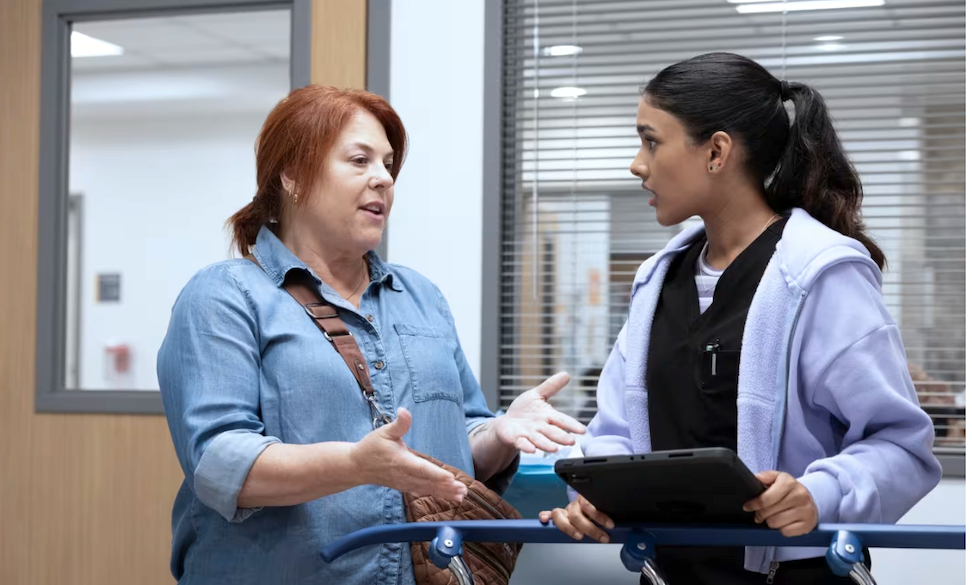
(Scene from The Pitt season 2, episode 5 of a death doula talking to a medical student. Image source: HBO Max)
In a shroud-weaving workshop hosted by Nashville-based artist Margo Cloniger, twelve people gather around tables covered with organic linen—three are terminally ill patients creating their own burial shrouds, while others weave shrouds for aging parents or simply to contemplate their own mortality. The group includes a Methodist minister, two Muslim women, a Reform rabbi, and several with no religious affiliation.
They’re part of a rising number of Americans who are interested in rituals related to death that come not from traditional funeral homes, but from a new type of spiritual helper: the death doula. These experts draw from ancient Jewish, Muslim, Christian, Buddhist, and Indigenous traditions and focus on how mourning can be a sacred act done in community.
Death doulas—also known as end-of-life doulas or death midwives—are predominantly women, though the field increasingly includes people of all gender identities. They offer emotional, spiritual, and hands-on assistance to people who are dying and to their loved ones. While hospice staff concentrate on medical treatment, death doulas tackle the deeper questions and spiritual aspects of passing away.
The movement poses a potential challenge to the $20 billion American funeral industry, which has controlled much of death care since the Civil War. Even more, it demonstrates how different faith groups find common ground in their shared human mortality. Still a niche practice, the movement represents a small fraction of the 3 million Americans who die annually. However, early indicators suggest growing interest: according to the National Funeral Directors Association’s 2023 Consumer Awareness Report, 60.5% of Americans now express interest in green funeral options (burial or cremation practices that minimize environmental impact, such as forgoing embalming, using biodegradable materials, and choosing natural burial grounds), up from 43% in 2015. The International End-of-Life Doula Association (INELDA), which started in 2015, has trained over 9,000 doulas globally as of mid-2025, with practitioners in all U.S. states and 56 countries. The National End-of-Life Doula Alliance (NEDA), established in 2017, has grown from 260 members in 2019 to 1,545 by January 2024.
Death doulas have even entered mainstream consciousness—most recently depicted in season 2, episode 5 of HBO’s medical drama The Pitt, where the character Lena introduces herself as “Roxie’s death doula” to a confused ER team, explaining, “I help advocate for people like Roxie to make their transition to death a more peaceful process. It’s like a birth doula but for the end of life.”
While the average American funeral currently costs between $7,000-$12,000 and follows standardized practices set by the funeral industry, the growing movement of death doulas and faith communities is reclaiming end-of-life care as a sacred, communal act—one that draws from ancient religious traditions rather than modern commercial practices. This interfaith movement is transforming how Americans understand death itself: not as a medical crisis to be managed by professionals, but as a spiritual journey to be honored in community.
Ancient Wisdom, Modern Practice
Leaders of this growing movement believe there are universal messages about caring for the dead that people of any religious tradition, or of no tradition at all, can find meaningful. Alua Arthur, a well-known death doula in Los Angeles founded Going with Grace, an organization to train death doulas to help clients from diverse religious communities. She describes the work of today’s death doulas by saying, “Christians have vigils and wakes. Jews have the chevra kadisha—a holy group that gets bodies ready to bury. Muslims have special ways to wash and cover bodies. Buddhists use meditation to help with dying. Native peoples honor how human bodies and the earth give and take from each other. The funeral business today took these practices away and replaced them with embalming, pricey coffins, and rooms for viewing. We’re helping people take back what was always theirs.”
This restoration starts with basic actions that were normal 100 years ago, such as home funerals. Death doulas like Dr. Sarah Kerr, who started The Centre for Sacred Deathcare, help families with home funerals. The practice largely stopped in the U.S. when embalming took off in popularity, following the Civil War when deceased Union soldiers had to be transported back to northern states. Soon, Americans appreciated that embalming allowed for funerals that did not have to take place immediately following death since the body would not decay quickly.
Today, home funerals remain legal in all 50 states, though specific regulations vary by state—some states like Connecticut and Louisiana require a licensed funeral director’s involvement for certain paperwork, while states like Texas mandate embalming or refrigeration if disposition won’t occur within 24 hours. Families choose home funerals for various reasons: extended time for private grieving, letting children see that death is a natural process, significant cost savings (often $3,000-$5,000 in home funeral fees), and fulfilling religious obligations that emphasize simplicity and direct family care of the deceased.
Although the movement began as a non-religious one, faith communities now see death doulas as key allies in spiritual care. The Iliff School of Theology in Denver, a United Methodist seminary, launched a Foundations of Death Care certificate course in 2024, becoming the first theology school to offer such training. Eden Theological Seminary is developing an End-of-Life Doula Certificate Program, and numerous Catholic parishes have begun informally referring parishioners to trained death doulas.
Death doulas typically charge $1,000-$3,000 for comprehensive support through death and immediate aftermath, though many offer sliding scale fees or pro bono work for low-income families, allowing them to sustain their practice as paid professionals. They don’t work as medical professionals, though many have backgrounds in healthcare fields such as nursing, hospice care, or social work. They’re not religious leaders, but they often use spiritual practices.
Death doulas say their work changes based on each dying person’s beliefs and wishes. Some help with legacy projects—aiding people to make recorded memories, write letters to family, or put their life stories on paper. Others focus on vigil support and stay with dying people to give their tired family members a break. Many assist families to plan funerals that show their values.
“Seminaries teach us death theology but not the practical aspects,” says Tom Waknitz, a chaplain and INELDA-certified end-of-life doula who earned his Master of Divinity degree in 2025 and now works with Walker Methodist Senior Living Community near Stillwater, Minnesota. “I can talk about resurrection hope, but I didn’t know how to help families deal with funeral homes pushing unneeded services. Now I can stand up for my congregants’ spiritual and money interests.”
“When families keep their loved ones at home for even a single day, it changes things,” says Lee Webster, director of the New Hampshire Funeral Resources and Education organization and a home funeral guide who has worked with Christian, Jewish, Muslim, and Buddhist families. “Kids who might not have seen death get to say goodbye. Older parents have time to tell stories. People gather in the home where the person lived, not in a cold funeral home. Death becomes part of life instead of something separate.”
The Interfaith Death Café
Beyond individual death doulas working with families, the broader movement has created communal spaces for interfaith dialogue about death. The Death Café movement began in London in 2011 when psychotherapist Sue Barsky Reid hosted the first meeting. Since then, it has grown to include thousands of locations around the world. These meetups bring together people who are dealing with terminal illnesses and those thinking about death to talk about mortality in friendly, interfaith environments. The idea is straightforward: people come together with cake and tea to discuss death without any set plan, goals, or topics—just frank conversations about dying.
Across America, cities are seeing similar gatherings. In Washington, D.C., the Historic Congressional Cemetery hosts monthly Death Cafés in its chapel, welcoming participants of all faiths and none. In Ann Arbor, Michigan, a Death Café founded in November 2012 by Merilynne Rush has met monthly for over a decade at Crazy Wisdom Bookstore, becoming one of the oldest continuous Death Cafés in the United States. Kansas City’s Plaza Library has hosted Death Café sessions on the second Wednesday of every month since 2022.
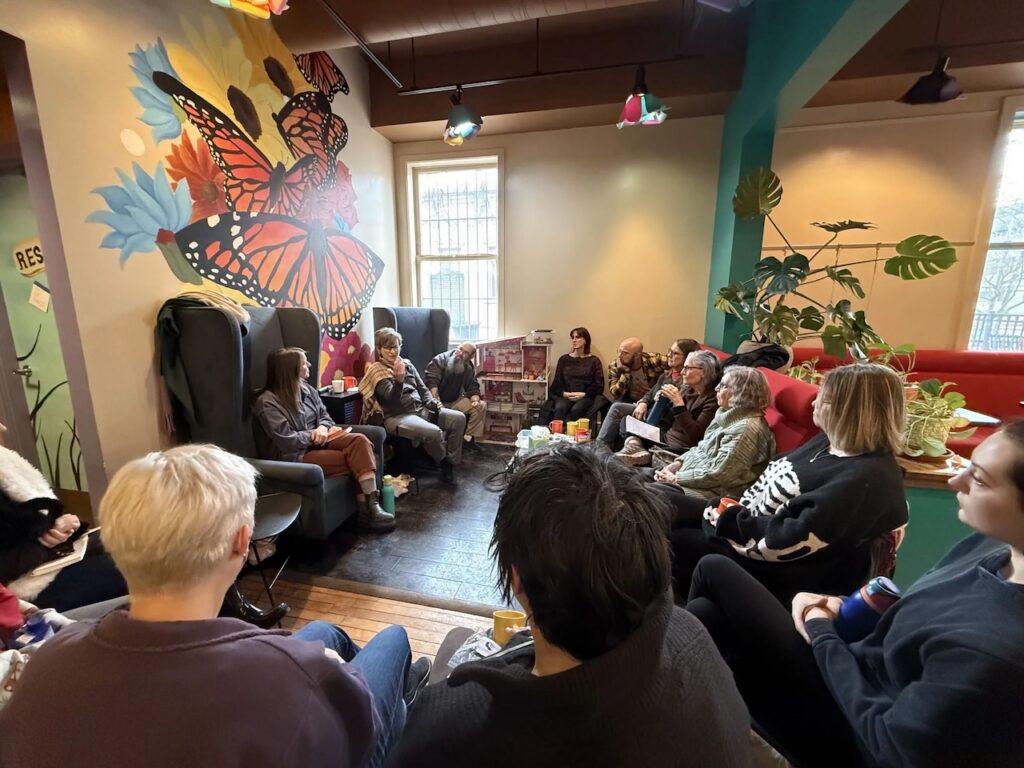
(A “death cafe” in Ypsilianti, Michigan. Source: Eli Newman/Bridge Michigan)
At a recent Death Café gathering in Ann Arbor, a Catholic woman with ALS shared that she wanted a natural burial (interment without embalming in a biodegradable shroud or casket) but her family expected a traditional funeral mass. Next to her, a Muslim man explained how his death doula helped him write a document that made sure his body would be buried within 24 hours, as Islamic law requires even though he lived far from a Muslim cemetery. A Jewish person at the meeting shared a story about her family. They found out their synagogue’s burial group needed more helpers. Muslim community members, who have similar body washing customs, stepped up to assist.
“Something that keeps coming up,” Merilynne Rush points out, “is how often we find that our customs, which look so different at first glance, have shared core beliefs about death. The Jewish custom of shmirah—keeping watch over the body—is similar to the Christian wake and the Muslim practice of always staying with the deceased. The rule against embalming in Judaism and Islam, the Christian saying of ashes to ashes—we’re all trying to respect the same idea about going back to the earth.”
These death cafés serve multiple purposes. For some, they provide the first opportunity to speak openly about mortality. For others facing terminal illness, they offer community support outside medical settings. And they create spaces to learn from each other’s traditions and build relationships that lead to practical collaboration.
Weaving Death into Life
The practice of shroud-making represents perhaps the most tangible way participants in the broader green burial and death preparation movement (which includes death doulas, green burial advocates, and those seeking alternative end-of-life practices) prepare for death. Drawing from multiple traditions—Jewish tachrichim, Muslim kafan, and the Christian tradition of grave clothes—shroud-weaving becomes a meditative act that transforms death from something that happens into something actively engaged with, whether by the dying person creating their own shroud or by loved ones weaving burial cloths for family members.
Workshops dedicated to shroud-making have emerged in locations nationwide. Angela Franklin, a natural dyer and folk artist in southern Oregon, conducts “Death & Dyeing” workshops teaching eco-printing and natural dye techniques to create personalized burial shrouds. Nashville-based Margo Cloniger creates custom woven shrouds priced on a sliding scale from $1,800 to $3,500. Participants source their materials carefully—organic linen and cotton that will decompose naturally, sometimes dyed with plants that hold religious significance. Some add lavender, traditionally used in Christian burial practices. Others incorporate rose petals, honoring the Islamic tradition of perfuming the deceased. Jewish participants often ensure their shrouds have no pockets, symbolizing that we leave this world as we entered it, carrying nothing material.
“In our culture, we’re taught to fight death, to see it as failure,” explains Jill Millar, a retired physician in the United Kingdom facing terminal cancer who embarked on creating her own burial shroud with family help. “But sitting here, weaving my own shroud with others who understand, death becomes something else. It becomes sacred. It becomes mine.”
For many religious participants, the practice initially feels transgressive. Elizabeth Soto Albrecht, who chose a green burial for her husband in Lancaster, Pennsylvania, recalls initially facing questions from some community members about the unconventional choice. “They thought it morbid, maybe even un-Christian,” she explains. “But I reminded them that Jesus was wrapped in a simple linen shroud. The expensive caskets, the embalming—that’s not biblical. That’s American consumer culture.”
Yet many Americans remain comfortable with conventional funerals and find substantial value in professional funeral services. The role of funeral directors extends far beyond logistics—they provide crucial emotional scaffolding during crisis. As funeral professionals note, traditional services offer families “a sense of community and support” through structured ceremonies like wakes and visitations, which “foster an environment where grief can be openly expressed, offering a vital outlet for emotional release.” Funeral directors guide grieving families through overwhelming decisions, handle complex paperwork, coordinate with cemeteries, and create space for families to focus on remembrance rather than logistics. The ritualistic elements—processionals, eulogies, communal prayers—provide psychological comfort and a sense of control when loss feels chaotic. For many families, the professional handling of remains and the formal structure of traditional services honor the deceased while alleviating burdens during intense grief.
Yet, with the average American funeral now costing between $7,000–$12,000, consumer protection groups are raising concerns about the funeral industry’s longstanding, near-monopoly on burial and cremation.
“The funeral industry has inserted itself between families and their sacred traditions,” argues Joshua Slocum, executive director of the Funeral Consumers Alliance, a nonprofit industry watchdog. “They’ve medicalized and commercialized death to the point where many Americans don’t know they have alternatives.”
Death doulas and religious communities are working to educate people about their rights. In all 50 states, families have the right to care for their own dead without hiring a funeral director. Embalming is rarely legally required—typically only when transporting bodies across state lines or when burial will be significantly delayed. Families can transport bodies themselves in most states. And “natural burial” without vaults or non-biodegradable caskets is permitted in a growing number of cemeteries.
Sacred Ground
The Green Burial Council, which gives its stamp of approval to natural burial grounds, says more and more certified providers have popped up in the last few years. Many of these new natural burial spots welcome all faiths while still following specific religious rules.
At Larkspur Conservation in Tennessee, the first green burial place in that state, you can see different religions represented in the landscape itself. Muslim graves point towards Mecca. Jewish areas maintain separate consecrated burial sections, ensuring Jewish burials occur only on ground sanctified according to Jewish law. Christian families put up simple wooden crosses or natural stone markers. Buddhist prayer flags wave from trees. The cemetery asks that burials be natural—no chemicals to preserve bodies, caskets that biodegrade, and native plants instead of well-trimmed grass.
“This land teaches theology,” says John Christian Phifer, who leads the cemetery as its executive director. “When Jewish and Muslim families bury their loved ones on the same day, see each other grieve, and realize the same earth takes us all in—that’s deep interfaith work.”
The green burial trend also tackles rising eco-worries. Bodies break down on their own without embalming chemicals and give nutrients back to the earth. The land itself becomes a living tribute, with woods growing where traditional cemeteries would need non-stop care.
The Future of Sacred Death
The movement faces substantial hurdles. Insurance seldom pays for doula services, putting them out of reach for many families with low incomes. And state rules differ considerably, with some putting more limits on home funerals or natural burial than others.
Still, more and more Americans are looking for alternatives to traditional funerals. The COVID-19 pandemic, which made families deal with death without the usual funeral services, sped up interest in other options. Additionally, young people who grew up aware of environmental issues have been questioning the environmental impact of regular burials and chemical embalming.
And, death can be a time that unites people.
“Death brings everyone together,” says Tara Bannon, Park Hill Library branch supervisor who facilitates monthly Death Café gatherings at Denver’s Park Hill Branch Library. “We may think about what’s next, but we all have to face dying. When we help each other through this, we see how alike we are.”
Leslie Williams is a seasoned Anglican pastor, author, and advocate for compassionate end-of-life care, based in Manchester, England. A frequent conference speaker, she explores how faith communities can reclaim ancient death rituals in contemporary practice.