More than Missionary
Cruising Religion
Entry Denied: A short history of LGBTQ+ cruises and religious conflicts
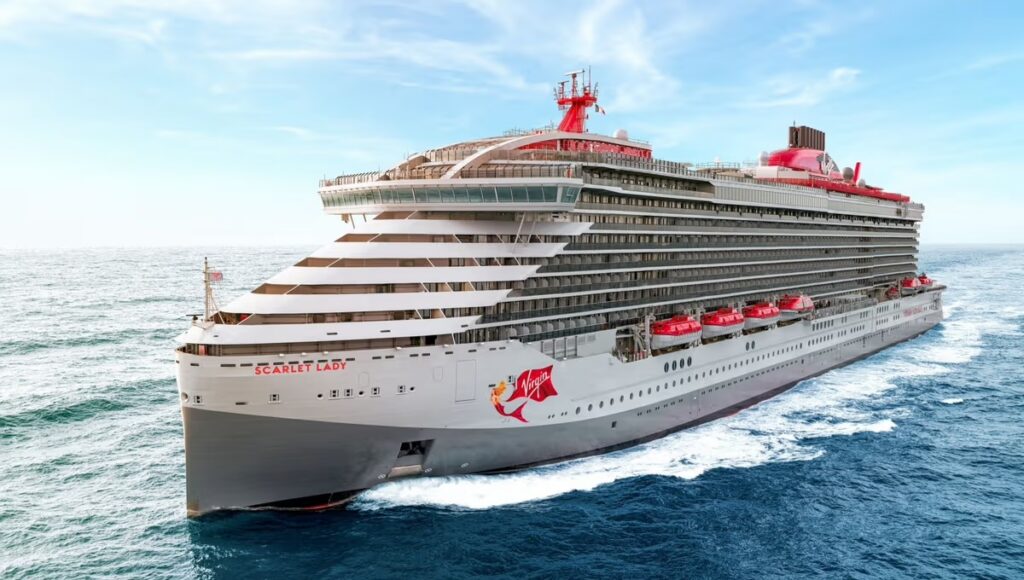
(The Scarlet Lady. Image source: Travel Weekly)
On July 5, 2026, passengers aboard the Scarlet Lady—an all-gay charter cruise—were informed of a change of plans. They would no longer be disembarking at Kuşadası because Turkish authorities had barred the cruise ship from docking, claiming its passengers, who were predominantly gay men from the U.S. (with other travelers from Canada, Australia, and the U.K.), would threaten the nation’s “family values” and “moral standards.” Acclaimed Broadway star Patti Lupone, who was one of the performers on the cruise, responded to these events on her Instagram account, saying “a ship — a magnificent ship — full of gay men. And me. Denied entry to Turkey simply because of who is on board.” Lupone was defiant and continued, “I am furious, but I am sailing, as the ship will make other ports of call.”
But another port of call proved to be equally fraught. Alexandria, Egypt also denied the Scarlet Lady entry a few hours before their scheduled docking. Egyptian authorities did not offer an explanation for their decision, but likely took inspiration from Turkey. Coming shortly after Egypt’s failed attempt to have FIFA ban LGBTQ+ Pride displays at the June 26th World Cup match in Seattle, the move pointed to a broader belief: openly gay people, as the Egyptian Football Association previously declared, violate the “cultural, religious and social values” of the country.
It would be tempting to invert the logic of the anti-gay representatives of these two countries, who claim that queerness is foreign and secular, by depicting their homophobia as retrograde, religious, and local. But such claims would miss the historical currents that have brought queer cruises to foreign shores for half a century: that of gays and lesbians from different countries seeking respite from homegrown homophobia by traveling together and going abroad. To say these events were simply reflective of escalating anti-gay prejudice in two Muslim-majority countries is to tell only part of the story. Most of the travelers on the Scarlet Lady were from the United States, which has seen its own upsurge (though in markedly different ways and on a different scale) of state sponsored anti-gay prejudice, including the Department of Veteran Affairs ordering “health facilities to eliminate gender identity-based initiatives and remove the LGBTQ designation from a network of medical coordinators created to help LGBTQ veterans navigate access to care”; the scrubbing of health data and resources for LGBTQ+ people from federal webpages; the Substance Abuse and Mental Health Services Administration’s termination of the national LGBTQ+ youth suicide lifeline and state-level initiatives such as the Florida’s “Don’t Say Gay” law. The Scarlet Lady’s turbulence speaks to the fact that anti-gay prejudice crosses national borders and plays out on a global stage. It also points to a larger and longer timeline of queer folks seeking—sometimes successfully and sometimes not—safe harbor from homophobia at home and abroad.
Like any aspect of queer public life from the past several decades, the history of queer maritime travel saw gay men mapping sites of sexual tolerance and flagging potential threats. You could see these dynamics at play immediately after Stonewall. In 1970, an article in the American magazine Gay Scene offered tips on cruising for sex while on a European cruise. “Do it with the Dutch and the Greeks,” the article advised, but avoid places like Rome, which was less friendly. Granted, the author was on an ostensibly straight cruise ship for an extravagant 28-day-adventure. Similar articles appearing in the mid-1970s, advised gay men on how to find each other on “straight” cruise ships by hanging out in the saunas, gyms, and discos. This kind of cruising was risky, especially, as one 1976 article in the Queen’s Quarterly reported, “By nautical law gay sex activity is just that—‘naughtical’—a crime.”
By the mid-1970s, the gay and lesbian charter cruise industry was a booming business and appealed to travelers who wanted to combine touring foreign countries with unselfconsciously socializing in spaces of their own. Boutique companies organized all-gay adventures. Hanns Ebensten Travel, operating out of Times Square in New York City, was an early pioneer, advertising “escorted tours, cruises and expeditions for sophisticated, adventurous travelers.” The impetus for such enterprises arose from tense and sometimes violent encounters abroad. For example, Kevin Mossier, founder of RSVP Travel Productions, decided to build a protected travel experience through gay cruises after being chased down a street by violent straight locals while on vacation in the early 1970s. But homophobia at home also fueled the industry. At the height of right-wing anti-gay backlashes in the United States in the late 1970s and early 1980s, chartered cruises became protective bubbles of sorts, where travelers, many of whom were in the closet in their daily lives, might let their hair down.
In the 1980s, local cruises—often party boats—lasting for only a few hours could be found in the United States, Canada, and other countries. In North America, gay cruises going abroad for longer excursions regularly traveled out of New York, Los Angeles, and Miami.
Not simply bacchanals, some of these ships sought to minister to the queer community’s spiritual needs. In 1986, for example, Mossier’s RSVP Travel invited Reverend Troy Perry, founder of the Metropolitan Community Church (MCC) to join one of the Caribbean cruises and serve as the ship’s minister. Five years later, Perry officiated a holy union ceremony for 47 lesbian couples for a different cruise line that was touring Mexico.
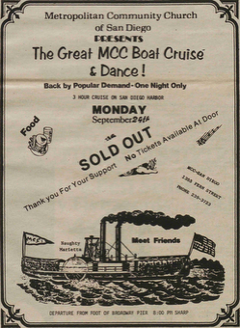
“The Great MCC Boat Cruises & Dance!” Update (San Diego California), 21 Sept. 1979, p. 25. Lambda Archives of San Diego via Archives of Sexuality and Gender
Perry’s presence on these ships spoke to broader encounters between queer religion and the travel industry. Starting in 1971, MCC San Diego held an annual event—a moonlight cruise for its community that became the highlight of its annual social calendar. News coverage of their cruise in 1979 gushed over how “300 men and women danced and socialized on the decks of the Marietta” with a “large number of senior citizens set[ting] the pace for younger Gays on the packed below decks disco dance floor.” One MCC congregant noted the communal significance of this event, which “brings a lot of people together that only see each other at Christmas, Thanksgiving and Easter.” Such events caught on with MCC congregations as far apart as Chattanooga, London (Ontario), Honolulu, and Sydney.
It was not just that queer religious groups socialized on ships. They traveled to spiritually significant destinations. In the 1970s, you could find advertisements for gay cruises touring the Holy Lands in the MCC San Francisco’s newsletter. New Way Ministries, an LGBTQ Catholic organization, also began organizing an annual “pilgrimage to the Holy Land, designed for lesbian and gay Catholics and those in gay ministry” in the 1980s. This tour included “baptismal vows at the River Jordan” and a “cruise on the Sea of Galilee.” But such spiritual journeys were not confined to religious organizations; One World Travel Club, which had been operating since the mid-1960s as an affiliate of the homophile group One Inc., organized trips to Egypt and Israel with an itinerary that included, “Cairo, Alexandria, a cruise on the Nile for all the great temples and tombs of the Pharaohs clear up to Aswan; then to Jerusalem, Tel Aviv and the famed Biblical scenes.”
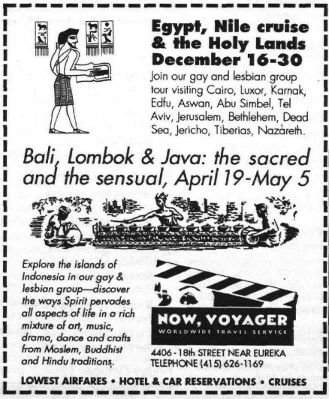
MCC Newsletter, Sept. 1990, pp. 5. GLBT Historical Society via Archives of Sexuality and Gender.
Whether explicitly religious or secular in their programming, for some passengers these cruises sometimes felt like a spiritual experience. When the founder of Olivia Records—the famed lesbian feminist record label—pivoted in the early 1990s to create Olivia Cruises and Resorts, she explained how such trips were transformative: “So many of the women who come on these trips are in the closet, and spending a week being completely out is incredible—it’s beyond a liberation. They don’t go home the same.”
But maritime travel also led to religious conflicts between locals and queer travelers. Because prohibitively expensive port fees made transatlantic cruises far more expensive, many of the gay chartered American cruises did shorter Caribbean or South American routes. In 1987, a gay cruise ship docked in George Town, the capital of the Cayman Islands. Some residents became outraged when they witnessed gay men holding hands and kissing in public. Some church groups vowed to never allow a gay cruise ship to disembark there again. Following that incident, the government of the Cayman Islands decided to deny landing to ships that violated, what a government minister called, the island’s “religious and culturally conservative” standards. In subsequent years, officials were reported to have boarded cruise ships to verify whether they were gay charters.
A decade later, in 1998, numerous incidents caused gay cruisers to hit rough waters in the Caribbean. In Nassau, a Christian coalition named “Save the Bahamas” mobilized hundreds of protesters to block American lesbian tourists from entering the island. The group, which was actively pushing for stricter sodomy laws and a ban on gay cruises, gathered in a square just a block from the docks, greeting passengers with hostile signs reading “God made woman for man” and “We don’t want sissies.” The protesters were unable to directly engage lesbian vacationers, who were ferried to a private island away from the tumult.
Most gays and lesbians living in the Caribbean lacked the luxury of a private retreat. That same year, 1998, the Cayman Islands drew international scrutiny when the Tourism Minister barred 910 gay passengers aboard the MS Leeward from shore. The ensuing months-long uproar forced a conversation over same-sex sexuality among and between tourists and Caymanians. In the Cayman Compass, an anonymous letter authored by a group of gays and lesbians exposed the pervasive, religion-fueled homophobia that they faced daily. “We have no gay role models,” the authors wrote, “nor do we have any minister, pastor or politician who would openly support Caymanian gays.” Still, they found hope: “We are exuberant that the incident shook this community who holds on to puritanical beliefs and attitudes but, for the most part, do not practice them.” Ultimately, the debate over gay cruises led to a showdown between Great Britain and its Caribbean territories, forcing the Foreign Office to mandate the decriminalization of consensual same-sex acts.
Such conflicts over queer cruising continued in, but were not confined to, the Caribbean in the early 2000s. And gay cruisers were not just wealthy white North Americans or Europeans. For instance, in 2001, Egyptian authorities raided the Queen Boat on the Nile, and arrested 52 local men whom police alleged were having a sex party. These gay Egyptian men, who sought companionship and more on a ship, were charged with “obscene behavior and contempt of religion.” While detained by police, they were beaten, coerced into confessions, and subjected to invasive medical inspections to “determine whether they had engaged in anal intercourse.” Their treatment raised grave concerns from Human Rights Watch and the International Gay and Lesbian Human Rights Commission. So too did a lengthy trial process, which saw the chief prosecutor declare that Egypt “will not be a den for the corruption of manhood, and homosexual groups will not establish themselves here.”
Past and present events make clear that, to mangle a metaphor, no queer is an island and no island is without queerness. This summer, when the Scarlet Lady was denied the right to dock at Kuşadası, Turkish authorities did not confine their animus to foreign travelers. They also targeted a popular Istanbul gay bar, shutting it down simply for posting a social media invitation welcoming the ship’s passengers. That invitation spoke to the cross-border connections queer people have long made. As a gay tourist observed back in the 1990s, “if you choose to discriminate against my tour group you are also choosing to discriminate against people within your own society.” These words were prescient and remind us that anti-gay backlashes are seldom merely local affairs; they ripple outward, connecting the fate of travelers on luxury liners to the survival of local communities on the shore.
Gillian Frank is an Assistant Professor in the History of the Modern United States at Trinity College Dublin. His book, A Sacred Choice: Liberal Religion and the Struggle for Abortion Before Roe v Wade, is forthcoming with University of North Carolina Press.